المستندات والموارد - نتائج البحث
نتائج البحث

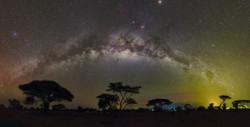
Cen-Lup-Cru-Panorama: Centaurus Carrying the Beast and Riding Along the Milky Way
صورة
أُنشئ لصالح OAE
الشرح: Winner in the 2022 IAU OAE Astrophotography Contest, category Still images of celestial patterns.
This image was taken in February 2020 in the Coquimbo Region along the northern coast of Chile. It is one of the best places on Earth for astronomical observations, thanks to its clear skies, lack of light pollution and lack of precipitation, as it is close to the Atacama desert, one of the driest places on our planet. It is no coincidence that many of the most modern professional observatories are located here. The picture shows prominent patterns visible in the southern latitudes, containing rich cultural significance for various Indigenous groups of the southern world. In the bottom of the image towards the right, the Southern Cross is prominent. The orange star at the top of the Southern Cross is called Gacrux (gamma crux). The people in Chile celebrate the beginning of winter at the beginning of May when the constellation Crux is high up in the sky; for them it is a symbol of the start of the cold season. For the festival of the Cruz de Mayo (the Great Cross), they put candles next to crosses in their villages when the constellation Crux is high. As in Christianity, the four endpoints (stars) of the cross symbolise the cardinal virtues. For some indigenous Chileans, they represent the fundamental cultural principles: force, reciprocity, wisdom, and spirituality.
Unlike modern constellations that are arrangements of several stars, Indigenous peoples sometimes associate stories with individual stars. In the case of the Southern Cross for example, the Boorong, Djab Wurrung and Jardwadjali peoples of Australia refer to the star Gacrux as Bunya (the ring-tailed possum). From the Southern Cross to the left of the image are two bright stars, these are called the pointer stars (as they point to the Southern Cross). The Djab Wurrung and Jardwadjali people refer to the pointer stars as the Bram-bram-bult brothers, who hunted and killed the giant Emu Tchingal. Alpha Centauri, which is the brighter and whiter of the two pointer stars, is the closest star to the Sun that we can see with our eyes, located just over four light-years away. To the bottom left of the Southern Cross is a dark nebula, which the Indigenous Australians see as the head of the Emu Tchnigal (the Coalsack Nebula). The pointers are located on the neck of the Emu. The image also shows two other IAU constellations, Centaurus (The Centaur) and Lupus (The Wolf), and HII regions of the Eta Carina Nebula (seen in pink).
المصدر: Uwe Reichert/IAU OAE
مصطلحات المعجم:
مجموعة نجمية او حشد نجمى , درب التبانة , الصليب الجنوبي
فئات:
درب التبانة والوسط بين النجمي
, علم الفلك بالعين المجردة
الترخيص: المشاع الإبداعي نَسب المُصنَّف 4.0 دولي (CC BY 4.0) المشاع الإبداعي نَسب المُصنَّف 4.0 دولي (CC BY 4.0) أيقونات
هذا الملف على Zenodo ( صورة 24.14 MB)

Drive
صورة
أُنشئ لصالح OAE
الشرح: Honourable mention in the 2022 IAU OAE Astrophotography Contest, category Still images of celestial patterns.
This image shows the Milky Way crossing the sky above the historical Bixby Bridge in Big Sur, a mountainous region in California, USA, in May 2021.
The star directly above the shore is Antares, a red supergiant in the heart of the Scorpion. To its left, the clouds of the Milky Way seem to emerge from the same point of the horizon as the rocky landmass. Above the land, below the Milky Way in the left quarter of the image, is another bright star, Altair, the bright star in Aquila, the Eagle.
The scorpion is considered a dangerous animal, so scorpion-men (human-scorpion hybrids) guarded the gate to the Netherworld in ancient Babylonian stories, as reported in the Gilgamesh saga. The Eagle, in contrast, appears in the Babylonian saga of King Etana who was taken to the sky by an Eagle and describes the world that he sees below him with increasing distance. Both heroes, Gilgamesh and Etana, are searching for the “herb of life” but one of them by going down, the other by travelling upwards. Gilgamesh aims to get back his dead friend Enkidu and to become immortal himself, while Etana is seeking the herb to help his wife become pregnant. The scorpion and the eagle are the animals supporting these heroes in their search, that ultimately remained unsuccessful. Gilgamesh finally learned that humans can only become immortal by their good deeds for humanity. The Eagle was also recognised in Greek culture, but it was only in Roman times that it became a messenger of a dead soul, carrying it towards the eternal stars. This was when Ptolemy created a constellation to represent the soul of Antinuous below the classical Eagle. This young friend and consultant of the Roman emperor Hadrian drowned in the Nile only seven years before the completion of the Almagest, and the whole Roman empire observed a state of national mourning.
The Milky Way is seen as a “pathway of souls” by many cultures, but in the Babylonian culture, this is not the case. Still, in Greco-Roman philosophy, the bright white parts of it between Antares and Altair, at the intersection of the Milky Way and the Zodiac do have a meaning: Plato, Macrobius and other philosophers refer to it as “the X in the sky”, and the second Celestial Gate was probably considered to be here (the first one being the gate formed by the Hyades and Pleiades).
These celestial pathways and gates, depicted above a gigantic bridge in the landscape and a site where the realms of land and ocean meet, make for an incredibly charged photograph. Additionally, the dark clouds in the Milky Way directly above the land form one of the two large dark constellations of the crocodiles, as interpreted by some people in southern Australia.
المصدر: Marcin Zajac/IAU OAE
مصطلحات المعجم:
الغبار , درب التبانة , كوكبة العقرب , سحابة الغبار , الاعتتام بين النجوم
فئات:
درب التبانة والوسط بين النجمي
, علم الفلك بالعين المجردة
الترخيص: المشاع الإبداعي نَسب المُصنَّف 4.0 دولي (CC BY 4.0) المشاع الإبداعي نَسب المُصنَّف 4.0 دولي (CC BY 4.0) أيقونات
هذا الملف على Zenodo ( صورة 8.85 MB)
The Milky Way Across the Zenith
صورة
أُنشئ لصالح OAE
الشرح: Winner in the 2022 IAU OAE Astrophotography Contest, category Still images of celestial patterns.
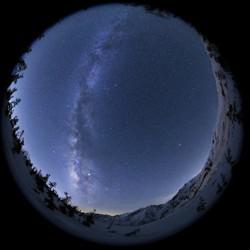
This all-sky image shows our home galaxy, the Milky Way, crossing the zenith, the point just above the observer as seen from Nagano, Japan, in May 2019. Such images of the whole sky can be taken either with a fish-eye lens or with a convex mirror on the ground, the latter of which would show the photographer as well.
Some of the brightest stars in the night sky can be seen in this image, as well as two of the giant planets of our Solar System: Jupiter, the brightest point in the bottom of this image, and Saturn, another bright point just to the opposite side of the Galaxy, to the bottom and next to the horizon.
Directly right of the Milky Way and below Jupiter, we can spot the bright red star Antares, the primary star of the Japanese asterism of The Heart. Japanese constellations derive from ancient Chinese constellations, which were adopted with only slight or no changes. In this tradition, The Heart is the heart of the “Azure Dragon”, a super-constellation that represents the spring. In the Babylonian and Greco-Roman traditions, this area is considered the heart of the Scorpion. In Babylonian religion, the star is associated with Lisi, the child of the mother goddess, but in Greek mythology it is related to the planet Mars, because of its colour. The reddish colour also led to the star’s Chinese name “The Fire Star”. We know that this colour is caused by its relatively cool temperature.
Going from Antares to the right of the image, we find the more northern parts of the sky. The bright star in the lower-right of the image, close to the horizon, is Arcturus, located in the modern constellation Boötes. While Antares and its surrounding area are considered the heart of the Azure Dragon, Arcturus and Spica (below the horizon) are two single-star asterisms forming its huge horn. Pointing towards it from above, at the right-hand edge of the image’s horizon, we can see the handle of the Big Dipper, or Plough, which is part of the constellation Ursa Major.
The bright point to the right of the galaxy and just above the middle of the image is Vega, located in the modern constellation Lyra. Extending a line to the other side of the Galaxy and a bit lower in the image we can find Altair, in the constellation Aquila. From that point we extend another line to Deneb, the brightest star in the constellation of the Swan, also a bit higher in this image and completely flooded by the Milky Way. These three bright stars comprise the asterism known as the Summer Triangle in the northern hemisphere.
المصدر: Ohnishi Kouji/IAU OAE
مصطلحات المعجم:
المشتري , درب التبانة , زُحل , كوكبة العقرب
فئات:
درب التبانة والوسط بين النجمي
, علم الفلك بالعين المجردة
الترخيص: المشاع الإبداعي نَسب المُصنَّف 4.0 دولي (CC BY 4.0) المشاع الإبداعي نَسب المُصنَّف 4.0 دولي (CC BY 4.0) أيقونات
هذا الملف على Zenodo ( صورة 11.13 MB)

Warm Winter Night Over Spiš Region
صورة
أُنشئ لصالح OAE
الشرح: Winner in the 2022 IAU OAE Astrophotography Contest, category Still images of celestial patterns.
This image, taken in Slovakia in January 2022, shows regions of the Milky Way and a rich variety of constellations. The summer constellations of the northern hemisphere are very low in the sky towards the bottom-right. The bright stars of Cygnus and Lyra shine through the artificial lights at the horizon. The huge array of northern winter and autumn constellations with many bright stars are associated with diverse cultural stories.
For the Lakota people in North America the belt of the Orion constellation represents the spine of a bison (“Tayamnicankh”). Orion, the Hunter of Greek mythology, is sometimes described chasing the Seven Sisters, the Pleiades. The Arabs transformed this view by considering the follower of the Pleiades only one star instead of a constellation. Aldebaran, the star in the right eye of Taurus, the Bull, comes from this interpretation, because the name Aldebaran derives from al-dabaran, The Follower.
At the bottom-right, on the horizon, we can see the milky lightcone of the Zodiacal light stretching from the constellation Pisces through Aries, almost reaching the Pleiades, indicating the path of the planets and the Moon in this area. The Pleiades and the Hyades together form a gate on this path, where the heavenly bodies occasionally pass before entering the Milky Way. The planets were considered sheep in ancient Babylon and the modern constellation Orion was considered the “True Shepherd” of the Sky, with his shepherd’s tool reaching the ecliptic. In Roman tradition, the bright white star above the Pleiades and the Milky Way is called Capella, the Goat, which can be traced back to an Egyptian constellation in this area.
Above the treetop in the middle-right part of the image, we see the autumn square, the Andromeda Galaxy and the W-shaped pattern of Cassiopeia. To the left of this group, in the central part of the visible Milky Way, is the constellation Perseus, with Cepheus in the dark area above Cassiopeia completing the celestial family. The Andromeda saga is a Greek story from the area that is now called Israel, and is rooted in Syrian traditions. The location of Andromeda was considered by the ancient Babylonians as the location of the goddess of sexual love, and by the Syrians as the location of the goddess of fertility. According to the saga, Andromeda was chained to a rock at the coast of Jaffa (Tel Aviv) in order to protect her land from a sea monster. The name of the hero who rescued her is Perseus, probably meaning “from Persia” (today’s Iran).
Noticeable in the valley are the lights from towns. The yellow light above the horizon indicates larger cities there, which are given away by their light pollution.
المصدر: Robert Barsa/IAU OAE
مصطلحات المعجم:
مجموعة نجمية او حشد نجمى , درب التبانة , برج الحوت , برج الثور , الجَبّار , الثريا
فئات:
درب التبانة والوسط بين النجمي
, علم الفلك بالعين المجردة
الترخيص: المشاع الإبداعي نَسب المُصنَّف 4.0 دولي (CC BY 4.0) المشاع الإبداعي نَسب المُصنَّف 4.0 دولي (CC BY 4.0) أيقونات
هذا الملف على Zenodo ( صورة 37.27 MB)





