المستندات والموارد - نتائج البحث
نتائج البحث

Celestial Coordinates
صورة
أُنشئ لصالح OAE
الشرح: Here we see how celestial coordinates map positions on the celestial sphere. The celestial sphere is an imaginary, hollow sphere that surrounds the Earth. Celestial objects appear to be attached to the inside of the celestial sphere, and the planets, Sun, and Moon appear to move slowly across it.
The celestial sphere has a spherical coordinate system similar to the latitude and longitude we see on the Earth. The celestial equator is the projection of the Earth's equator onto the celestial sphere while the north and south celestial poles are the projections of the Earth's north and south poles onto the celestial sphere.
Declination is similar to latitude on the Earth in that it marks the angle above and below the celestial equator. Declination is zero on the celestial equator, is positive to the north of the celestial equator and negative to the south of it. It is commonly measured in degrees and sometimes in radians.
Right Ascension is similar to longitude as it marks the angle around the celestial equator. As with longitude the zero point of right ascension (shown here as a dashed line) is a matter of choice. Traditionally the zero point of right ascension was the position of the Sun at the northern hemisphere vernal equinox (spring equinox) in March. It is positive and increases to the east, unlike longitude on Earth which is defined as east or west of the prime meridian. It is most commonly measured in hours, minutes and seconds or occasionally in degrees or radians.
The ecliptic marks the Sun's path across the celestial sphere when viewed from the Earth.
The Earth rotates within the celestial sphere. This leads to objects like stars or galaxies, which appear static on the celestial sphere, rising and setting when viewed from the Earth but remaining in the same position on the celestial sphere.
The Earth's axis precesses within the celestial sphere. This slowly moves the celestial equator and the celestial poles meaning that the traditional celestial coordinate system changes slowly over time meaning that stars and galaxies that do not move will have positions that change. Astronomers have used coordinate systems defined by the position of the celestial poles and equator at a fixed point in time. Now celestial positions are most commonly measured on a fixed coordinate system defined by the position of the celestial poles and equator on the 1st of January 2000.
المصدر: Maria Cristina Fortuna/IAU OAE
فئات:
علم الفلك بالعين المجردة
, علم الفلك الرصدي
الترخيص: المشاع الإبداعي نَسب المُصنَّف 4.0 دولي (CC BY 4.0) المشاع الإبداعي نَسب المُصنَّف 4.0 دولي (CC BY 4.0) أيقونات
ملف
( صورة
517.83 kB)
ملف PDF
(PDF file
203.59 kB)
Also available in black and white
ملف
( صورة
501.79 kB)
ملف PDF
(
202.13 kB)
Star Trail in the Southern Hemisphere with Bortle 4 Scale Light Pollution
صورة
أُنشئ لصالح OAE
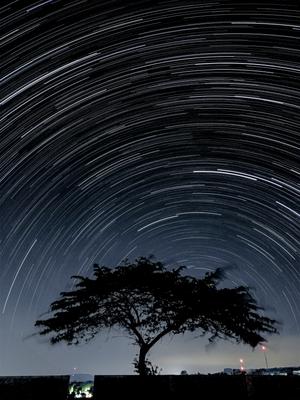
الشرح: Winner in the 2023 IAU OAE Astrophotography Contest, category of Still images taken exclusively with smartphones/mobile devices.
This breathtaking photo, captured under the clear night sky of Linggamekar Village, Cilimus, Kuningan, West Java, Indonesia on 25 June 2020, displays star trails sweeping across the southern hemisphere’s heavens. The star trails are due to Earth’s rotation causing the apparent motion of stars, creating these mesmerising arcs of light when followed over extended periods. Here, the point the stars rotate around (the South Celestial Pole) is close to the horizon, as the image was taken close to the equator. The photographer used the star trail feature on a smartphone, which captured a series of images over an extended period and stacked them together. The striking tree in the foreground adds depth to the image, contrasting the celestial motion above with its Earthly stillness, while also masking some of the surrounding light pollution. Different parts of the world offer diverse and stunning perspectives on the night sky, emphasising the importance of preserving dark skies everywhere.
المصدر: Slamat Riyadi/IAU OAE (CC BY 4.0)
مصطلحات المعجم:
القطب السماوى , القبة السماوية , دوران الأرض
فئات:
علم الفلك بالعين المجردة
وسوم:
astrophotography
الترخيص: المشاع الإبداعي نَسب المُصنَّف 4.0 دولي (CC BY 4.0) المشاع الإبداعي نَسب المُصنَّف 4.0 دولي (CC BY 4.0) أيقونات
هذا الملف على Zenodo ( صورة 5.35 MB)
The Last Hour of the Day
صورة
أُنشئ لصالح OAE
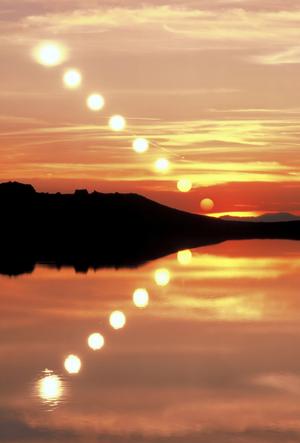
الشرح: Honorable mention in the 2023 IAU OAE Astrophotography Contest, category of Still images of day arcs of the Sun and Solargraphs.
This image, taken on 2 May 1997 at Lake Scaffaiolo in Italy, masterfully captures the Sun's descent in a sequence of mirrored reflections on the placid waters. Its breathtaking representation of time showcases the serene beauty of the surroundings, and stands as a timeless testament to the fleeting moments of the day’s final hour.
المصدر: Fabrizio Melandri/IAU OAE (CC BY 4.0)
مصطلحات المعجم:
مسار الشمس (قوس النهار)
فئات:
علم الفلك بالعين المجردة
وسوم:
astrophotography
الترخيص: المشاع الإبداعي نَسب المُصنَّف 4.0 دولي (CC BY 4.0) المشاع الإبداعي نَسب المُصنَّف 4.0 دولي (CC BY 4.0) أيقونات
هذا الملف على Zenodo ( صورة 940.09 kB)
Where the Sun Sets Every Month
صورة
أُنشئ لصالح OAE
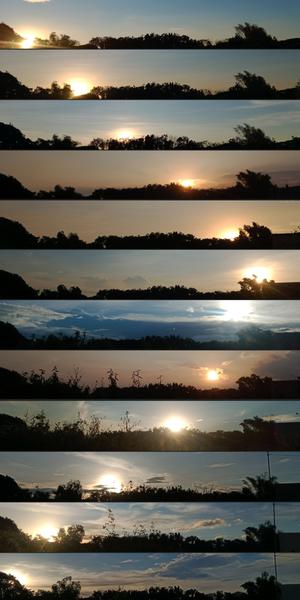
الشرح: Third place winner in the 2023 IAU OAE Astrophotography Contest, category of Still images of sunrise and sunset location over the year.
Taken with a smartphone from San Rafael, Bulacan, Philippines, this series of images capture the changing position of sunset over the year owing to Earth’s axial tilt and orbit around the Sun. From January to December 2022, each image reflects the changing backdrop and position of the Sun at dusk. Observe the changing foliage and the appearance of an electricity pole in October. This collection serves as a visual testament to the celestial dance between Earth and the Sun, and the natural transformations on the ground.
المصدر: John Paul Pile/IAU OAE (CC BY 4.0)
مصطلحات المعجم:
الاعتدال , الانقلاب الشمسي , الانقلاب الصيفي , مسار الشمس (قوس النهار) , الانقلاب الشتوي
فئات:
علم الفلك بالعين المجردة
وسوم:
astrophotography
الترخيص: المشاع الإبداعي نَسب المُصنَّف 4.0 دولي (CC BY 4.0) المشاع الإبداعي نَسب المُصنَّف 4.0 دولي (CC BY 4.0) أيقونات
هذا الملف على Zenodo ( صورة 11.82 MB)