المستندات والموارد - نتائج البحث
نتائج البحث
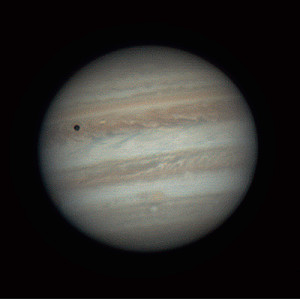
Jupiter, Io and its shadow, by Ralf Burkart, Germany
فيديو
أُنشئ لصالح OAE
الشرح: First place in the 2021 IAU OAE Astrophotography Contest, category Galilean moons.
This time-lapse of Jupiter taken in 2017 from Germany beautifully illustrates the transit of one of the Galilean moons, Io, in front of Jupiter. As this is simply a moon casting a shadow on a planet it is equivalent to a lunar eclipse on Earth observed from further away. While the shadow of the moon is clearly visible from the beginning, it might be difficult to spot the moon itself against the background of the beautiful atmospheric bands of Jupiter the first time the video is seen. Watching it repeatedly allows appreciating the rapid motion and rotation in this fantastic observation.
المصدر: Ralf Burkart/IAU OAE
مصطلحات المعجم:
أقمار غاليليو , عملاق غازي , آيو , المشتري , الأقمار , المدار , الكواكب الخارجية , الكوكب , العبور
فئات:
النظام الشمسي
الترخيص: المشاع الإبداعي نَسب المُصنَّف 4.0 دولي (CC BY 4.0) المشاع الإبداعي نَسب المُصنَّف 4.0 دولي (CC BY 4.0) أيقونات
هذا الملف على Zenodo ( فيديو 12.64 MB)
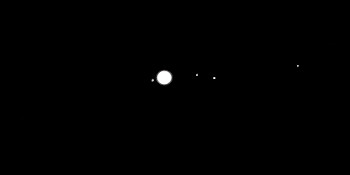
Jupiter Moons Movie2, by Nicolas Hurez, Paul-Antoine Matrangolo, and Carl Pennypacker, United States of America
فيديو
أُنشئ لصالح OAE
الشرح: Second place in the 2021 IAU OAE Astrophotography Contest, category Galilean moons.
This sequence shows the orbit of the four Galilean moons around the planet Jupiter. Almost two entire orbits of the innermost moon, Io, can be seen, with the other moons (Europa and Ganymede, but in particular Callisto) being further away, orbiting noticeably slower. The images were obtained in 2018 with the Las Cumbres Global Observatory at different locations on Earth, allowing a continuous sequence of images over approximately half a week without gaps during the day. With clear skies and over the course of several nights, the motion of the Galilean moons can also be observed with binoculars (ideally steady your elbows on a surface).
المصدر: Nicolas Hurez, Paul-Antoine Matrangolo and Carl Pennypacker/IAU OAE
مصطلحات المعجم:
أقمار غاليليو , عملاق غازي , آيو , المشتري , الأقمار , المدار , الكواكب الخارجية , الكوكب
فئات:
النظام الشمسي
الترخيص: المشاع الإبداعي نَسب المُصنَّف 4.0 دولي (CC BY 4.0) المشاع الإبداعي نَسب المُصنَّف 4.0 دولي (CC BY 4.0) أيقونات
هذا الملف على Zenodo ( فيديو 890.47 kB)

Halley's Comet
صورة
الشرح: Halley’s Comet, is a well-known periodic comet, named after the English astronomer Edmond Halley. It has an orbital period of approximately 75 years and is visible from Earth with the naked eye when it passes through the inner solar system.
The image shows Halley’s Comet, officially designated 1P/Halley, with a tail of gas and dust streaming away from the Sun. It was taken from the La-Silla-Observatory in Chile in 1986 during Halley's Comet's last visit to the inner solar system. The stars in this image appear elongated or as lines of three different colored dots as image was created from three separate observations in different colors of light and the telescope was tracking the comet, which was moving very slightly compared to the background stars. Note that the comets tail does not point in exactly the same direction as the elongation of the stars. This shows us that the comet tail is not always behind the comet, but instead pointing away from the Sun.
The comet passes its perihelion (closest distance to the Sun) at a distance of around 0.59 astronomical units, right between the orbits of Mercury and Venus. Beyond Neptune, it reaches its aphelion (furthest distance from the Sun) at a distance of approximately 35 astronomical units. Halley's Comet reached aphelion in December 2023 and is now moving inwards again. It is expected to be seen with the naked eye from Earth again in mid-2061.
المصدر: ESO
رابط المصدر
مصطلحات المعجم:
الأوج , المذنب , ذيل المذنب , مذنب هالي , الحضيض الشمسي
الترخيص: المشاع الإبداعي نَسب المُصنَّف 4.0 دولي (CC BY 4.0) المشاع الإبداعي نَسب المُصنَّف 4.0 دولي (CC BY 4.0) أيقونات
ملف
( صورة
5.23 MB)

H-alpha image of the Sun's chromosphere
صورة
الشرح: This false-color image was captured with a 10-cm telescope at the Big Bear Solar Observatory (BBSO) in the United States in July 2002. It depicts the full disk of the Sun using the H-alpha emission line of hydrogen. When observed in this spectral line, the Sun's chromosphere appears particularly prominent due to hydrogen atoms emitting light at the specific wavelength. This emission produces a distinctive red color, making features such as spicules (jets of plasma that look hair-like) and plage (bright patches in the chromosphere) highly visible. Several small solar prominences can be seen protruding from the edge of the solar disk. When prominences (also known as filaments) cross the face of the disk they appear as dark threads caused by the cooler material in the prominence absorbing light. The chromosphere is also visible in the violet part of the solar spectrum due to ionized calcium showing emissions in these wavelengths.
المصدر: Big Bear Solar Observatory (BBSO)/New Jersey Institut of Technology (NJIT)
رابط المصدر
مصطلحات المعجم:
الطبقة اللونية , الشواظ الشمسي , الشمس , الخط الطيفي
فئات:
الشمس
الترخيص: الملكية العامة الملكية العامة أيقونات
ملف
( صورة
2.82 MB)
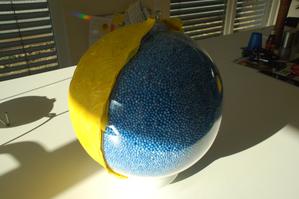
One Million Earths inside our Sun نشاط تعليمي astroEDU (رابط إلى موقع astroEDU) Origin: astroEDU الوصف: Learn how to build a model of the Sun...which can fit nearly 1 million little Earth balls!
مصطلحات المعجم:
الأرض , الشمس
فئات:
الرياضيات
, النظام الشمسي
, الشمس
وسوم:
Dimension
, Distances
, Hands-on
, Model
, Relative sizes
, Scales
الفئات العمرية:
4-6
, 6-8
, 8-10
, 10-12
, 12-14
, 14-16
, 16-19
, 19+
المرحلة التعليمية:
غير رسمي
, المرحلة المتوسطة
, أخرى
, مرحلة ما قبل المدرسة
, المرحلة الابتدائية
, المرحلة الثانوية
, الجامعة
مجالات التعلم:
تعلم استكشافي موجه
, النمذجة
, حل المشكلات
التكاليف:
تكلفة متوسطة
المدة:
30 دقيقة
حجم المجموعة:
جماعي
المهارات:
تحليل البيانات وتفسيرها
, طرح الأسئلة
, توصيل المعلومات
, تطوير النماذج واستخدامها
, استخدام الرياضيات والتفكير الحاسوبي
المؤلفون: Natalie Fischer
الترخيص: المشاع الإبداعي نَسب المُصنَّف 4.0 دولي (CC BY 4.0) المشاع الإبداعي نَسب المُصنَّف 4.0 دولي (CC BY 4.0) أيقونات