المستندات والموارد - نتائج البحث
نتائج البحث
Southern Sky Over La Silla
فيديو
أُنشئ لصالح OAE
الشرح: First place winner in the 2023 IAU OAE Astrophotography Contest, category of Time-lapses of rotation of Big Dipper or Southern Cross.
This video shows the Milky Way’s sprawling brilliance across the celestial expanse. Among the stars’ grand theatre, the Southern Cross constellation claims its place in the scene, distinguished by its distinctive cross shape as seen in the top of this video and slightly to the right just over the Milky Way, slowly disappearing as the video progresses. This celestial marker, a prominent feature in the southern hemisphere, holds cultural and navigational significance, having served as a navigational guidepost for centuries. Accompanying the Milky Way’s grandeur are the two Magellanic clouds, celestial companions seen dancing in the distant sky. The Carina Nebula adds its ethereal glow to the cosmic panorama, painting a radiant hue against the darkness. In the midst of this celestial ballet, a gentle green hue envelops the atmosphere, a phenomenon known as airglow, adding a touch of subtle luminescence to the night sky. The terrestrial also makes an appearance, with planes flying overhead and vehicles driving between observatory buildings. This time-lapse, taken from the La Silla Observatory in Chile, is a window to the captivating dance of stars, offering a glimpse into the awe-inspiring beauty of our galaxy and the celestial landmarks that grace the southern sky.
المصدر: José Rodrigues/IAU OAE (CC BY 4.0)
مصطلحات المعجم:
القطب السماوى , القبة السماوية , دوران الأرض , الرصد الفلكي , السماء , الصليب الجنوبي
فئات:
علم الفلك بالعين المجردة
وسوم:
astrophotography
الترخيص: المشاع الإبداعي نَسب المُصنَّف 4.0 دولي (CC BY 4.0) المشاع الإبداعي نَسب المُصنَّف 4.0 دولي (CC BY 4.0) أيقونات
هذا الملف على Zenodo ( فيديو 1.07 GB)
Between Two Skies
صورة
أُنشئ لصالح OAE
الشرح: Honourable mention in the 2022 IAU OAE Astrophotography Contest, category Still images of celestial patterns.
Taken from Narrabri, Australia, in April 2014, this photograph shows a meteor next to the Large Magellanic Cloud and the reflection of all this in the water.
The Magellanic Clouds are named after the Portuguese explorer Ferdinand Magellan, who made the first maps of the southern part of South America in the early 16th century but did not survive his expedition voyage. His shipmates called the two nebulae after him, and it was only in the 20th century that astronomy research discovered that they are in fact dwarf galaxies accompanying our own.
In the 18th century, the French mathematician J-N. Lacaille, who lived in South Africa for some years in order to draw maps of the sky and the land, invented some new constellations. He measured the positions of some faint stars and listed them in his star catalogue, but did not try to overlay beautiful drawings of real-world objects on the star patterns, so he could name them however he wanted. He was based in the trade station that is now the city of Cape Town and, from this bay, Table Mountain is visible. Lacaille learned from the navigators that they used the clouds around this mountain to predict whether or not the wind would blow in the correct direction and allow for sailing. Normally, there is a huge white cloud at the top of Table Mountain, so Lacaille considered the larger one of the two dwarf galaxies not a “Magellanic Cloud”, but the cloud at Table Mountain. Consequently, he invented the constellation “Mensa”, Table Mountain, in the small area of faint stars directly attached to this dwarf galaxy.
المصدر: Fabrizio Melandri/IAU OAE
مصطلحات المعجم:
مجموعة نجمية او حشد نجمى , الشهاب , سحابة ماجلان الكبرى , سحابة ماجلان الصغيرى
فئات:
المجرات
, علم الفلك بالعين المجردة
الترخيص: المشاع الإبداعي نَسب المُصنَّف 4.0 دولي (CC BY 4.0) المشاع الإبداعي نَسب المُصنَّف 4.0 دولي (CC BY 4.0) أيقونات
هذا الملف على Zenodo ( صورة 1.82 MB)

The Milky Way Over Anglers Reach
صورة
أُنشئ لصالح OAE
الشرح: Winner in the 2022 IAU OAE Astrophotography Contest, category Still images of celestial patterns.
The Milky Way and several astronomical objects are seen in this image taken from the southern hemisphere, in Anglers Reach, Australia, in April 2022.
On the bottom-left side we can identify the constellation Scorpius with its brightest star, Antares, the reddish spot just above the arc. Some prominent but small southern constellations can also be seen: the dominating bright stars in the middle-left of the image in the Milky Way are the four bright stars of Crux (the Southern Cross) and to its left the two pointer stars, alpha and beta Centauri. Crux points towards the southern celestial pole, which is not marked by a bright star, and The pointer stars point towards Crux, distinguishing it from the asterism of the False Cross in the constellation Argo.
Crux features on the national flags of Australia, Brazil, Papua New Guinea, Samoa and New Zealand. As Crux lies in the brightest parts of the Milky Way, the dark cloud of the famous Coalsack Nebula is prominent next to the bright stars. It forms one of the dark constellations in South American, South African and Australian indigenous cultures. The huge Australian dark constellation of the Emu is almost completely above the horizon in this image, stretching from its head in the Coal Sack to the horizon.
In Greek antiquity, the stars of Crux also belonged to the constellation Centaurus, a hybrid creature with a human torso and head attached to a horse body with four legs. The Greek centaur represents Chiron, the wise teacher of all Greek heroes. Its brightest star is Rigil Kentaurus (Alpha Centauri), the front hoof of the centaur. Just below it, we find the small constellation Triangulum Australe. The triple star system of Alpha Centauri is our Sun’s nearest stellar neighbour.
Along the Milky Way in the middle-right of the picture we find the huge constellation Argo, the Ship. The smaller ancient constellation Argo was extended by Dutch navigators around 1600, and the number of stars in this constellation was then so big that the 18th-century French mathematician Lacaille needed to introduce subtitles for Argo in his star catalogue. In doing so, he invented the constellations Puppis, Carina and Vela. In Carina, the Keel of the ship, this reddish photograph clearly displays the Carina Nebula.
At the right edge of the image we can spot the brightest star in the night sky, Sirius, while the second brightest star, Canopus, the rudder of Argo, the Ship, dominates the area under the arch of the Milky Way.
Also below the Milky Way arc, we can see the Large Magellanic Cloud and the Small Magellanic Cloud, which are small satellite galaxies of our own Galaxy.
المصدر: Lucy Yunxi Hu/IAU OAE
مصطلحات المعجم:
اللون , الغبار , درب التبانة , كوكبة العقرب , الصليب الجنوبي , سحابة الغبار , الاعتتام بين النجوم , سحابة ماجلان الكبرى , سحابة ماجلان الصغيرى , رجل القنطور
فئات:
المجرات
, درب التبانة والوسط بين النجمي
, علم الفلك بالعين المجردة
الترخيص: المشاع الإبداعي نَسب المُصنَّف 4.0 دولي (CC BY 4.0) المشاع الإبداعي نَسب المُصنَّف 4.0 دولي (CC BY 4.0) أيقونات
هذا الملف على Zenodo ( صورة 9.39 MB)

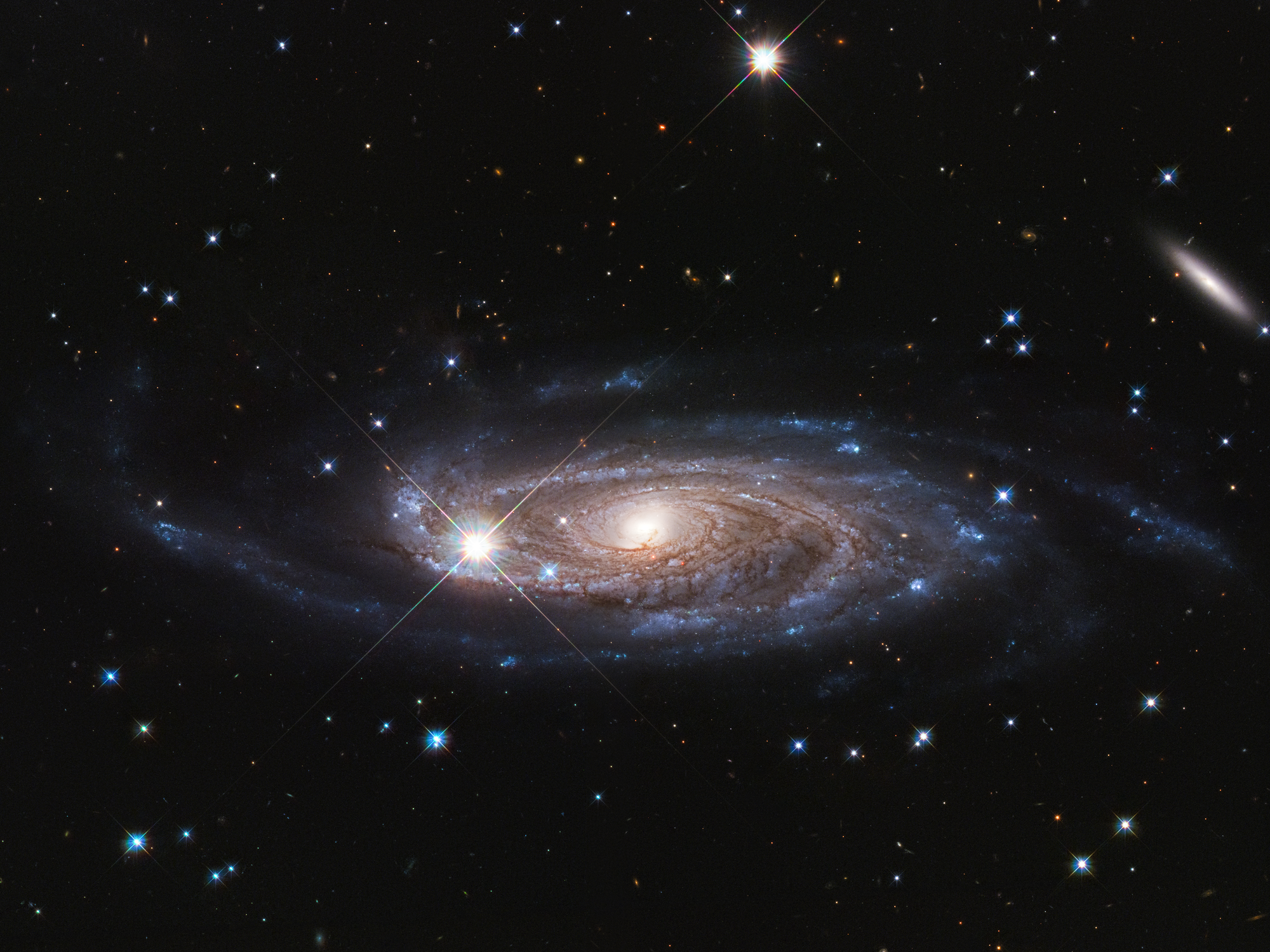
Spiral Galaxy UGC 2885
صورة
الشرح: This image shows UGC 2885, a spiral galaxy located in the constellation Perseus, about 230 million light-years from Earth. Spiral galaxies have rotating disks of stars, gas, and dust, with spiral arms extending outward from the central region. In UGC 2885, these arms are very broad and faint, revealing the galaxy’s large size. This galaxy is tilted at an angle to the observer on Earth, meaning it does not appear as the circular "grand design" spiral it would look like if viewed face-on, nor as the thin line with a central bulge it would appear as if viewed edge-on.
UGC 2885 is remarkable because it is roughly twice the diameter of the Milky Way. It was studied by astronomer Vera Rubin, whose observations of how galaxies rotate — including systems like this one — played a key role in the search for dark matter.
The bright star which appears to the left of the galaxy's center is a foreground object not related to the galaxy.
المصدر: NASA, ESA, Benne Holwerda (University of Louisville)
رابط المصدر
مصطلحات المعجم:
المجرة القرصية , المجرة الحلزونية
الترخيص: الملكية العامة الملكية العامة أيقونات
ملف
( صورة
4.87 MB)

3D Universe: the Milky Way and friends نشاط تعليمي astroEDU (رابط إلى موقع astroEDU) Origin: astroEDU الوصف: Use tactile models printed in 3D to explore our galactic neighborhood.
مصطلحات المعجم:
مجرة المرأة المسلسلة , المجرة , السحب المجلانية , سحابة ماجلان الكبرى , سحابة ماجلان الصغيرى
فئات:
المجرات
, الفيزياء
الفئات العمرية:
10-12
, 12-14
, 14-16
, 16-19
, 19+
المرحلة التعليمية:
المرحلة المتوسطة
, المرحلة الثانوية
, الجامعة
مجالات التعلم:
تعلم استكشافي موجه
, محاضرة تفاعلية
, النمذجة
التكاليف:
تكلفة متوسطة
المدة:
ساعة واحدة
حجم المجموعة:
جماعي
المهارات:
تحليل البيانات وتفسيرها
, تطوير النماذج واستخدامها
المؤلفون: Amelia Ortiz-Gil، Emilio Terol، Alberto Fernández-So
الترخيص: المشاع الإبداعي نَسب المُصنَّف 4.0 دولي (CC BY 4.0) المشاع الإبداعي نَسب المُصنَّف 4.0 دولي (CC BY 4.0) أيقونات