المستندات والموارد - نتائج البحث
نتائج البحث
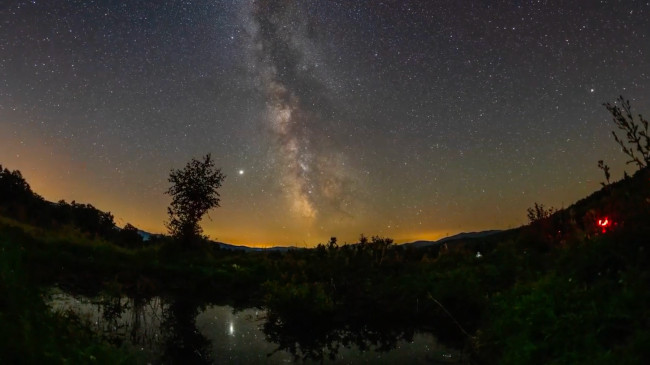
Flowing Night Sky
فيديو
أُنشئ لصالح OAE
الشرح: Honourable mention in the 2022 IAU OAE Astrophotography Contest, category Time lapses of celestial patterns.
This time-lapse was shot from Slovakia in August 2020. By fixing the relative movement of the sky to Earth's rotation in some of the frames, we can experience a different perspective as a viewer.
The Milky Way, our home galaxy, is visible throughout the whole video. The bright objects near the Milky Way are Jupiter and Saturn, close together, Jupiter being the brighter one.
This video also shows the interaction of amateur astronomers observing the Perseids meteor shower with their telescopes pointed towards the sky. An unfortunate aspect of the art of astronomical observing, clouds can suddenly cover the whole sky. The fog occurs mostly because of the higher humidity after the rain.
Most of the light trails in the sky are made by satellites, but some of them, appearing just very briefly and not very noticeably, are meteors, as the video was shot around the peak of Perseids meteor shower.
المصدر: Robert Barsa/IAU OAE
مصطلحات المعجم:
المشتري , درب التبانة , زُحل , الشهاب
فئات:
درب التبانة والوسط بين النجمي
, علم الفلك بالعين المجردة
, النجوم
الترخيص: المشاع الإبداعي نَسب المُصنَّف 4.0 دولي (CC BY 4.0) المشاع الإبداعي نَسب المُصنَّف 4.0 دولي (CC BY 4.0) أيقونات
هذا الملف على Zenodo ( فيديو 254.11 MB)
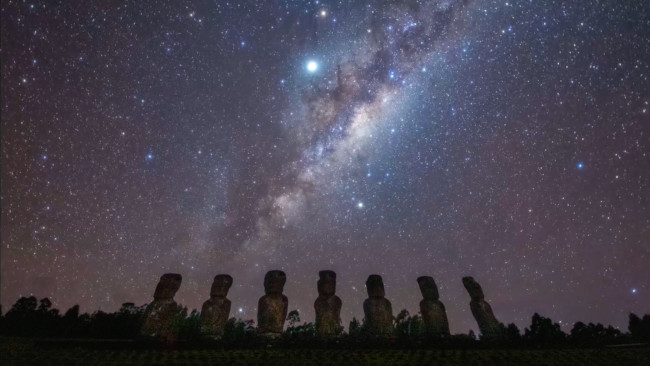
Southern Sky
فيديو
أُنشئ لصالح OAE
الشرح: First place in the 2022 IAU OAE Astrophotography Contest, category Time lapses of celestial patterns.
This video is a compilation of several recordings taken on various occasions in June 2019, both on Easter Island and in the Atacama Desert in Chile. It starts with an impressive opening of clouds seeming to emerge behind the famous statues on Easter Island and moving directly forwards towards the observer. It evokes the impression of the mighty deities sending clouds to cover the night sky.
In the next couple of scenes, we see landscapes with an impressive Milky Way turning overhead, but this quiet scene is continuously interrupted by hasty satellites or — in one of the scenes — even by car lights on the ground. It illustrates both the majesty of the sky and the disturbance of nature by human influence.
Then there is another scene of clouds passing by, but now from left to right. The terrestrial clouds pass below the clouds of stars that form the Milky Way. The last scene shows an undisturbed still pattern of stars that looks like a flight over a zoomed-in photograph, and shows how we are not used to experiencing nature’s stillness and silence.
المصدر: Jianfeng Dai/IAU OAE
مصطلحات المعجم:
درب التبانة
فئات:
درب التبانة والوسط بين النجمي
, علم الفلك بالعين المجردة
الترخيص: المشاع الإبداعي نَسب المُصنَّف 4.0 دولي (CC BY 4.0) المشاع الإبداعي نَسب المُصنَّف 4.0 دولي (CC BY 4.0) أيقونات
هذا الملف على Zenodo ( فيديو 526.21 MB)
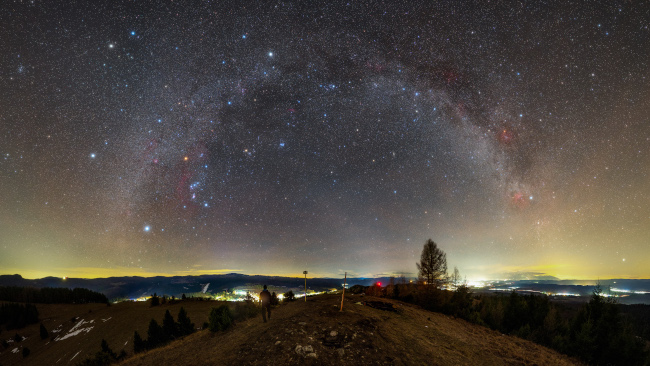
Warm Winter Night Over Spiš Region
صورة
أُنشئ لصالح OAE
الشرح: Winner in the 2022 IAU OAE Astrophotography Contest, category Still images of celestial patterns.
This image, taken in Slovakia in January 2022, shows regions of the Milky Way and a rich variety of constellations. The summer constellations of the northern hemisphere are very low in the sky towards the bottom-right. The bright stars of Cygnus and Lyra shine through the artificial lights at the horizon. The huge array of northern winter and autumn constellations with many bright stars are associated with diverse cultural stories.
For the Lakota people in North America the belt of the Orion constellation represents the spine of a bison (“Tayamnicankh”). Orion, the Hunter of Greek mythology, is sometimes described chasing the Seven Sisters, the Pleiades. The Arabs transformed this view by considering the follower of the Pleiades only one star instead of a constellation. Aldebaran, the star in the right eye of Taurus, the Bull, comes from this interpretation, because the name Aldebaran derives from al-dabaran, The Follower.
At the bottom-right, on the horizon, we can see the milky lightcone of the Zodiacal light stretching from the constellation Pisces through Aries, almost reaching the Pleiades, indicating the path of the planets and the Moon in this area. The Pleiades and the Hyades together form a gate on this path, where the heavenly bodies occasionally pass before entering the Milky Way. The planets were considered sheep in ancient Babylon and the modern constellation Orion was considered the “True Shepherd” of the Sky, with his shepherd’s tool reaching the ecliptic. In Roman tradition, the bright white star above the Pleiades and the Milky Way is called Capella, the Goat, which can be traced back to an Egyptian constellation in this area.
Above the treetop in the middle-right part of the image, we see the autumn square, the Andromeda Galaxy and the W-shaped pattern of Cassiopeia. To the left of this group, in the central part of the visible Milky Way, is the constellation Perseus, with Cepheus in the dark area above Cassiopeia completing the celestial family. The Andromeda saga is a Greek story from the area that is now called Israel, and is rooted in Syrian traditions. The location of Andromeda was considered by the ancient Babylonians as the location of the goddess of sexual love, and by the Syrians as the location of the goddess of fertility. According to the saga, Andromeda was chained to a rock at the coast of Jaffa (Tel Aviv) in order to protect her land from a sea monster. The name of the hero who rescued her is Perseus, probably meaning “from Persia” (today’s Iran).
Noticeable in the valley are the lights from towns. The yellow light above the horizon indicates larger cities there, which are given away by their light pollution.
المصدر: Robert Barsa/IAU OAE
مصطلحات المعجم:
مجموعة نجمية او حشد نجمى , درب التبانة , برج الحوت , برج الثور , الجَبّار , الثريا
فئات:
درب التبانة والوسط بين النجمي
, علم الفلك بالعين المجردة
الترخيص: المشاع الإبداعي نَسب المُصنَّف 4.0 دولي (CC BY 4.0) المشاع الإبداعي نَسب المُصنَّف 4.0 دولي (CC BY 4.0) أيقونات
هذا الملف على Zenodo ( صورة 37.27 MB)

Milky Way Arch over La Palma
صورة
أُنشئ لصالح OAE
الشرح: Winner in the 2022 IAU OAE Astrophotography Contest, category Still images of celestial patterns.
This image, which shows the majestic band of the Milky Way and a range of culturally significant patterns, was taken in May 2022 at a very high altitude from the Roque de los Muchachos Observatory in La Palma, from which one can see the clouds below. Some prominent star patterns include Scorpius, Sagittarius, Lyra, Cygnus, Aquila, the Summer Triangle asterism, and the Teapot asterism.
As the Canary Islands used to be a starting point for European sailors to explore the world, we use this place to point to the many indigenous cultures they encountered. Most notably it is the dark patterns within the band of the Milky Way that hold significance for many Indigenous cultures around the world. The dark patterns are in fact dense, cool clouds of gas and dust that block the light from stars. Indigenous people see caves, waterways and various patterns associated with the dark regions of the Milky Way.
The constellations and patterns hold different cultural significance and interpretations for different people. For example, the constellation Scorpius is referred to by Polynesian people as the demigod Maui’s Fishhook. The Yolnu people of Arnhem Land associate Scorpius with a crocodile called Ingalpir. Some Indigenous Australian groups associate stories with individual stars within Scorpius, most notably Antares, the orange-red star in the top right of the image above the band of the Milky Way. Next to the Scorpion and above the bright centre of the Milky Way, there is a prominent dark cloud that is called the Pipe Nebula by modern astrophotographers. The smoke of this pipe goes up to rho Ophiuchi. This and all the other dark clouds in the Milky Way together form the backbone of heaven for some tribes, and an animal with black-and-white skin for South African Zulu people.
The nomenclature of bright stars also has cross-cultural roots. For example, Vega (the bright blue star towards the top of the image) comes from the Arabic waqi, from al-nasr al-waqi, the Eagle who throws himself down (in order to hunt). This contrasts with the Flying Eagle, Altair, also derived from Arabic. Antares is a Greek word meaning “the one similar to Mars”, referring to its colour. The star name Shaula in the stinger of the Scorpion is a modern version of the Babylonian or even Sumerian star name.
المصدر: Amirreza Kamkar/IAU OAE
مصطلحات المعجم:
مجموعة نجمية او حشد نجمى , الغبار , درب التبانة , كوكبة العقرب , المجمة , سحابة الغبار , الاعتتام بين النجوم , القوس
فئات:
درب التبانة والوسط بين النجمي
, علم الفلك بالعين المجردة
, التلسكوبات والأجهزة والمراصد
الترخيص: المشاع الإبداعي نَسب المُصنَّف 4.0 دولي (CC BY 4.0) المشاع الإبداعي نَسب المُصنَّف 4.0 دولي (CC BY 4.0) أيقونات
هذا الملف على Zenodo ( صورة 3.31 MB)