المستندات والموارد - نتائج البحث
نتائج البحث
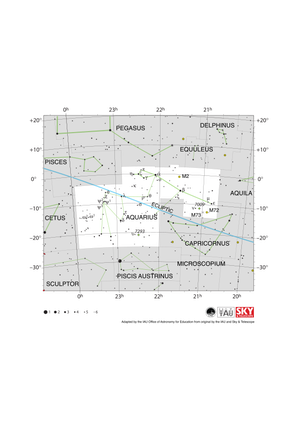
Aquarius Constellation Map
صورة
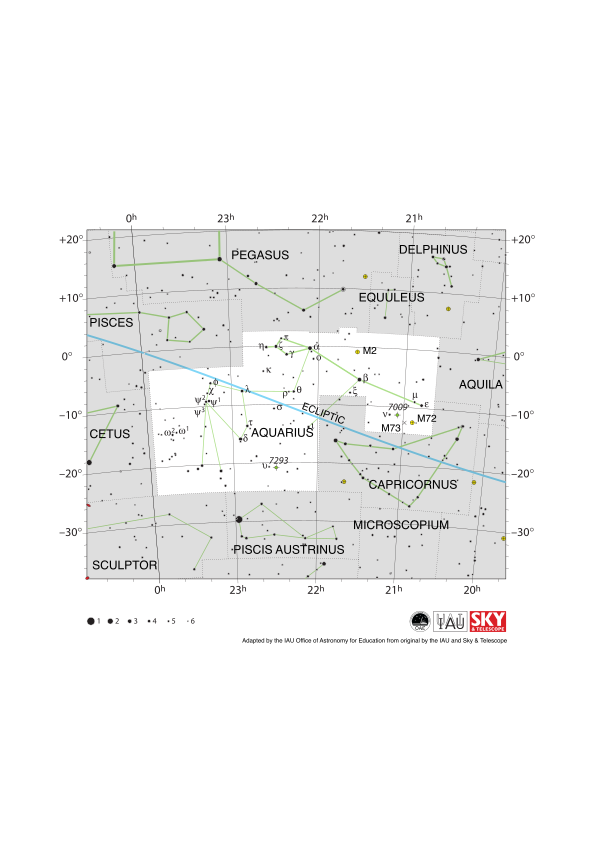
الشرح: The constellation Aquarius along with its bright stars and surrounding constellations. Aquarius is surrounded by (going clockwise from the top) Pegasus, Equuleus, Aquila, Capricornus, Piscis Austrinus, Sculptor, Cetus and Pisces. Aquarius lies on the ecliptic (shown here as a blue line), this is the path the Sun appears to take across the sky over the course of a year. The Sun is in Aquarius from mid February to mid March. The other planets of the Solar System can often be found in Aquarius.
Aquarius spans the celestial equator and is thus visible at some time in the year from all of planet Earth. In the most arctic or antarctic regions of the world, some parts of the constellation may not be visible. Aquarius is most visible in the evenings in the northern hemisphere autumn and southern hemisphere spring.
The yellow circles with plus symbols superimposed on them mark the globular clusters M2 and M72. The green circles superimposed on plus symbols mark the planetary nebulae NGC 7293 (the Helix Nebula) and NGC 7002 (the Saturn Nebula). M73 (marked with an x symbol) is a coincident grouping of stars previously erroneously classified as an open cluster.
The y-axis of this diagram is in degrees of declination with north as up and the x-axis is in hours of right ascension with east to the left. The sizes of the stars marked here relate to the star's apparent magnitude, a measure of its apparent brightness. The larger dots represent brighter stars. The Greek letters mark the brightest stars in the constellation. These are ranked by brightness with the brightest star being labeled alpha, the second brightest beta, etc., although this ordering is not always followed exactly. The dotted boundary lines mark the IAU's boundaries of the constellations and the solid green lines mark one of the common forms used to represent the figures of the constellations. Neither the constellation boundaries, nor the line marking the ecliptic, nor the lines joining the stars appear on the sky.
المصدر: Adapted by the IAU Office of Astronomy for Education from the original by IAU/Sky & Telescope
رابط المصدر
مصطلحات المعجم:
القدرالظاهري , كوكبة الجدي , الإحداثيات السماوية , مجموعة نجمية او حشد نجمى , الميل , مسار البروج , العنقود النجمي الكروي , برج الحوت , السديم الكوكبي , المطلع المستقيم , دائرة البروج , الدلو , العنقود المفتوح
فئات:
علم الفلك بالعين المجردة
الترخيص: المشاع الإبداعي نَسب المُصنَّف 4.0 دولي (CC BY 4.0) المشاع الإبداعي نَسب المُصنَّف 4.0 دولي (CC BY 4.0) أيقونات
ملف
( صورة
119.18 kB)
ملف PDF
(PDF file
215.13 kB)

Equuleus Constellation Map
صورة
الشرح: The constellation Equuleus with its brighter stars and surrounding constellations. Equuleus is surrounded by (going clockwise from the top): Delphinus, Aquarius and Pegasus. It is a relatively small constellation with few bright stars.
Equuleus lies just north of the celestial equator and thus the whole constellation is visible at some point in the year to all but the most antarctic regions. Equuleus is best viewed in the evening in the early northern hemisphere autumn and early southern hemisphere spring.
The y-axis of this diagram is in degrees of declination with north as up and the x-axis is in hours of right ascension with east to the left. The sizes of the stars marked here relate to the star's apparent magnitude, a measure of its apparent brightness. The larger dots represent brighter stars. The Greek letters mark the brightest stars in the constellation. These are ranked by brightness with the brightest star being labeled alpha, the second brightest beta, etc., although this ordering is not always followed exactly. The dotted boundary lines mark the IAU's boundaries of the constellations and the solid green lines mark one of the common forms used to represent the figures of the constellations. Neither the constellation boundaries, nor the lines joining the stars appear on the sky.
المصدر: Adapted by the IAU Office of Astronomy for Education from the original by the IAU and Sky & Telescope
رابط المصدر
مصطلحات المعجم:
القدرالظاهري , الإحداثيات السماوية , مجموعة نجمية او حشد نجمى , الميل , المطلع المستقيم , الدلو
فئات:
علم الفلك بالعين المجردة
الترخيص: المشاع الإبداعي نَسب المُصنَّف 4.0 دولي (CC BY 4.0) المشاع الإبداعي نَسب المُصنَّف 4.0 دولي (CC BY 4.0) أيقونات
ملف
( صورة
61.60 kB)
ملف PDF
(PDF file
143.63 kB)

خريطة كوكبة الدلفين
صورة
الشرح: كوكبة الدلفين مع نجومها الأكثر إشراقاً والكوكبات المحيطة بها. يحيط بكوكبة الدلفين (في اتجاه عقارب الساعة من الأعلى): فولبيكولا، ساجيتا، أكيلا، أكويلا، أكواريوس، إيكوليوس وبيجاسوس. وتعتبر الدلفين كوكبة صغيرة نسبياً مع عدد قليل من النجوم اللامعة.
تقع كوكبة الدلفين شمال خط الاستواء السماوي، وبالتالي فإن الكوكبة بأكملها مرئية في وقت ما من السنة في جميع المناطق باستثناء المناطق القطبية. من الأفضل مشاهدة الكوكبة في المساء في أوائل الخريف في نصف الكرة الشمالي وأوائل الربيع في نصف الكرة الجنوبي.
يقع الحشد النجمى الكوري NGC 6934 في الدلفين. وقد تم تمييزه هنا بدائرة صفراء عليها علامة زائد.
المحور y في هذا الرسم البياني مقيس بدرجات الانحراف مع وضع الشمال في الأعلى والمحور x مقيس بساعات الصعود إلى اليمين مع وضع الشرق إلى اليسار. ترتبط أحجام النجوم المُحدَّدة هنا بالقدر الظاهري للنجم، وهو مقياس لسطوعه الظاهري. تمثل النقاط الأكبر حجماً النجوم الأكثر سطوعاً. تشير الحروف اليونانية إلى ألمع النجوم في الكوكبة. وهي مُرتَّبة حسب السطوع حيث يُسمَّى النجم الأكثر سطوعًا ألفا، وثاني ألمع نجم بيتا، إلخ، على الرغم من أن هذا الترتيب لا يُتَّبع دائمًا بدقة. تشير خطوط الحدود المنقطة إلى الحدود التي وضعها الاتحاد الفلكي الدولي للمجموعات النجمية والخطوط الخضراء الصلبة تشير إلى أحد الأشكال الشائعة المستخدمة لتمثيل أشكال المجموعات النجمية. لا تظهر حدود الكوكبات ولا الخطوط التي تربط بين النجوم على السماء.
المصدر: بتصرف من قبل مكتب الاتحاد الفلكي الدولي للاتحاد الفلكي الدولي للتعليم من النسخة الأصلية للاتحاد الفلكي الدولي والاتحاد الفلكي الدولي وسكاي آند تليسكوب
رابط المصدر
مصطلحات المعجم:
القدرالظاهري , الإحداثيات السماوية , خط الاستواء السماوي , مجموعة نجمية او حشد نجمى , الميل , العنقود النجمي الكروي , المطلع المستقيم , الدلو
فئات:
علم الفلك بالعين المجردة
الترخيص: المشاع الإبداعي نَسب المُصنَّف 4.0 دولي (CC BY 4.0) المشاع الإبداعي نَسب المُصنَّف 4.0 دولي (CC BY 4.0) أيقونات
ملف
( صورة
68.66 kB)
ملف PDF
(PDF file
162.12 kB)

Piscis Austrinus Constellation Map
صورة
الشرح: The constellation Piscis Austrinus with its bright stars and surrounding constellations. Piscis Austrinus is surrounded by (going clockwise from the top): Aquarius, Capricornus, Microscopium, Grus and Sculptor.
Piscis Austrinus is a southern constellation and thus the whole constellation is visible at some point in the year throughout the southern hemisphere. The whole constellation is also visible to some equatorial regions of the northern hemisphere with parts of the constellation visible to the remaining equatorial and some temperate northern hemisphere regions. Piscis Austrinus is best viewed in the evening in the northern hemisphere autumn and southern hemisphere spring.
The y-axis of this diagram is in degrees of declination with north as up and the x-axis is in hours of right ascension with east to the left. The sizes of the stars marked here relate to the star's apparent magnitude, a measure of its apparent brightness. The larger dots represent brighter stars. The Greek letters mark the brightest stars in the constellation. These are ranked by brightness with the brightest star being labeled alpha, the second brightest beta, etc., although this ordering is not always followed exactly. The dotted boundary lines mark the IAU's boundaries of the constellations and the solid green lines mark one of the common forms used to represent the figures of the constellations. The blue line in the top right of the diagram marks the ecliptic. Neither the constellation boundaries, nor the lines joining the stars, nor the ecliptic, appear on the sky.
المصدر: Adapted by the IAU Office of Astronomy for Education from the original by the IAU and Sky & Telescope
رابط المصدر
مصطلحات المعجم:
القدرالظاهري , كوكبة الجدي , الإحداثيات السماوية , مجموعة نجمية او حشد نجمى , الميل , مسار البروج , المطلع المستقيم , الدلو
فئات:
علم الفلك بالعين المجردة
الترخيص: المشاع الإبداعي نَسب المُصنَّف 4.0 دولي (CC BY 4.0) المشاع الإبداعي نَسب المُصنَّف 4.0 دولي (CC BY 4.0) أيقونات
ملف
( صورة
81.19 kB)
ملف PDF
(PDF file
155.49 kB)
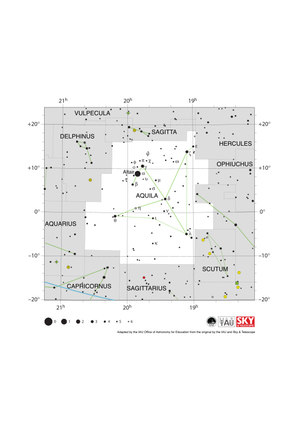
Aquila Constellation Map
صورة
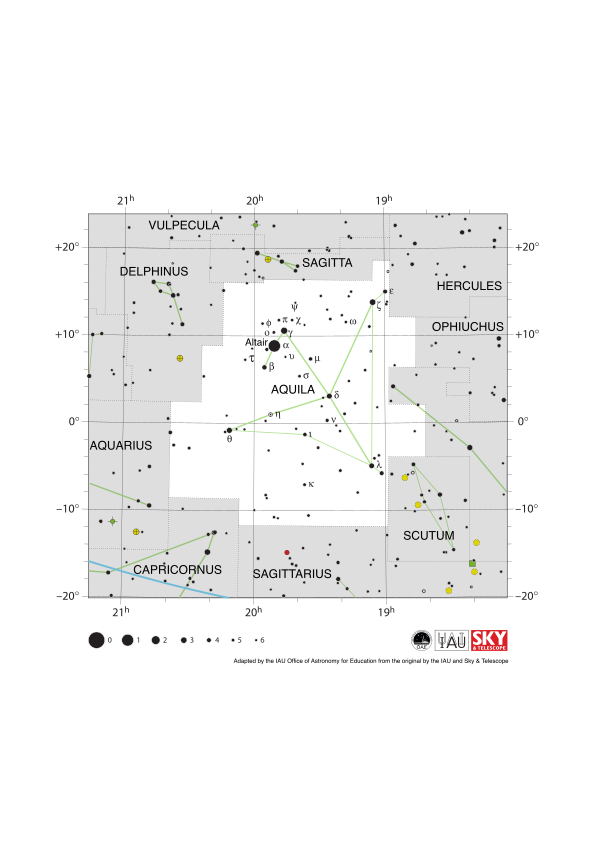
الشرح: The constellation Aquila with its bright stars and surrounding constellations. Aquila is surrounded by (going clockwise from the top): Sagitta, Hercules, Ophiuchus, Serpens Cauda, Scutum, Sagittarius, Capricornus, Aquarius and Delphinus. Aquila is most notable for its brightest star Altair. This forms one vertex of the prominent Summer Triangle asterism that is visible in northern hemisphere summer evenings.
Aquila spans the celestial equator and thus some part of it is visible from all of the Earth at some point in the year. It is most visible in the evenings in the late northern hemisphere summer and late southern hemisphere winter.
The y-axis of this diagram is in degrees of declination with north as up and the x-axis is in hours of right ascension with east to the left. The sizes of the stars marked here relate to the star's apparent magnitude, a measure of its apparent brightness. The larger dots represent brighter stars. The Greek letters mark the brightest stars in the constellation. These are ranked by brightness with the brightest star being labeled alpha, the second brightest beta, etc., although this ordering is not always followed exactly. The dotted boundary lines mark the IAU's boundaries of the constellations and the solid green lines mark one of the common forms used to represent the figures of the constellations. The blue line in the lower right of the diagram is the ecliptic. Neither the constellation boundaries, nor the line marking the ecliptic, nor the lines joining the stars appear on the sky.
المصدر: Adapted by the IAU Office of Astronomy for Education from the original by IAU/Sky & Telescope
رابط المصدر
مصطلحات المعجم:
القدرالظاهري , كوكبة الجدي , الإحداثيات السماوية , خط الاستواء السماوي , مجموعة نجمية او حشد نجمى , الميل , مسار البروج , المطلع المستقيم , الدلو , المجمة
فئات:
علم الفلك بالعين المجردة
الترخيص: المشاع الإبداعي نَسب المُصنَّف 4.0 دولي (CC BY 4.0) المشاع الإبداعي نَسب المُصنَّف 4.0 دولي (CC BY 4.0) أيقونات
ملف
( صورة
95.28 kB)
ملف PDF
(PDF file
175.09 kB)