المستندات والموارد - نتائج البحث
نتائج البحث

The Pillar of Creation
صورة
أُنشئ لصالح OAE
الشرح: Winner in the 2022 IAU OAE Astrophotography Contest, category Still images of celestial patterns.
This image shows the night sky over Tre Cime di Lavaredo, (Dolomites Natural Park), in the region of Veneto, Italy, in October 2021.
The bright spot on the left-hand side is the planet Jupiter, appearing in the constellation Capricorn. To the right of Jupiter and below the two horn stars of Capricorn is the planet Saturn. Just above Jupiter we can see parts of Aquarius, one of the largest constellations and also part of the Zodiac. North of these constellations, left of the Milky Way, there are mostly faint stars. The brighter whitish one in the top left corner is Enif, a binary star in the constellation Pegasus.
The Milky Way seems to emerge from a rock like celestial vapour. Roughly centred in the image are two bright stars left and right of the Milky Way: Altair and Vega, respectively. They seem to be separated by the galactic stream, as told in a popular Chinese folk story where they represent a loving couple. Today, in popular astronomy, the fairly bright star at the upper edge of the photograph is added to form a huge triangle with them, the Summer Triangle in the northern hemisphere.
Altair is the brightest star of the Babylonian constellation Aquila, the Eagle. In ancient Babylon, it was said that the Eagle was carrying king Etana up in the air so that he could see Earth from above. Next to the Babylonian Eagle was the constellation of the Corpse, that returned only in Roman times when Ptolemy put it below the Eagle as the new sub-constellation “Antinous”. It is seen as the corpse (or soul) of the Roman emperor Hadrian’s favourite who had just died in the Nile.
Vega is the bright white star to the right of the Milky Way. It forms part of the small constellation Lyra, famous for hosting the Ring Nebula, which is an impressive planetary nebula — a dying star blowing its gas into space.
At the right edge of the image, three stars in a bent row appear rather prominently. This is the handle of the Big Dipper pointing downwards to a bright star close to the horizon: Arcturus, the bright star of the constellation Bootes (Greek: the Ploughman). This kite-like constellation is probably a pagan interpretation of the Babylonian god “Enlil” whose constellation also occupied that place in the sky. The Romans re-interpreted this figure as The Ox-Driver who controlled the Seven Oxen seen in the bright stars of Ursa Major.
Directly right of Vega, there is the huge constellation Hercules and below it, directly to the left of Bootes, we find a half-circle of stars comprising the small constellation Corona Borealis, associated with Ariadne, daughter of King Minos of Crete in Greek culture.
The lights seen in the bottom left side of the image are due to the reflection of artificial lights in the clouds.
المصدر: Giorgia Hofer/IAU OAE
مصطلحات المعجم:
كوكبة الجدي , الغبار , المشتري , درب التبانة , زُحل , سحابة الغبار , الاعتتام بين النجوم
فئات:
درب التبانة والوسط بين النجمي
, علم الفلك بالعين المجردة
الترخيص: المشاع الإبداعي نَسب المُصنَّف 4.0 دولي (CC BY 4.0) المشاع الإبداعي نَسب المُصنَّف 4.0 دولي (CC BY 4.0) أيقونات
هذا الملف على Zenodo ( صورة 10.71 MB)

Lyrid of the Lake
صورة
أُنشئ لصالح OAE
الشرح: Winner in the 2022 IAU OAE Astrophotography Contest, category Still images of celestial patterns.
Taken in the early hours of 24 April 2022, this image captures the sky of Yunnan Province, China, with a reflection on Lake Nian. The Milky Way is visible on the left side, while whitish Earth clouds are visible on the right. A Lyrid meteor crosses the sky along the Milky Way, its tail pointing back toward the shower's radiant in the constellation Lyra, which lies outside the image above the upper edge. The natural colours of the meteor are impressively clear.
A few constellations are also visible. In the top left corner we can recognise the small constellation of the Dolphin, in which five brightest stars comprise the asterism. This asterism forms the head-part of the larger Greek constellation of the Dolphin and was considered the Dolphin since Roman times, when Ptolemy formed the new constellation of Equuleus in the southern part of the original figure. In mediaeval China, this asterism was considered the Good and the Rotten Gourd, the good one being formed by the brighter rhombus on the top and the rotten one made of faint stars in the tail of the Roman dolphin.
The bright star to the right of the Dolphin and at the top of the image is Altair, the brightest star in the constellation Aquila. In Chinese uranology, Altair, together with some adjacent areas, forms the constellation of the Drum at the River. However, in Chinese folklore, the bright star stands for a boy in love with a girl, who is represented by the bright star Vega (in Lyra) on the other side of a huge celestial stream, the Milky Way. Vega is not visible in this image but the Lyrid meteor is like a teardrop of the unlucky girl who cannot reach her lover.
In the upper right of the image, the constellation Scorpius shines with its bright reddish star Antares. With some of its neighbouring stars, it was regarded in China as the asterism of The Heart, which was also one of the Lunar Mansions. It was considered the heart of the Azure Dragon, the super-constellation of spring, in ancient China.
Scorpius and Sagittarius, in the middle of the image, contain the brightest clouds of the Milky Way, the Galactic Centre, which also has clearly visible dark clouds in front of the bright ones.
There is no classical Greco-Roman constellation between Aquila and Scorpius, but in the 17th century, two Polish astronomers, the couple Jan and Elizabeta Hevelius, named this area of bright clouds in the Milky Way Scutum, the Shield, in memory of a Polish king. In China, however, this area directly outside the super-constellation (or heavenly enclosure) of the Celestial Market Place was seen as depicting Market Officers.
المصدر: Jianfeng Dai/IAU OAE
مصطلحات المعجم:
درب التبانة , كوكبة العقرب , الشهاب , القوس
فئات:
درب التبانة والوسط بين النجمي
, علم الفلك بالعين المجردة
الترخيص: المشاع الإبداعي نَسب المُصنَّف 4.0 دولي (CC BY 4.0) المشاع الإبداعي نَسب المُصنَّف 4.0 دولي (CC BY 4.0) أيقونات
هذا الملف على Zenodo ( صورة 7.19 MB)
Portrait of a Bat
صورة
أُنشئ لصالح OAE
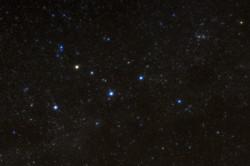
الشرح: Honourable mention in the 2022 IAU OAE Astrophotography Contest, category Still images of celestial patterns.
Taken in November 2019 from the Doi Inthanon National Park, Chiang Mai, Thailand, this image captures the notable northern constellation Cassiopeia, in the shape of the letter M. Although the official constellation name is the Latinised version of the name of queen “Kasseipeia” from Greek mythology, these five bright stars were considered a constellation in many cultures around the world and they are associated with diverse stories. In Thailand, for example, the constellation represents a Bat, while in Hawaiian culture it is called 'Iwa Keli'i, the chief frigate bird.
For the Navajo in North America, the bright stars are the central part of the celestial mother (of all stars and humans) revolving around the celestial pole together with her husband, the celestial father (of all stars and humans) seen in the constellation of Ursa Major. For the Maya it was part of the huge constellation of the Hole-Backed Caiman, and for the Inuit a Lamp Stand and a Blubber Container.
In ancient China, the bottom-left star was associated with the mythological general Wangliang who drove four horses, represented by the two bright and two fainter stars of the M’s next stroke (from upper-left to lower-middle). The remaining two bright stars and a couple of the other fainter ones are considered a Flying Corridor, a sort of highway, next to the Emperor’s Forbidden Palace that is located at the northern polar region.
On the island of Tonga in the South Pacific, this asterism is considered the Wing of Tafahi and it is not clear if this refers to the shape of the island of Tafahi, or if it is based on an error and originally referred to a wing of the Polynesian hero Tafaki.
The various colours of the stars indicate their temperatures, with redder stars being relatively cooler on their surface than blue and white stars.
المصدر: Thanakrit Santikunaporn/IAU OAE
مصطلحات المعجم:
اللون , مجموعة نجمية او حشد نجمى , المجمة
فئات:
علم الفلك بالعين المجردة
الترخيص: المشاع الإبداعي نَسب المُصنَّف 4.0 دولي (CC BY 4.0) المشاع الإبداعي نَسب المُصنَّف 4.0 دولي (CC BY 4.0) أيقونات
هذا الملف على Zenodo ( صورة 9.65 MB)

The Milky Way Over Anglers Reach
صورة
أُنشئ لصالح OAE
الشرح: Winner in the 2022 IAU OAE Astrophotography Contest, category Still images of celestial patterns.
The Milky Way and several astronomical objects are seen in this image taken from the southern hemisphere, in Anglers Reach, Australia, in April 2022.
On the bottom-left side we can identify the constellation Scorpius with its brightest star, Antares, the reddish spot just above the arc. Some prominent but small southern constellations can also be seen: the dominating bright stars in the middle-left of the image in the Milky Way are the four bright stars of Crux (the Southern Cross) and to its left the two pointer stars, alpha and beta Centauri. Crux points towards the southern celestial pole, which is not marked by a bright star, and The pointer stars point towards Crux, distinguishing it from the asterism of the False Cross in the constellation Argo.
Crux features on the national flags of Australia, Brazil, Papua New Guinea, Samoa and New Zealand. As Crux lies in the brightest parts of the Milky Way, the dark cloud of the famous Coalsack Nebula is prominent next to the bright stars. It forms one of the dark constellations in South American, South African and Australian indigenous cultures. The huge Australian dark constellation of the Emu is almost completely above the horizon in this image, stretching from its head in the Coal Sack to the horizon.
In Greek antiquity, the stars of Crux also belonged to the constellation Centaurus, a hybrid creature with a human torso and head attached to a horse body with four legs. The Greek centaur represents Chiron, the wise teacher of all Greek heroes. Its brightest star is Rigil Kentaurus (Alpha Centauri), the front hoof of the centaur. Just below it, we find the small constellation Triangulum Australe. The triple star system of Alpha Centauri is our Sun’s nearest stellar neighbour.
Along the Milky Way in the middle-right of the picture we find the huge constellation Argo, the Ship. The smaller ancient constellation Argo was extended by Dutch navigators around 1600, and the number of stars in this constellation was then so big that the 18th-century French mathematician Lacaille needed to introduce subtitles for Argo in his star catalogue. In doing so, he invented the constellations Puppis, Carina and Vela. In Carina, the Keel of the ship, this reddish photograph clearly displays the Carina Nebula.
At the right edge of the image we can spot the brightest star in the night sky, Sirius, while the second brightest star, Canopus, the rudder of Argo, the Ship, dominates the area under the arch of the Milky Way.
Also below the Milky Way arc, we can see the Large Magellanic Cloud and the Small Magellanic Cloud, which are small satellite galaxies of our own Galaxy.
المصدر: Lucy Yunxi Hu/IAU OAE
مصطلحات المعجم:
اللون , الغبار , درب التبانة , كوكبة العقرب , الصليب الجنوبي , سحابة الغبار , الاعتتام بين النجوم , سحابة ماجلان الكبرى , سحابة ماجلان الصغيرى , رجل القنطور
فئات:
المجرات
, درب التبانة والوسط بين النجمي
, علم الفلك بالعين المجردة
الترخيص: المشاع الإبداعي نَسب المُصنَّف 4.0 دولي (CC BY 4.0) المشاع الإبداعي نَسب المُصنَّف 4.0 دولي (CC BY 4.0) أيقونات
هذا الملف على Zenodo ( صورة 9.39 MB)
Most Brightest Stars of the Sky
صورة
أُنشئ لصالح OAE
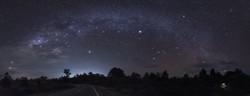
الشرح: Honourable mention in the 2022 IAU OAE Astrophotography Contest, category Still images of celestial patterns.
Taken in March 2016 in Bromo-Tengger-Semeru National Park, Java Island, Indonesia, this image shows the arch of the Milky Way and many prominent constellations, including many of the brightest stars in the night sky.
In the lower-left corner, we see Rigil Kentaurus and Hadar, the first one lower and the other higher up, both located in the large constellation Centaurus. As pointers they point towards Crux, the Southern Cross, whose long axis points towards the southern pole, which is located roughly at the horizon because the Island of Java is almost at the equator. Crux is almost entirely obscured by clouds, with only the four bright stars visible in the photograph. Confusingly, the asterism of the False Cross (consisting of stars in Argo, The Ship) is clearly prominent a bit further up the Milky Way.
The pinkish spot between the true and the False Cross is the Carina Nebula, located about 8500 light-years from Earth, in the constellation Carina, and invisible to the unaided eye. In Carina we can also find Canopus, the second-brightest star in the night sky, seen just below the Galaxy and above the road on the ground.
Even brighter is Sirius, the brightest star in the night sky. Sirius lies in the constellation Canis Major, The Great Dog, one of the dogs that follow Orion, the Hunter, who is depicted in the right half of this image, just above the clouds at the horizon. Orion’s Belt of three bright stars points to Sirius in the upper left and to Aldebaran in the lower right, just above the horizon.
Orion contains some of the brightest stars in the sky, making it the most colourful constellation as it hosts Rigel, the bright bluish star below the Galaxy toward the right, and Betelgeuse, the reddish bright star higher up and to the right of Rigel. Between them we find the three stars that comprise the belt of Orion, a famous asterism. Just next to the belt we find the Great Orion Nebula, a star-forming region whose bright centre is visible to the unaided eye and also in this image.
Above Betelgeuse but on the opposite side of the Galaxy, we see the bright star Procyon, whose name means literally “Before the Dog”. It is mythologically often considered a tiny one-star dog asterism accompanying Orion, and transformed into the modern constellation of Canis Minor.
In the upper-right corner, the Beehive Star Cluster in the constellation Cancer is easily recognisable. Below it, we find the constellation Gemini with the stars Pollux and Castor, which are not prominent in this image. In contrast, the bright white star Capella in the constellation Auriga, the Charioteer, shines through the clouds at the middle-right edge of the image.
Some light pollution is visible along the road.
المصدر: Giorgia Hofer/IAU OAE
مصطلحات المعجم:
مجموعة نجمية او حشد نجمى , الجوزاء , درب التبانة , الصليب الجنوبي , كوكبة السرطان , الجَبّار , رجل القنطور
فئات:
درب التبانة والوسط بين النجمي
, علم الفلك بالعين المجردة
الترخيص: المشاع الإبداعي نَسب المُصنَّف 4.0 دولي (CC BY 4.0) المشاع الإبداعي نَسب المُصنَّف 4.0 دولي (CC BY 4.0) أيقونات
هذا الملف على Zenodo ( صورة 12.70 MB)


