المستندات والموارد - نتائج البحث
نتائج البحث
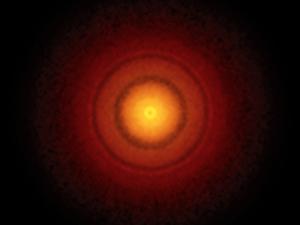
Planet formation around the star TW Hydrae
صورة
الشرح: This image shows the disk around the young star TW Hydrae. This star is only about 10 million years old, young enough that planets are still forming in a disk of gas and dust around it. This image was created using an array of submillimetre telescopes, each of which looks like a satellite dish. The signals from these telescopes were combined by a central processing computer to make this image. The lighter and darker patches show areas of the disk where there is more or less dust respectively. The dark rings and bright rings are evidence that the dust in the disk has been shepherded into some orbits and away from others. This is likely because there is one or more planets that are still forming hidden in the disk.
The whole image shows the disk around TW Hydrae out to a distance of about 70 astronomical units frm the central star. The two outer dark rings are separated from the central star by approximately the average distance between the Sun and Uranus and the average distance between the Sun and Pluto. The inner central hole appears to have been carved out by a planet orbiting TW Hydrae at a distance similar to the distance between the Earth and the Sun.
المصدر: S. Andrews (Harvard-Smithsonian CfA); B. Saxton (NRAO/AUI/NSF); ALMA (ESO/NAOJ/NRAO)
رابط المصدر
مصطلحات المعجم:
تكوُّن الكواكب
فئات:
الكواكب الخارجية وعلم الأحياء الفلكية
الترخيص: المشاع الإبداعي نَسب المُصنَّف 4.0 دولي (CC BY 4.0) المشاع الإبداعي نَسب المُصنَّف 4.0 دولي (CC BY 4.0) أيقونات
ملف
( صورة
210.48 kB)
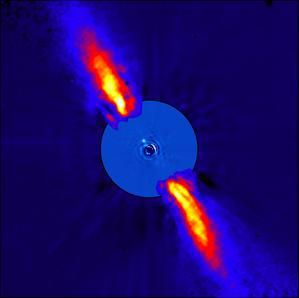
beta Pictoris b
صورة
الشرح: This composite of two images shows the planet beta Pictoris b and a disk of material both of which orbit the young star beta Pictoris. Both are taken in infrared light. The inner image was one of the first pictures taken of a planet around another star (an exoplanet). This image was made using a technique called adaptive optics which removes the blurring effect of the Earth's atmosphere that spreads out a star's light. The star's light is then concentrated tightly enough that it can be hidden behind a blocking circle (shown here in black) called a coronagraph. The ripples around this are artifacts of the imaging process. Beta Pictoris b, a gas giant planet about twelve times the mass of Jupiter, appears as a dot above and to the left of the black circle.
The outer image shows the thermal emission from the warm disk of material surrounding the young star beta Pictoris. As we are viewing this disk edge-on it appears as a line. This disk of gas and dust provided the material to form beta Pictoris b.
المصدر: ESO/A.-M. Lagrange et al.
رابط المصدر
مصطلحات المعجم:
الكوكب الخارجي , تكوُّن الكواكب , البصريات المكيفة
فئات:
الكواكب الخارجية وعلم الأحياء الفلكية
الترخيص: المشاع الإبداعي نَسب المُصنَّف 4.0 دولي (CC BY 4.0) المشاع الإبداعي نَسب المُصنَّف 4.0 دولي (CC BY 4.0) أيقونات
ملف
( صورة
128.05 kB)

The planet PDS 70b inside a protoplanetary disk
صورة
الشرح: An image of the planet PDS 70b. The young star PDS 70b has a protoplanetary disk surrounding it. Disks like these contains gas, fine sandy particles that astronomers refer to as dust and also larger bodies ranging from objects the size of pebbles to protoplanets (planets that are still forming).
This image was taken in infrared light using adaptive optics. Adaptive optics is a technique that uses flexible mirrors and computer analysis to remove the blurring effect of the Earth's atmosphere. This allows astronomers to search regions close to stars like PDS 70 that would otherwise be swamped by light from the star spread out by the Earth's atmosphere. In the center is a black circle. This is caused by a coronograph, a small circle that blocks out light from the parent star. This is surrounded by a bright oval, infrared light emitted from the material in the protoplanetary disk. To the right of the black circle covering the star is a bright dot. This is PDS 70b, a giant planet that is still forming .
المصدر: ESO/ A. Müller, MPIA
رابط المصدر
مصطلحات المعجم:
تكوُّن الكواكب , الكوكب الأوّلي , القرص الكوكبي الأولي , البصريات المكيفة
فئات:
الكواكب الخارجية وعلم الأحياء الفلكية
الترخيص: المشاع الإبداعي نَسب المُصنَّف 4.0 دولي (CC BY 4.0) المشاع الإبداعي نَسب المُصنَّف 4.0 دولي (CC BY 4.0) أيقونات
ملف
( صورة
1.59 MB)

The Rotating Planet
فيديو
أُنشئ لصالح OAE
الشرح: Second place winner in the 2023 IAU OAE Astrophotography Contest, category of Time-lapses of rotation of Big Dipper or Southern Cross.
A cosmic journey unfolds across continents in this time-lapse video which captures both iconic constellations from diverse corners of the world. Starting in China, the Big Dipper graces the night sky, a steadfast guide embedded in cultural narratives. Its luminance marks the beginning of this celestial odyssey. The two pointer stars on the end of the Big Dipper point to the North Star (Polaris) which appears to remain stationary as the sky rotates. From Nepal’s lofty peaks, the Big Dipper’s familiarity persists, a reliable fixture in the shifting panorama of the rotating planet. Moving to Chile, the Southern Cross adorns the firmament, emblematic of the southern skies. Frames from Chile showcase this constellation accompanied by the Milky Way Galaxy. In Namibia, a telescope from the H.E.S.S. Observatory appears in the video. Later, nestled beneath sheltering trees, the Big Dipper persists in its celestial prominence, appearing against a canvas of stars. Using varied techniques — fisheye lenses, static cameras, and Earth's movement-tracking — each frame unveils the Cross’s grandeur against diverse landscapes. These sequences — marked by star trails and Earth’s rotation—highlight the enduring presence of the Big Dipper and Southern Cross, bridging cultures and celestial beauty across hemispheres.
المصدر: Jianfeng Dai/IAU OAE (CC BY 4.0)
مصطلحات المعجم:
المغرفة الكبرى , القطب السماوى , القبة السماوية , دوران الأرض , القطب السماوي الشمالي , النجم القطبي , الصليب الجنوبي , القطب السماوي الجنوبي (SCP)
فئات:
علم الفلك بالعين المجردة
وسوم:
astrophotography
الترخيص: المشاع الإبداعي نَسب المُصنَّف 4.0 دولي (CC BY 4.0) المشاع الإبداعي نَسب المُصنَّف 4.0 دولي (CC BY 4.0) أيقونات
هذا الملف على Zenodo ( فيديو 863.53 MB)
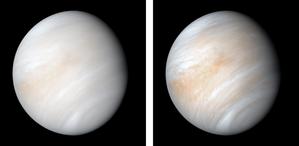
Venus in visible light
صورة
الشرح: This picture taken by NASA's Mariner 10 probe shows what the planet Venus looks like when looking at it with naked eyes. Venus is enshrouded inside a thick cloudy atmosphere dominated by carbon dioxide, never revealing its hot surface.
المصدر: NASA/JPL-Caltech
رابط المصدر
مصطلحات المعجم:
الكوكب , كوكب أرضي , كوكب الزهرة , الكوكب الداخلي
فئات:
النظام الشمسي
الترخيص: الملكية العامة الملكية العامة أيقونات
ملف
( صورة
94.31 kB)





