المستندات والموارد - نتائج البحث
نتائج البحث

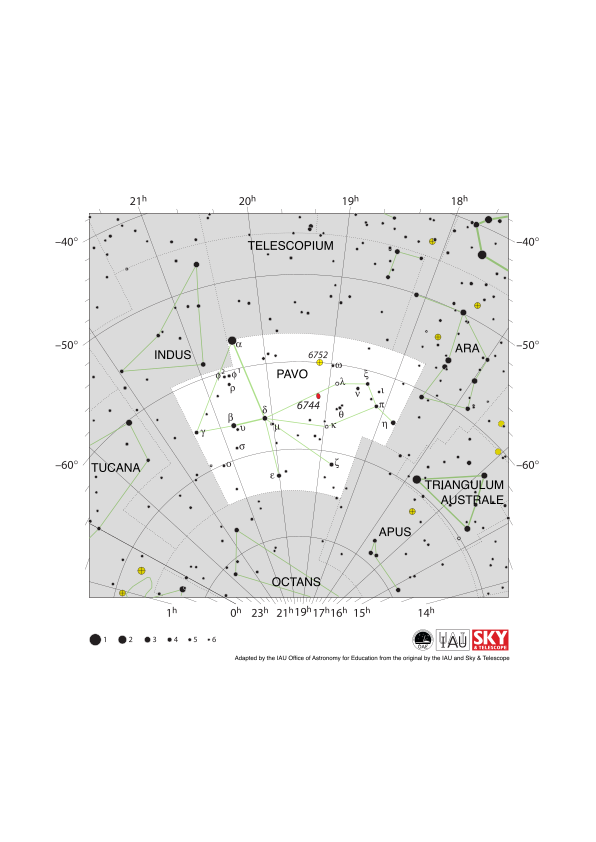
Pavo Constellation Map
صورة
الشرح: The constellation Pavo with its bright stars and surrounding constellations. Pavo is surrounded by (going clockwise from the top): Telescopium, Ara, Apus, Octans and Indus.
Pavo is a southern constellation and thus the whole constellation is visible at some point in the year throughout the southern hemisphere. The whole constellation is also visible in some equatorial regions of the northern hemisphere with parts of the constellation visible in the remaining northern equatorial regions. Pavo is circumpolar in antarctic and most temperate regions of the southern hemisphere. The constellation is best viewed in the evening in the northern hemisphere summer and southern hemisphere winter.
The globular cluster NGC 6752 lies in Pavo and is marked here with a yellow circle with a plus sign superimposed on it.
The y-axis of this diagram is in degrees of declination with north as up and the x-axis is in hours of right ascension with east to the left. The sizes of the stars marked here relate to the star's apparent magnitude, a measure of its apparent brightness. The larger dots represent brighter stars. The Greek letters mark the brightest stars in the constellation. These are ranked by brightness with the brightest star being labeled alpha, the second brightest beta, etc., although this ordering is not always followed exactly. The dotted boundary lines mark the IAU's boundaries of the constellations and the solid green lines mark one of the common forms used to represent the figures of the constellations. Neither the constellation boundaries, nor the lines joining the stars appear on the sky.
المصدر: Adapted by the IAU Office of Astronomy for Education from the original by the IAU and Sky & Telescope
رابط المصدر
مصطلحات المعجم:
القدرالظاهري , الإحداثيات السماوية , النجوم القطبية , مجموعة نجمية او حشد نجمى , الميل , العنقود النجمي الكروي , المطلع المستقيم
فئات:
علم الفلك بالعين المجردة
الترخيص: المشاع الإبداعي نَسب المُصنَّف 4.0 دولي (CC BY 4.0) المشاع الإبداعي نَسب المُصنَّف 4.0 دولي (CC BY 4.0) أيقونات
ملف
( صورة
128.18 kB)
ملف PDF
(PDF file
188.85 kB)
خريطة كوكبة آرا او المجمرة
الشرح: كوكبة آرا مع نجومها اللامعة والكوكبات المحيطة بها. آرا محاطة بـ (في اتجاه عقارب الساعة من الأعلى) سكوربيوس، ونورما، وتريانجولوم أوسترال، وأبوس، وبافو، وتيليسكوبيوم، وكورونا أوستراليس.
وكوكبة آرا هي كوكبة جنوبية يمكن رؤيتها من نصف الكرة الجنوبي بأكمله في وقت ما من السنة ويمكن رؤيتها من المنطقة الاستوائية مع أجزاء من الكوكبة مرئية من بعض الأجزاء المعتدلة من نصف الكرة الشمالي. من الأفضل مشاهدتها في المساء في صيف نصف الكرة الشمالي وشتاء نصف الكرة الجنوبي.
تقع مجموعتا العناقيد الكروية NGC 6352 و NGC 6397 في آرا. وقد تم تمييزها هنا بدوائر صفراء مع رموز زائد متراكبة عليها. يقع العنقود المفتوح NGC 6193 أيضاً في آرا، وقد تم تمييزه هنا بدائرة صفراء محجوبة جزئياً بنقطة تشير إلى ألمع عضو في العنقود الذي يمكن رؤيته بالعين المجردة في ظروف جيدة.
المحور y في هذا الرسم البياني يمثل المطلع المستقيم وهو الزاويه المحصوره بين الدائره الساعيه لجرم سماوى و الدائره الساعيه لنقطة الاعتدال الربيعى. المطلع المستقيم يقاس بالساعات ويمثل قوس دائره الاستواء السماويه من نقطه الاعتدال الربيعى الى نقطه تقاطع الدائره الساعيه لجرم سماوى مع دائره الاستواء السماويه.
والمحور X يمثل الميل و يقاس بالدرجات وهو قيمة الزاويه بين أى جسم سماوى و خط الاستواء السماوى. لو وقع النجم شمال خط الاستواء السماوى تكون قيمة الميل بالموجب ولو وقع النجم جنوب خط الاستواء السماوى تكون قيمة بالميل بالسالب.
يوضح الشكل أحجام النجوم المحددة هنا بالقدر الظاهري للنجم، وهو مقياس لسطوعه الظاهري. تمثل النقاط الأكبر حجماً النجوم الأكثر سطوعاً. تشير الحروف اليونانية إلى ألمع النجوم في الكوكبة. وهي مُرتَّبة حسب السطوع حيث يُسمَّى النجم الأكثر سطوعًا ألفا، وثاني ألمع نجم بيتا، إلخ، على الرغم من أن هذا الترتيب لا يُتَّبع دائمًا بدقة. تشير خطوط الحدود المنقطة إلى الحدود التي وضعها الاتحاد الفلكي الدولي للمجموعات النجمية والخطوط الخضراء المتصلة تشير إلى أحد الأشكال الشائعة المستخدمة لتمثيل أشكال المجموعات النجمية. وبالطبع فإن حدود الكوكبات و الخطوط التي تربط بين النجوم فى هذا الشكل لاتظهر على صفحة السماء.
المصدر: بتصرف من قبل مكتب الاتحاد الفلكي الدولي للاتحاد الفلكي الدولي للتعليم من النسخة الأصلية للاتحاد الفلكي الدولي/سكاي آند تليسكوب
رابط المصدر
مصطلحات المعجم:
القدرالظاهري , الإحداثيات السماوية , مجموعة نجمية او حشد نجمى , الميل , العنقود النجمي الكروي , المطلع المستقيم , كوكبة العقرب , العنقود المفتوح
فئات:
علم الفلك بالعين المجردة
الترخيص: المشاع الإبداعي نَسب المُصنَّف 4.0 دولي (CC BY 4.0) المشاع الإبداعي نَسب المُصنَّف 4.0 دولي (CC BY 4.0) أيقونات

Serpens Caput Constellation Map
صورة
الشرح: A map of part of the constellation Serpens. Serpens is unique amongst IAU constellations in that it is divided into two non-contiguous parts. The part of Serpens shown here is known as Serpens Caput, representing the head of the serpent. This part of Serpens is surrounded by (going clockwise from the top): Corona Borealis, Boötes, Virgo, Libra, Ophiuchus and Hercules.
Serpens Caput spans the celestial equator thus parts of the constellation are visible at some point in the year across the Earth. The whole constellation is visible to temperate and equatorial regions of the southern hemisphere and all of the northern hemisphere except a small region around the north pole. Serpens Caput is best viewed in the evening in the northern hemisphere summer and southern hemisphere winter.
The globular cluster M5 lies in Serpens Caput. It is marked here with a yellow circle with a plus sign superimposed on it.
The y-axis of this diagram is in degrees of declination with north as up and the x-axis is in hours of right ascension with east to the left. The sizes of the stars marked here relate to the star's apparent magnitude, a measure of its apparent brightness. The larger dots represent brighter stars. The Greek letters mark the brightest stars in the constellation. These are ranked by brightness with the brightest star being labeled alpha, the second brightest beta, etc., although this ordering is not always followed exactly. The dotted boundary lines mark the IAU's boundaries of the constellations and the solid green lines mark one of the common forms used to represent the figures of the constellations. Neither the constellation boundaries, nor the lines joining the stars appear on the sky.
المصدر: Adapted by the IAU Office of Astronomy for Education from the original by the IAU and Sky & Telescope
رابط المصدر
مصطلحات المعجم:
القدرالظاهري , الإحداثيات السماوية , خط الاستواء السماوي , مجموعة نجمية او حشد نجمى , الميل , العنقود النجمي الكروي , الميزان , المطلع المستقيم , العذراء
فئات:
علم الفلك بالعين المجردة
الترخيص: المشاع الإبداعي نَسب المُصنَّف 4.0 دولي (CC BY 4.0) المشاع الإبداعي نَسب المُصنَّف 4.0 دولي (CC BY 4.0) أيقونات
ملف
( صورة
97.60 kB)
ملف PDF
(PDF file
161.10 kB)

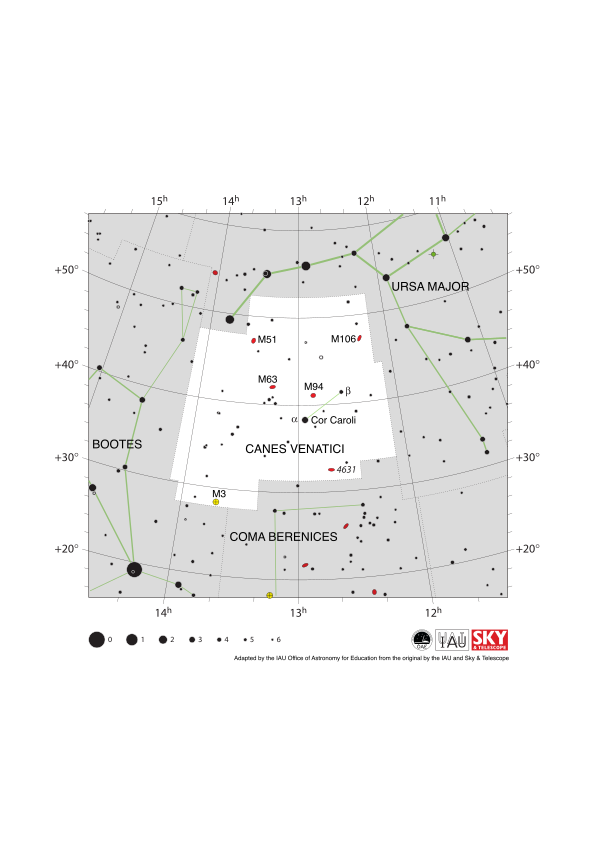
Canes Venatici Constellation Map
صورة
الشرح: The constellation Canes Venatici with its brighter stars and surrounding constellations. Canes Venatici is surrounded by (going clockwise from the top): Ursa Major, Coma Berenices and Boötes.
Canes Venatici is a northern constellation and thus the whole constellation is visible at some point in the year from the whole of the northern hemisphere. The whole of the constellation is also visible from equatorial regions of the southern hemisphere with parts of it visible from temperate southern regions. The constellation is best viewed in the northern hemisphere late spring and southern hemisphere late autumn.
The famous spiral galaxy commonly known as the Whirlpool Galaxy (M51) lies in Canes Venatici and is marked here with a red ellipse. Other notable spiral galaxies in the constellation include M63, M94, M106 and NGC 4631. All are marked here with red ellipses. The globular cluster M3 is marked here with a yellow circle with a plus symbol superimposed on it.
The y-axis of this diagram is in degrees of declination with north as up and the x-axis is in hours of right ascension with east to the left. The sizes of the stars marked here relate to the star's apparent magnitude, a measure of its apparent brightness. The larger dots represent brighter stars. The Greek letters mark the brightest stars in the constellation. These are ranked by brightness with the brightest star being labeled alpha, the second brightest beta, etc., although this ordering is not always followed exactly. The dotted boundary lines mark the IAU's boundaries of the constellations and the solid green lines mark one of the common forms used to represent the figures of the constellations. Neither the constellation boundaries, nor the lines joining the stars appear on the sky.
المصدر: Adapted by the IAU Office of Astronomy for Education from the original by the IAU and Sky & Telescope
رابط المصدر
مصطلحات المعجم:
القدرالظاهري , الإحداثيات السماوية , مجموعة نجمية او حشد نجمى , الميل , العنقود النجمي الكروي , المطلع المستقيم , المجرة الحلزونية
فئات:
علم الفلك بالعين المجردة
الترخيص: المشاع الإبداعي نَسب المُصنَّف 4.0 دولي (CC BY 4.0) المشاع الإبداعي نَسب المُصنَّف 4.0 دولي (CC BY 4.0) أيقونات
ملف
( صورة
93.71 kB)
ملف PDF
(PDF file
165.31 kB)
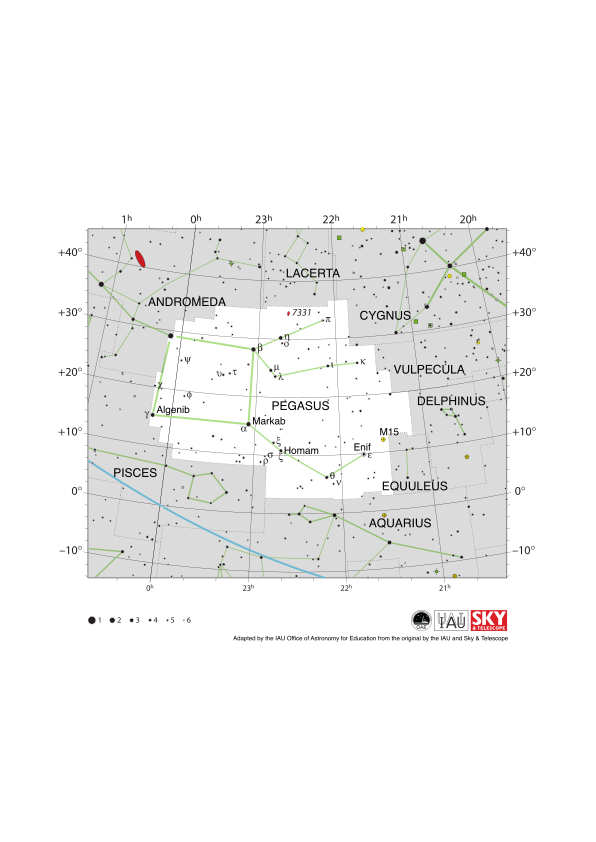
Pegasus Constellation Map
صورة
الشرح: The constellation Pegasus with its bright stars and surrounding constellations. Pegasus is surrounded by (going clockwise from the top): Lacerta, Cygnus, Vulpecula, Delphinus, Equuleus, Aquarius, Pisces and Andromeda. Pegasus is known for the prominent asterism the “Square of Pegasus” which consists of its three brightest stars plus the brightest star in Andromeda.
Pegasus is a northern constellation and thus the whole constellation is visible at some point in the year throughout the northern hemisphere. The whole constellation is also visible to southern hemisphere equatorial and temperate zones with parts of the constellation visible from all but the most antarctic regions. Pegasus is best viewed in the evening in the northern hemisphere autumn and southern hemisphere spring.
The globular cluster M15 lies in Pegasus and is marked here with a yellow circle with a plus sign superimposed on it. The spiral galaxy NGC 7331 also lies in Pegasus and is marked here with a red ellipse.
The y-axis of this diagram is in degrees of declination with north as up and the x-axis is in hours of right ascension with east to the left. The sizes of the stars marked here relate to the star's apparent magnitude, a measure of its apparent brightness. The larger dots represent brighter stars. The Greek letters mark the brightest stars in the constellation. These are ranked by brightness with the brightest star being labeled alpha, the second brightest beta, etc., although this ordering is not always followed exactly. The dotted boundary lines mark the IAU's boundaries of the constellations and the solid green lines mark one of the common forms used to represent the figures of the constellations. The blue line at the bottom of the diagram marks the ecliptic. Neither the constellation boundaries, nor the lines joining the stars, nor the ecliptic, appear on the sky.
المصدر: Adapted by the IAU Office of Astronomy for Education from the original by the IAU and Sky & Telescope
رابط المصدر
مصطلحات المعجم:
المرأة المسلسلة , القدرالظاهري , الإحداثيات السماوية , مجموعة نجمية او حشد نجمى , الميل , مسار البروج , العنقود النجمي الكروي , برج الحوت , المطلع المستقيم , المجرة الحلزونية , الدلو , المجمة
فئات:
علم الفلك بالعين المجردة
الترخيص: المشاع الإبداعي نَسب المُصنَّف 4.0 دولي (CC BY 4.0) المشاع الإبداعي نَسب المُصنَّف 4.0 دولي (CC BY 4.0) أيقونات
ملف
( صورة
122.04 kB)
ملف PDF
(PDF file
213.33 kB)