المستندات والموارد - نتائج البحث
نتائج البحث
Camelopardalis Constellation Map
صورة
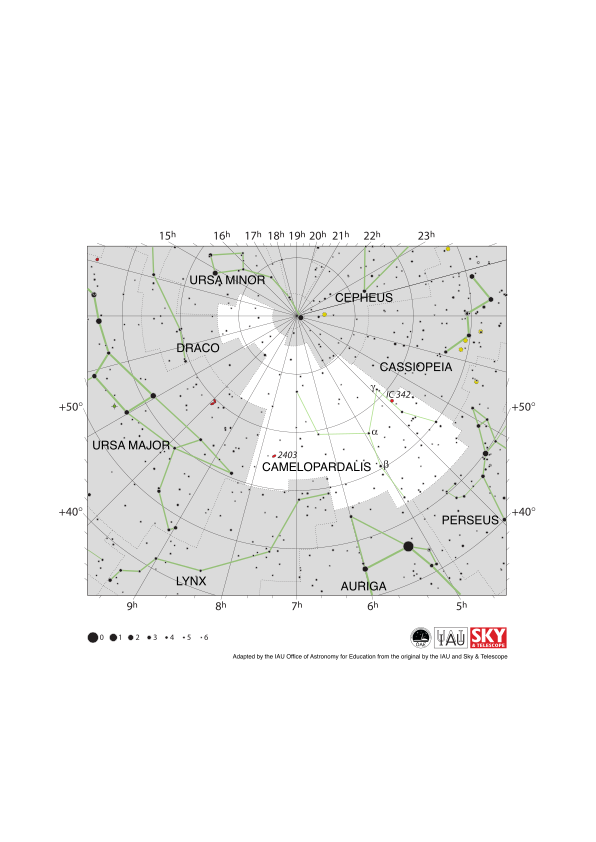
الشرح: The constellation Camelopardalis with its bright stars and surrounding constellations. Camelopardalis is surrounded by (going clockwise from the top): Cepheus, Cassiopea, Perseus, Auriga, Lynx, Ursa Major, Draco and Ursa Minor. Camelopardalis is a large constellation but contains relatively few bright stars.
Camelopardalis is a northern constellation and as such the whole constellation is visible for the whole northern hemisphere at some point in the year. It is also visible from equatorial parts of the southern hemisphere with some parts visible to temperate southern regions. The whole constellation is circumpolar for all arctic and more northerly temperate regions of the northern hemisphere. Camelopardalis is best viewed in the evening in the late northern hemisphere winter and late southern hemisphere summer.
The spiral galaxies NGC 2403 and IC 342 lie in Camelopardalis and are marked here with red ellipses.
This diagram maps an area around the north celestial pole. Here lines of constant right ascension converge. The right ascension values of these lines are marked on the x-axis above and below the diagram. Some of the lines of constant declination are marked on the y-axis. The sizes of the stars marked here relate to the star's apparent magnitude, a measure of its apparent brightness. The larger dots represent brighter stars. The Greek letters mark the brightest stars in the constellation. These are ranked by brightness with the brightest star being labeled alpha, the second brightest beta, etc., although this ordering is not always followed exactly. The dotted boundary lines mark the IAU's boundaries of the constellations and the solid green lines mark one of the common forms used to represent the figures of the constellations. Neither the constellation boundaries, nor the lines joining the stars appear on the sky.
المصدر: Adapted by the IAU Office of Astronomy for Education from the original by the IAU and Sky & Telescope
رابط المصدر
مصطلحات المعجم:
القدرالظاهري , الإحداثيات السماوية , النجوم القطبية , مجموعة نجمية او حشد نجمى , الميل , القطب السماوي الشمالي , المطلع المستقيم , المجرة الحلزونية
فئات:
علم الفلك بالعين المجردة
الترخيص: المشاع الإبداعي نَسب المُصنَّف 4.0 دولي (CC BY 4.0) المشاع الإبداعي نَسب المُصنَّف 4.0 دولي (CC BY 4.0) أيقونات
ملف
( صورة
138.40 kB)
ملف PDF
(PDF file
215.25 kB)

Seasons
صورة
أُنشئ لصالح OAE
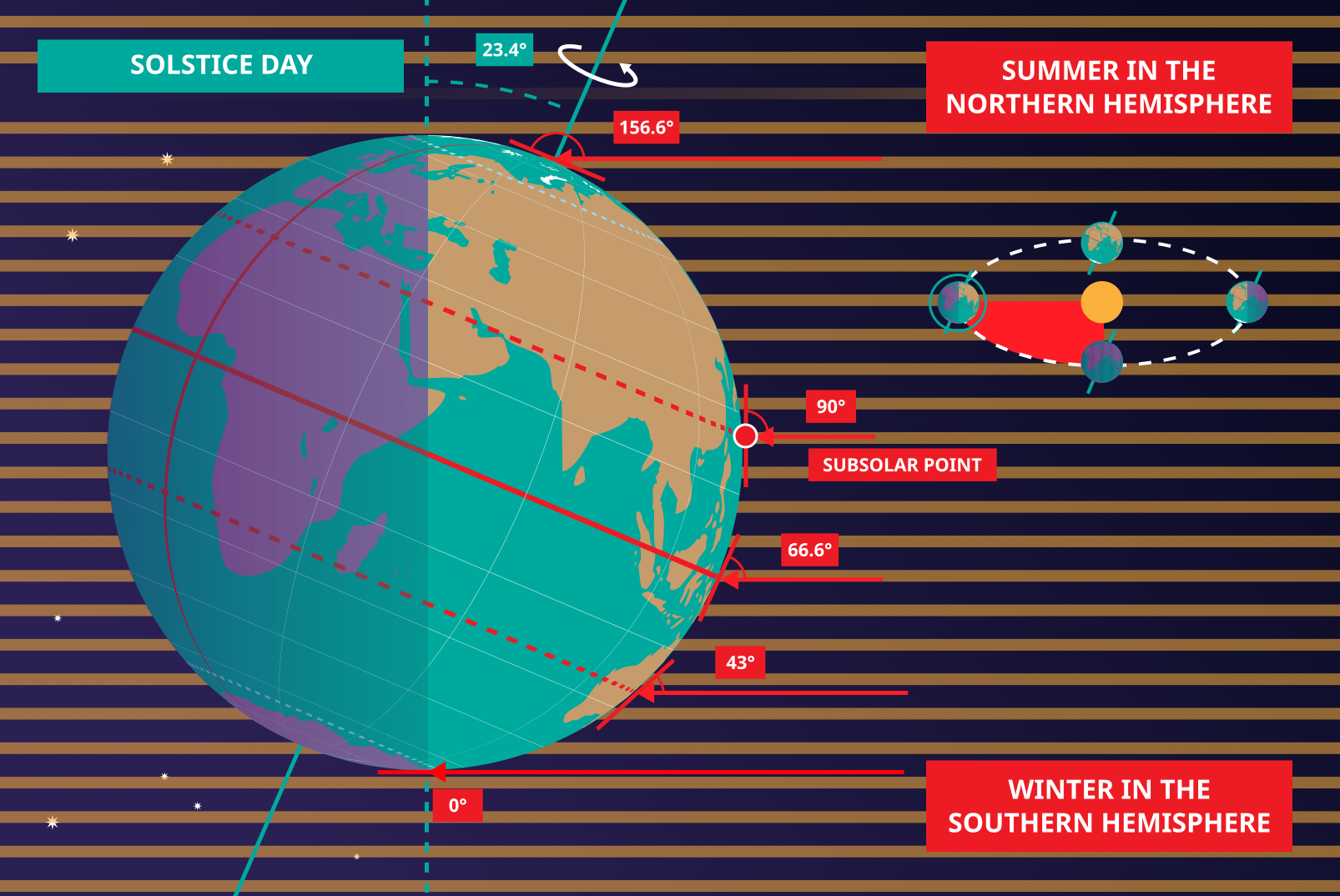
الشرح: This diagram shows the Earth at the June solstice which is known as the summer solstice in the Northern Hemisphere and the winter solstice in the Southern Hemisphere. The Earth’s axis of rotation is tilted from the axis of the Earth’s orbit around the Sun by 23.4°. Here we see light from the sun represented as parallel lines, in the diagram the Sun would lie far off the right-hand edge. Five lines are marked with angles. These lines hit the Earth at special latitudes. From top to bottom these lines hit the Earth at the North Pole, the Tropic of Cancer, the Equator, the Tropic of Capricorn and the Antarctic Circle. The lines are shown hitting the Earth at the longitude where it is currently noon. For the last four lines, the angles marked show the angle above the horizon (the altitude) which the Sun appears in the sky at at local noon.
At the June solstice, the Sun will appear directly overhead at local noon on every point on the Tropic of Capricorn. By contrast the Sun reaches a maximum altitude of 0° at local noon on every point in the Antarctic Circle. This means the Sun never rises and every point south of the Antarctic Circle experiences a long Polar Night. By contrast the Sun never sets on this day north of the Arctic Circle and the regions here experience a Polar Day. The at the North Pole the Sun will remain at a constant altitude all day. This altitude will be the angle 180°-156.6° (23.4°).
The altitude the Sun appears at is important as it defines how spread out the Sun’s rays are on the Earth’s surface. Look at the thick, faint parallel lines in the background. Notice how at the Tropic of Cancer the area the lines intersect with the Earth’s surface perpendicularly and the line only covers a small part of the Earth’s surface. Now look at a line near the Tropic of Capricorn and see that this intersects with the Earth at a grazing angle and the line is spread out, covering a much wider area of the Earth’s surface. This means that a given amount of light from the Sun that hits the Tropic of Cancer is more concentrated and the same amount of light hitting the Tropic of Capricorn would be more spread out. This leads to more energy per unit area from the Sun hitting the Tropic of Cancer and less energy per unit area hitting the Tropic of Capricorn. This means it will be warmer at the Tropic of Cancer than at the Tropic of Capricorn. It is thus summer at the Tropic of Cancer and winter at the Tropic of Capricorn.
Six months later this situation will be reversed and it will be summer at the Tropic of Capricorn and winter at the Tropic of Cancer.
المصدر: Maria Cristina Fortuna/IAU OAE
مصطلحات المعجم:
خط الاستواء , الانقلاب الشمسي , الانقلاب الصيفي , الشتاء , الانقلاب الشتوي , الدائرة القطبية الشمالية , الدائرة القطبية الجنوبية , مدار السرطان , مدار الجدي , القطب الشمالي
الترخيص: المشاع الإبداعي نَسب المُصنَّف 4.0 دولي (CC BY 4.0) المشاع الإبداعي نَسب المُصنَّف 4.0 دولي (CC BY 4.0) أيقونات
ملف
( صورة
1.09 MB)
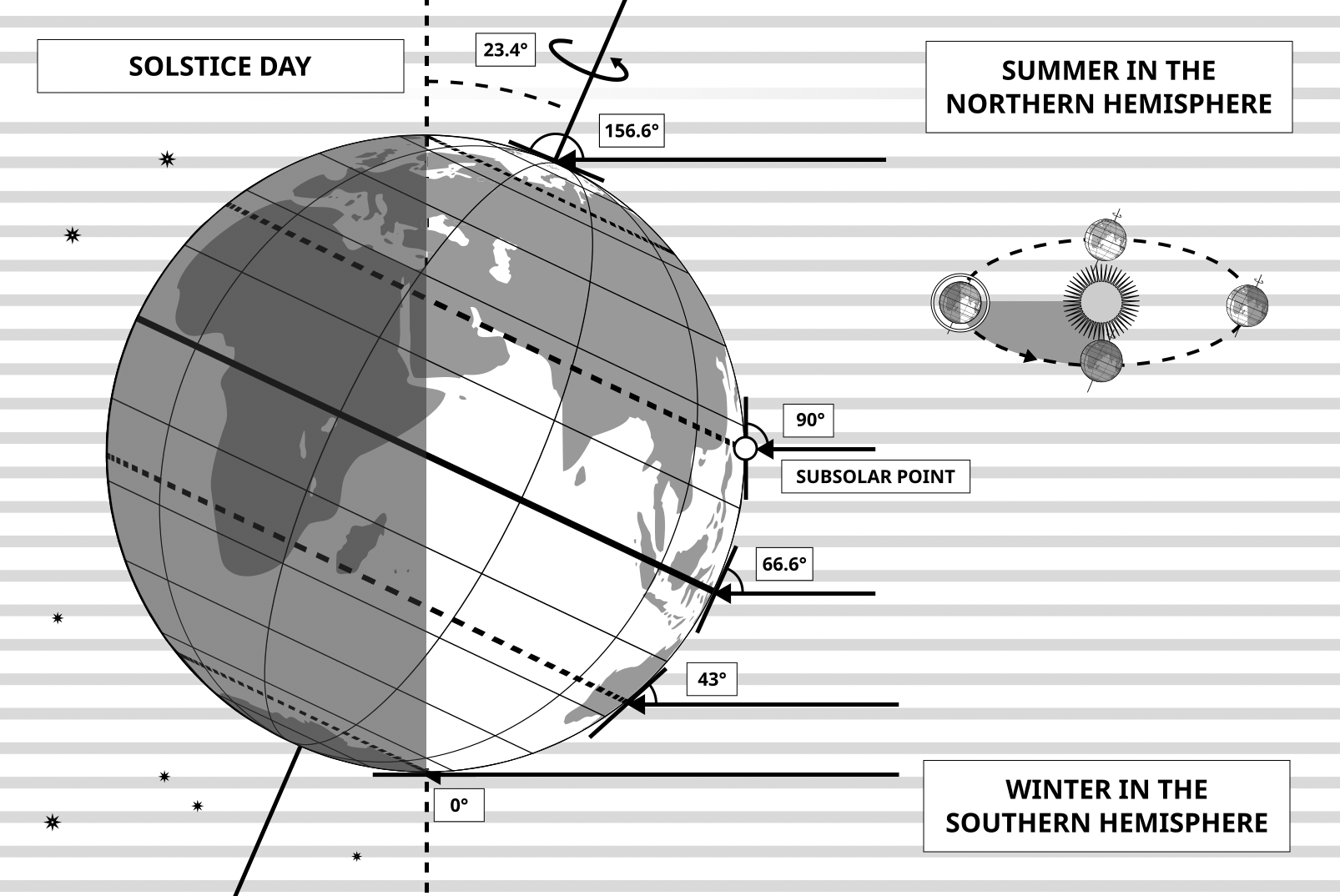
Also available in black and white
ملف
( صورة
400.17 kB)
ملف PDF
(
477.01 kB)
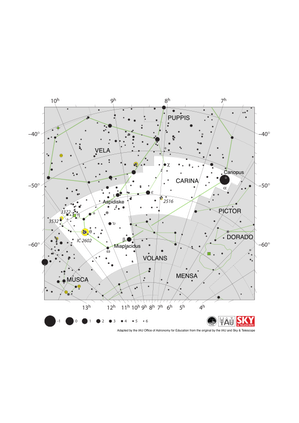
Carina Constellation Map
صورة
الشرح: The constellation Carina along with its bright stars and surrounding constellations. Carina is surrounded by (going clockwise from the top): Vela, Puppis, Pictor, Volans, Chamaeleon, Musca and Centaurus. Carina is notable for Canopus, the second brightest star in the night sky and for the famous variable star Eta Carinae. This latter object is a binary star system of two young very massive stars. Its brightness has varied greatly over the past few centuries. At one point it outshone Canopus before dimming by a factor of four thousand to become invisible to the naked eye. In recent years it has brightened enough to again be visible without the aid of a telescope.
Carina is a southern constellation and thus the whole constellation is visible at some point in the year to the entire southern hemisphere. The whole constellation is also visible from equatorial regions of the northern hemisphere with parts of the constellation visible from northern temperate regions.
The open clusters NGC 2516, NGC 3532 and IC 2602 lie in Carina. These are marked here by yellow circles. The Carina Nebula, also known as NGC 3372, lies in the constellation. This large nebula contains many massive young stars, including Eta Carinae.
This diagram maps an area around the south celestial pole. Here lines of constant right ascension converge. The right ascension values of these lines are marked on the x-axis above and below the diagram. Some of the lines of constant declination are marked on the y-axis. The sizes of the stars marked here relate to the star's apparent magnitude, a measure of its apparent brightness. The larger dots represent brighter stars. The Greek letters mark the brightest stars in the constellation. These are ranked by brightness with the brightest star being labeled alpha, the second brightest beta, etc., although this ordering is not always followed exactly. Carina was previously part of the larger Argo Navis constellation along with Vela and Puppis. As the letter designations for stars were created before this division took place, Greek letter designations are now divided between the three constellations with Carina having stars designated alpha and beta but no gamma or delta. The dotted boundary lines mark the IAU's boundaries of the constellations and the solid green lines mark one of the common forms used to represent the figures of the constellations. Neither the constellation boundaries, nor the lines joining the stars appear on the sky.
المصدر: Adapted by the IAU Office of Astronomy for Education from the original by the IAU and Sky & Telescope
رابط المصدر
مصطلحات المعجم:
القدرالظاهري , النجم المزدوج , الإحداثيات السماوية , مجموعة نجمية او حشد نجمى , الميل , السديم , المطلع المستقيم , العنقود المفتوح , النجم المتغير
فئات:
علم الفلك بالعين المجردة
الترخيص: المشاع الإبداعي نَسب المُصنَّف 4.0 دولي (CC BY 4.0) المشاع الإبداعي نَسب المُصنَّف 4.0 دولي (CC BY 4.0) أيقونات
ملف
( صورة
144.72 kB)
ملف PDF
(PDF file
214.81 kB)