المستندات والموارد - نتائج البحث
نتائج البحث

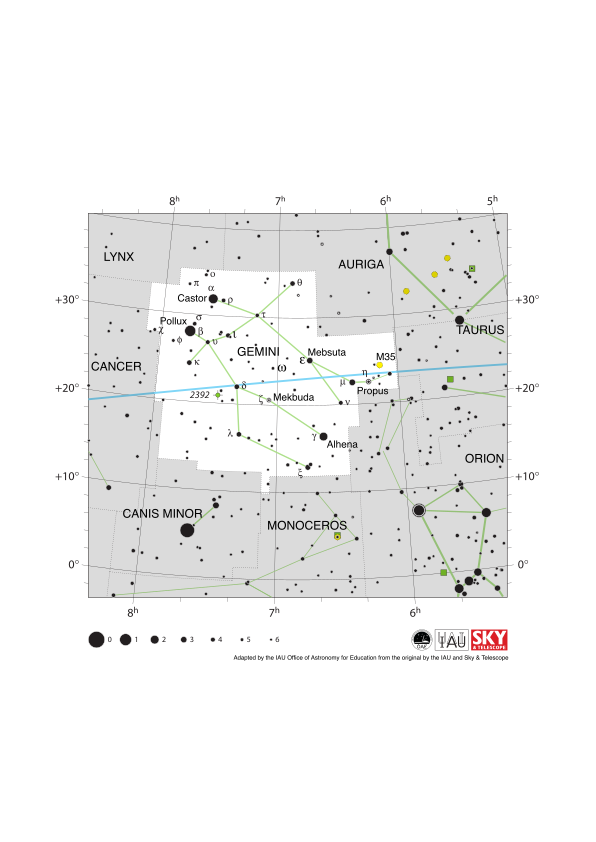
Gemini Constellation Map
صورة
الشرح: The zodiac constellation Gemini and its surrounding constellations. Starting from the top of the diagram and going clockwise, these are Auriga, Taurus, Lynx, Orion, Monoceros, Canis Minor and Cancer. The brightest stars in Gemini, Castor and Pollux appear in the upper lefthand corner (north-east) of the diagram. In Greek mythology, the stars in this constellation are thought to resemble twins with their arms wrapped around each other, with Castor and Pollux indicating their heads. Gemini lies on the ecliptic (shown here as a blue line), this is the path the Sun appears to take across the sky over the course of a year. The Sun is in Gemini from late June to late July. The other planets of the Solar System can often be found in Gemini.
Gemini lies north of the celestial equator and is visible in all but the antarctic regions of the world. Gemini is most visible in the evenings in the northern hemisphere winter and southern hemisphere summer.
Just to the right of the foot of the Castor twin is an open cluster of stars (labelled as a yellow circle with a dotted line border), Messier 35, also known as the Shoe-Buckle Cluster. This cluster is spread out over an area roughly the size of the full moon. In addition to this cluster of stars, there is a planetary nebula (labelled as a green circle with four radial spikes) – NGC 2392 – near the celestial equator and just to the left of the Pollux twin. Two variable stars (Mekbuda and Propus; labelled as two concentric circles) can be found in the “legs” of each twin, but are so faint that an observer would need dark skies to see them.
The y-axis of this diagram is in degrees of declination with north as up and the x-axis is in hours of right ascension with east to the left. The sizes of the stars marked here relate to the star's apparent magnitude, a measure of its apparent brightness. The larger dots represent brighter stars. The Greek letters mark the brightest stars in the constellation. These are ranked by brightness with the brightest star being labelled alpha, the second brightest beta, etc., although this ordering is not always followed exactly. The dotted boundary lines mark the IAU's boundaries of the constellations and the solid green lines mark one of the common forms used to represent the figures of the constellations. Neither the constellation boundaries, nor the line marking the ecliptic, nor the lines joining the stars appear on the sky.
المصدر: Adapted by the IAU Office of Astronomy for Education from the original by IAU/Sky & Telescope
رابط المصدر
مصطلحات المعجم:
القدرالظاهري , الإحداثيات السماوية , مجموعة نجمية او حشد نجمى , الميل , مسار البروج , الجوزاء , المطلع المستقيم , برج الثور , دائرة البروج
فئات:
علم الفلك بالعين المجردة
الترخيص: المشاع الإبداعي نَسب المُصنَّف 4.0 دولي (CC BY 4.0) المشاع الإبداعي نَسب المُصنَّف 4.0 دولي (CC BY 4.0) أيقونات
ملف
( صورة
111.96 kB)
ملف PDF
(PDF file
187.83 kB)

Equuleus Constellation Map
صورة
الشرح: The constellation Equuleus with its brighter stars and surrounding constellations. Equuleus is surrounded by (going clockwise from the top): Delphinus, Aquarius and Pegasus. It is a relatively small constellation with few bright stars.
Equuleus lies just north of the celestial equator and thus the whole constellation is visible at some point in the year to all but the most antarctic regions. Equuleus is best viewed in the evening in the early northern hemisphere autumn and early southern hemisphere spring.
The y-axis of this diagram is in degrees of declination with north as up and the x-axis is in hours of right ascension with east to the left. The sizes of the stars marked here relate to the star's apparent magnitude, a measure of its apparent brightness. The larger dots represent brighter stars. The Greek letters mark the brightest stars in the constellation. These are ranked by brightness with the brightest star being labeled alpha, the second brightest beta, etc., although this ordering is not always followed exactly. The dotted boundary lines mark the IAU's boundaries of the constellations and the solid green lines mark one of the common forms used to represent the figures of the constellations. Neither the constellation boundaries, nor the lines joining the stars appear on the sky.
المصدر: Adapted by the IAU Office of Astronomy for Education from the original by the IAU and Sky & Telescope
رابط المصدر
مصطلحات المعجم:
القدرالظاهري , الإحداثيات السماوية , مجموعة نجمية او حشد نجمى , الميل , المطلع المستقيم , الدلو
فئات:
علم الفلك بالعين المجردة
الترخيص: المشاع الإبداعي نَسب المُصنَّف 4.0 دولي (CC BY 4.0) المشاع الإبداعي نَسب المُصنَّف 4.0 دولي (CC BY 4.0) أيقونات
ملف
( صورة
61.60 kB)
ملف PDF
(PDF file
143.63 kB)

Mensa Constellation Map
صورة
الشرح: The constellation Mensa with its brighter stars and surrounding constellations. Mensa is surrounded by (going clockwise from the top): Dorado, Hydrus, Octans, Chamaeleon and Volans. Mensa is a faint constellation with relatively few bright stars.
Mensa lies close to the south celestial pole and thus the whole constellation is visible at some point in the year throughout the southern hemisphere. The whole constellation is visible to a thin strip of the northern hemisphere around the equator with parts of the constellation visible to some other northern equatorial regions. Mensa is circumpolar in temperate, antarctic and some equatorial regions of the southern hemisphere. Mensa is best viewed in the evenings in the northern hemisphere winter and southern hemisphere summer.
The Large Magellanic Cloud (LMC), a satellite galaxy of the Milky Way, lies in Mensa and the neighboring constellation Dorado. The outline of the Large Magellanic Cloud is marked here as a roughly circular loop in green.
This diagram maps an area around the south celestial pole. Here lines of constant right ascension converge. The right ascension values of these lines are marked on the x-axis above and below the diagram. The solid circle around the pole marks a line of -80° declination with the larger, incomplete circle to the right marking -70° declination. The sizes of the stars marked here relate to the star's apparent magnitude, a measure of its apparent brightness. The larger dots represent brighter stars. The Greek letters mark the brightest stars in the constellation. These are ranked by brightness with the brightest star being labeled alpha, the second brightest beta, etc., although this ordering is not always followed exactly. The dotted boundary lines mark the IAU's boundaries of the constellations and the solid green lines mark one of the common forms used to represent the figures of the constellations. Neither the constellation boundaries, nor the lines joining the stars appear on the sky.
المصدر: Adapted by the IAU Office of Astronomy for Education from the original by the IAU and Sky & Telescope
رابط المصدر
مصطلحات المعجم:
القدرالظاهري , الإحداثيات السماوية , مجموعة نجمية او حشد نجمى , الميل , المطلع المستقيم
فئات:
علم الفلك بالعين المجردة
الترخيص: المشاع الإبداعي نَسب المُصنَّف 4.0 دولي (CC BY 4.0) المشاع الإبداعي نَسب المُصنَّف 4.0 دولي (CC BY 4.0) أيقونات
ملف
( صورة
135.16 kB)
ملف PDF
(PDF file
172.00 kB)
Canis Minor Constellation Map
صورة
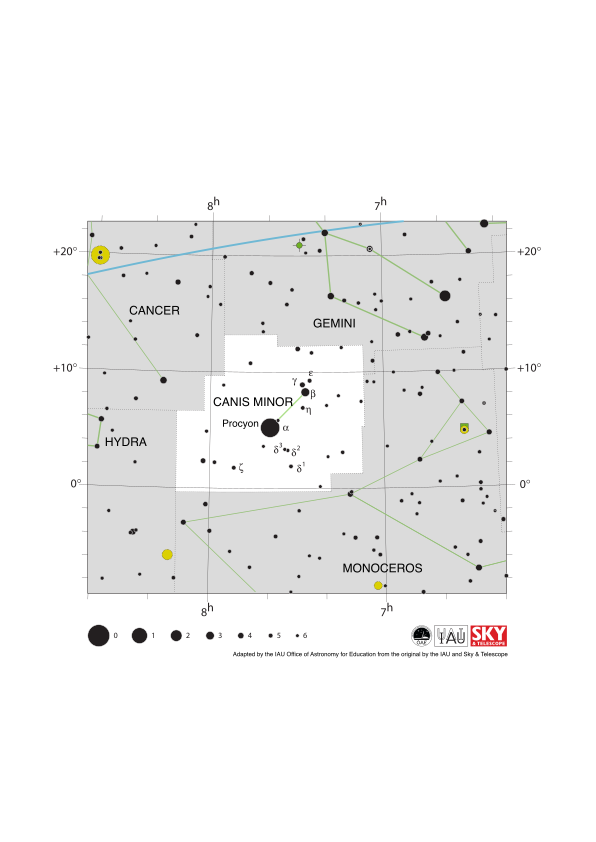
الشرح: The constellation Canis Minor with its bright stars and surrounding constellations. Canis Minor is surrounded by (going clockwise from the top): Gemini, Monoceros, Hydra and Cancer. Canis Minor has relatively few bright stars but its brightest star Procyon is the eight brightest star in the sky.
Canis Minor spans the celestial equator and thus part of the constellation is visible from the whole Earth at some point during the year. The whole constellation is visible to all but the most arctic and antarctic regions.
The y-axis of this diagram is in degrees of declination with north as up and the x-axis is in hours of right ascension with east to the left. The sizes of the stars marked here relate to the star's apparent magnitude, a measure of its apparent brightness. The larger dots represent brighter stars. The Greek letters mark the brightest stars in the constellation. These are ranked by brightness with the brightest star being labeled alpha, the second brightest beta, etc., although this ordering is not always followed exactly. The dotted boundary lines mark the IAU's boundaries of the constellations and the solid green lines mark one of the common forms used to represent the figures of the constellations. The blue line in the top right of the diagram marks the ecliptic. Neither the constellation boundaries, nor the line marking the ecliptic, nor the lines joining the stars appear on the sky.
المصدر: Adapted by the IAU Office of Astronomy for Education from the original by the IAU and Sky & Telescope
رابط المصدر
مصطلحات المعجم:
القدرالظاهري , الإحداثيات السماوية , خط الاستواء السماوي , مجموعة نجمية او حشد نجمى , الميل , مسار البروج , المطلع المستقيم
فئات:
علم الفلك بالعين المجردة
الترخيص: المشاع الإبداعي نَسب المُصنَّف 4.0 دولي (CC BY 4.0) المشاع الإبداعي نَسب المُصنَّف 4.0 دولي (CC BY 4.0) أيقونات
ملف
( صورة
76.24 kB)
ملف PDF
(PDF file
153.55 kB)
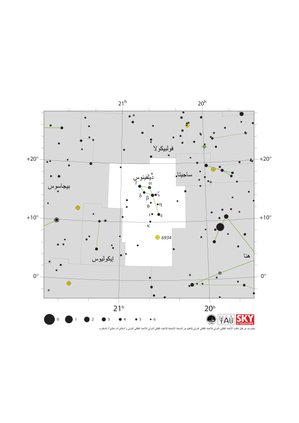
خريطة كوكبة الدلفين
صورة
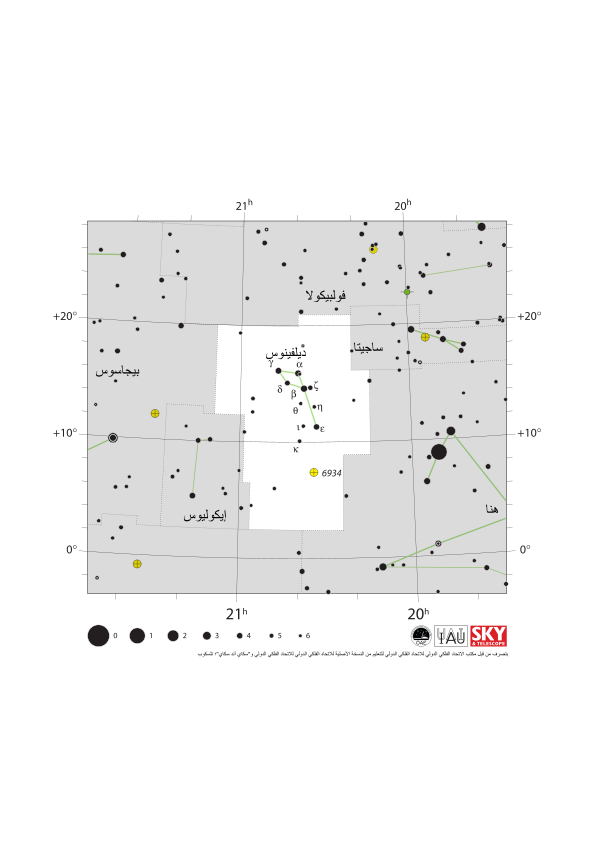
الشرح: كوكبة الدلفين مع نجومها الأكثر إشراقاً والكوكبات المحيطة بها. يحيط بكوكبة الدلفين (في اتجاه عقارب الساعة من الأعلى): فولبيكولا، ساجيتا، أكيلا، أكويلا، أكواريوس، إيكوليوس وبيجاسوس. وتعتبر الدلفين كوكبة صغيرة نسبياً مع عدد قليل من النجوم اللامعة.
تقع كوكبة الدلفين شمال خط الاستواء السماوي، وبالتالي فإن الكوكبة بأكملها مرئية في وقت ما من السنة في جميع المناطق باستثناء المناطق القطبية. من الأفضل مشاهدة الكوكبة في المساء في أوائل الخريف في نصف الكرة الشمالي وأوائل الربيع في نصف الكرة الجنوبي.
يقع الحشد النجمى الكوري NGC 6934 في الدلفين. وقد تم تمييزه هنا بدائرة صفراء عليها علامة زائد.
المحور y في هذا الرسم البياني مقيس بدرجات الانحراف مع وضع الشمال في الأعلى والمحور x مقيس بساعات الصعود إلى اليمين مع وضع الشرق إلى اليسار. ترتبط أحجام النجوم المُحدَّدة هنا بالقدر الظاهري للنجم، وهو مقياس لسطوعه الظاهري. تمثل النقاط الأكبر حجماً النجوم الأكثر سطوعاً. تشير الحروف اليونانية إلى ألمع النجوم في الكوكبة. وهي مُرتَّبة حسب السطوع حيث يُسمَّى النجم الأكثر سطوعًا ألفا، وثاني ألمع نجم بيتا، إلخ، على الرغم من أن هذا الترتيب لا يُتَّبع دائمًا بدقة. تشير خطوط الحدود المنقطة إلى الحدود التي وضعها الاتحاد الفلكي الدولي للمجموعات النجمية والخطوط الخضراء الصلبة تشير إلى أحد الأشكال الشائعة المستخدمة لتمثيل أشكال المجموعات النجمية. لا تظهر حدود الكوكبات ولا الخطوط التي تربط بين النجوم على السماء.
المصدر: بتصرف من قبل مكتب الاتحاد الفلكي الدولي للاتحاد الفلكي الدولي للتعليم من النسخة الأصلية للاتحاد الفلكي الدولي والاتحاد الفلكي الدولي وسكاي آند تليسكوب
رابط المصدر
مصطلحات المعجم:
القدرالظاهري , الإحداثيات السماوية , خط الاستواء السماوي , مجموعة نجمية او حشد نجمى , الميل , العنقود النجمي الكروي , المطلع المستقيم , الدلو
فئات:
علم الفلك بالعين المجردة
الترخيص: المشاع الإبداعي نَسب المُصنَّف 4.0 دولي (CC BY 4.0) المشاع الإبداعي نَسب المُصنَّف 4.0 دولي (CC BY 4.0) أيقونات
ملف
( صورة
68.66 kB)
ملف PDF
(PDF file
162.12 kB)