المستندات والموارد - نتائج البحث
نتائج البحث

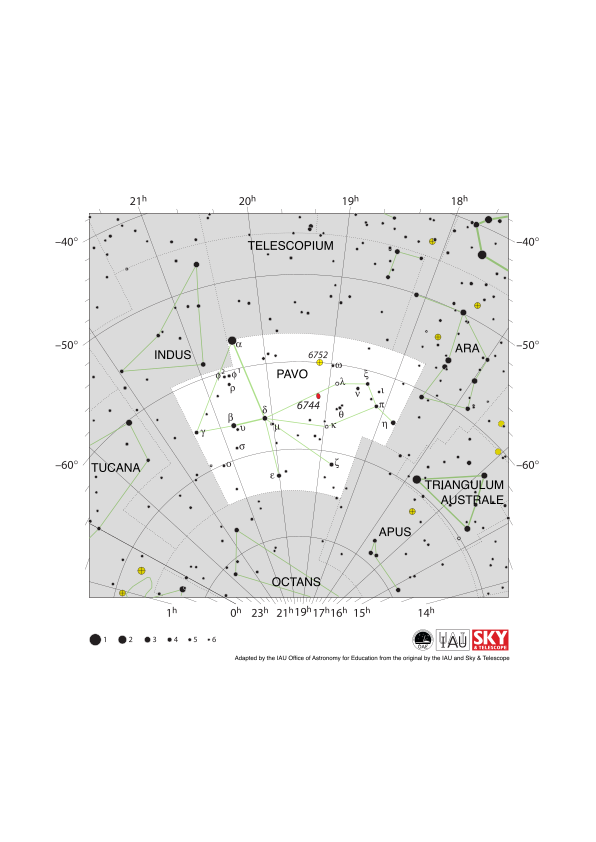
Pavo Constellation Map
صورة
الشرح: The constellation Pavo with its bright stars and surrounding constellations. Pavo is surrounded by (going clockwise from the top): Telescopium, Ara, Apus, Octans and Indus.
Pavo is a southern constellation and thus the whole constellation is visible at some point in the year throughout the southern hemisphere. The whole constellation is also visible in some equatorial regions of the northern hemisphere with parts of the constellation visible in the remaining northern equatorial regions. Pavo is circumpolar in antarctic and most temperate regions of the southern hemisphere. The constellation is best viewed in the evening in the northern hemisphere summer and southern hemisphere winter.
The globular cluster NGC 6752 lies in Pavo and is marked here with a yellow circle with a plus sign superimposed on it.
The y-axis of this diagram is in degrees of declination with north as up and the x-axis is in hours of right ascension with east to the left. The sizes of the stars marked here relate to the star's apparent magnitude, a measure of its apparent brightness. The larger dots represent brighter stars. The Greek letters mark the brightest stars in the constellation. These are ranked by brightness with the brightest star being labeled alpha, the second brightest beta, etc., although this ordering is not always followed exactly. The dotted boundary lines mark the IAU's boundaries of the constellations and the solid green lines mark one of the common forms used to represent the figures of the constellations. Neither the constellation boundaries, nor the lines joining the stars appear on the sky.
المصدر: Adapted by the IAU Office of Astronomy for Education from the original by the IAU and Sky & Telescope
رابط المصدر
مصطلحات المعجم:
القدرالظاهري , الإحداثيات السماوية , النجوم القطبية , مجموعة نجمية او حشد نجمى , الميل , العنقود النجمي الكروي , المطلع المستقيم
فئات:
علم الفلك بالعين المجردة
الترخيص: المشاع الإبداعي نَسب المُصنَّف 4.0 دولي (CC BY 4.0) المشاع الإبداعي نَسب المُصنَّف 4.0 دولي (CC BY 4.0) أيقونات
ملف
( صورة
128.18 kB)
ملف PDF
(PDF file
188.85 kB)
Camelopardalis Constellation Map
صورة
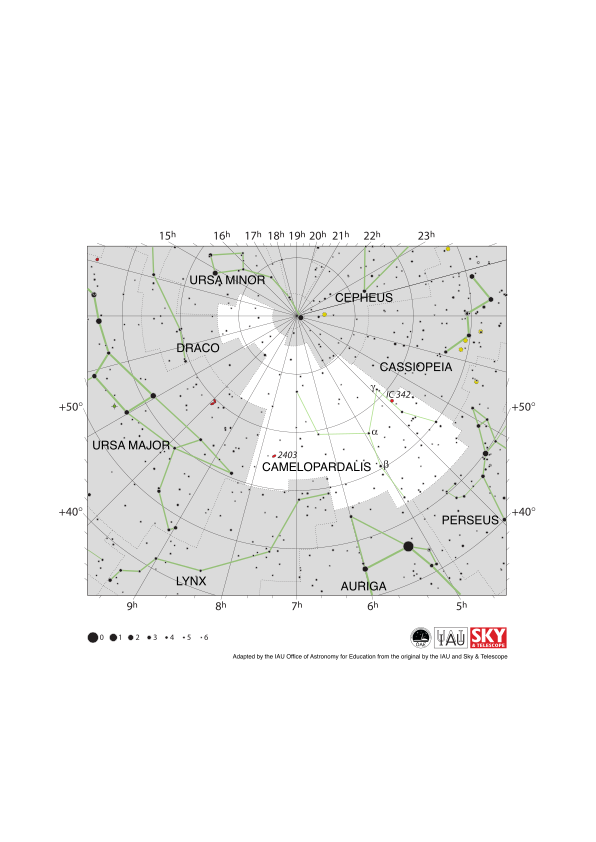
الشرح: The constellation Camelopardalis with its bright stars and surrounding constellations. Camelopardalis is surrounded by (going clockwise from the top): Cepheus, Cassiopea, Perseus, Auriga, Lynx, Ursa Major, Draco and Ursa Minor. Camelopardalis is a large constellation but contains relatively few bright stars.
Camelopardalis is a northern constellation and as such the whole constellation is visible for the whole northern hemisphere at some point in the year. It is also visible from equatorial parts of the southern hemisphere with some parts visible to temperate southern regions. The whole constellation is circumpolar for all arctic and more northerly temperate regions of the northern hemisphere. Camelopardalis is best viewed in the evening in the late northern hemisphere winter and late southern hemisphere summer.
The spiral galaxies NGC 2403 and IC 342 lie in Camelopardalis and are marked here with red ellipses.
This diagram maps an area around the north celestial pole. Here lines of constant right ascension converge. The right ascension values of these lines are marked on the x-axis above and below the diagram. Some of the lines of constant declination are marked on the y-axis. The sizes of the stars marked here relate to the star's apparent magnitude, a measure of its apparent brightness. The larger dots represent brighter stars. The Greek letters mark the brightest stars in the constellation. These are ranked by brightness with the brightest star being labeled alpha, the second brightest beta, etc., although this ordering is not always followed exactly. The dotted boundary lines mark the IAU's boundaries of the constellations and the solid green lines mark one of the common forms used to represent the figures of the constellations. Neither the constellation boundaries, nor the lines joining the stars appear on the sky.
المصدر: Adapted by the IAU Office of Astronomy for Education from the original by the IAU and Sky & Telescope
رابط المصدر
مصطلحات المعجم:
القدرالظاهري , الإحداثيات السماوية , النجوم القطبية , مجموعة نجمية او حشد نجمى , الميل , القطب السماوي الشمالي , المطلع المستقيم , المجرة الحلزونية
فئات:
علم الفلك بالعين المجردة
الترخيص: المشاع الإبداعي نَسب المُصنَّف 4.0 دولي (CC BY 4.0) المشاع الإبداعي نَسب المُصنَّف 4.0 دولي (CC BY 4.0) أيقونات
ملف
( صورة
138.40 kB)
ملف PDF
(PDF file
215.25 kB)
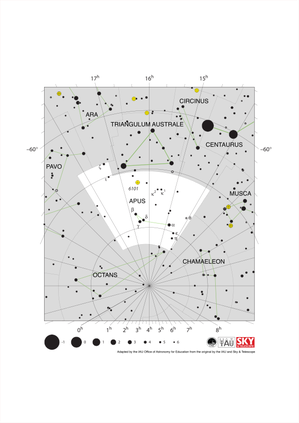
Apus Constellation Map
صورة
الشرح: The constellation Apus with its bright stars and surrounding constellations. Apus is surrounded by (going clockwise from the top): Triangulum Australe, Circinus, Musca, Chamaeleon, Octans, Pavo and Ara.
Apus is a southern constellation lying close to the south celestial pole. As such it is visible at some point in the year from the entire southern hemisphere but is only visible from the most equatorial regions of the northern hemisphere. Apus is circumpolar for all temperate and antarctic regions of the southern hemisphere. It is most visible in the evenings in the northern hemisphere summer and southern hemisphere autumn.
The globular cluster NGC 6101 can be found in Apus. It is marked here with a yellow circle with a plus symbol superimposed on it.
This diagram maps an area around the south celestial pole. Here lines of constant right ascension converge. The right ascension values (in hours) of these lines are marked on the x-axis above and below the diagram. Lines of constant declination (in degrees) are marked on the y-axis. The sizes of the stars marked here relate to the star's apparent magnitude, a measure of its apparent brightness. The larger dots represent brighter stars. The Greek letters mark the brightest stars in the constellation. These are ranked by brightness with the brightest star being labeled alpha, the second brightest beta, etc., although this ordering is not always followed exactly. The dotted boundary lines mark the IAU's boundaries of the constellations and the solid green lines mark one of the common forms used to represent the figures of the constellations. Neither the constellation boundaries, nor the lines joining the stars appear on the sky.
المصدر: Adapted by the IAU Office of Astronomy for Education from the original by IAU/Sky & Telescope
رابط المصدر
مصطلحات المعجم:
القدرالظاهري , الإحداثيات السماوية , النجوم القطبية , مجموعة نجمية او حشد نجمى , الميل , المطلع المستقيم , القطب السماوي الجنوبي (SCP)
فئات:
علم الفلك بالعين المجردة
الترخيص: المشاع الإبداعي نَسب المُصنَّف 4.0 دولي (CC BY 4.0) المشاع الإبداعي نَسب المُصنَّف 4.0 دولي (CC BY 4.0) أيقونات
ملف
( صورة
128.00 kB)
ملف PDF
(PDF file
174.09 kB)

Chamaeleon Constellation Map
صورة
الشرح: The constellation Chamaeleon with its bright stars and surrounding constellations. Chamaeleon is surrounded by (going clockwise from the top): Carina, Volans, Mensa, Octans, Apus and Musca.
Chamaeleon lies close to the south celestial pole and this the whole of the constellation is visible from the whole southern hemisphere at some point in the year. All or part of the constellation can be seen from equatorial regions of the northern hemisphere. The whole constellation is circumpolar for all but the most equatorial regions of the southern hemisphere. Chamaeleon is best viewed in the evenings in the northern hemisphere spring and southern hemisphere autumn.
This diagram maps an area around the south celestial pole. Here lines of constant right ascension converge. The right ascension values of these lines are marked on the x-axis above and below the diagram. The solid circle around the pole marks a line of -80° declination with the larger, incomplete circles above it marking -70° and -60° declination respectively. The sizes of the stars marked here relate to the star's apparent magnitude, a measure of its apparent brightness. The larger dots represent brighter stars. The Greek letters mark the brightest stars in the constellation. These are ranked by brightness with the brightest star being labeled alpha, the second brightest beta, etc., although this ordering is not always followed exactly. The dotted boundary lines mark the IAU's boundaries of the constellations and the solid green lines mark one of the common forms used to represent the figures of the constellations. Neither the constellation boundaries, nor the lines joining the stars appear on the sky.
المصدر: Adapted by the IAU Office of Astronomy for Education from the original by the IAU and Sky & Telescope
رابط المصدر
مصطلحات المعجم:
القدرالظاهري , الإحداثيات السماوية , النجوم القطبية , مجموعة نجمية او حشد نجمى , الميل , المطلع المستقيم , القطب السماوي الجنوبي (SCP)
فئات:
علم الفلك بالعين المجردة
الترخيص: المشاع الإبداعي نَسب المُصنَّف 4.0 دولي (CC BY 4.0) المشاع الإبداعي نَسب المُصنَّف 4.0 دولي (CC BY 4.0) أيقونات
ملف
( صورة
141.46 kB)
ملف PDF
(PDF file
166.96 kB)

Dorado Constellation Map
صورة
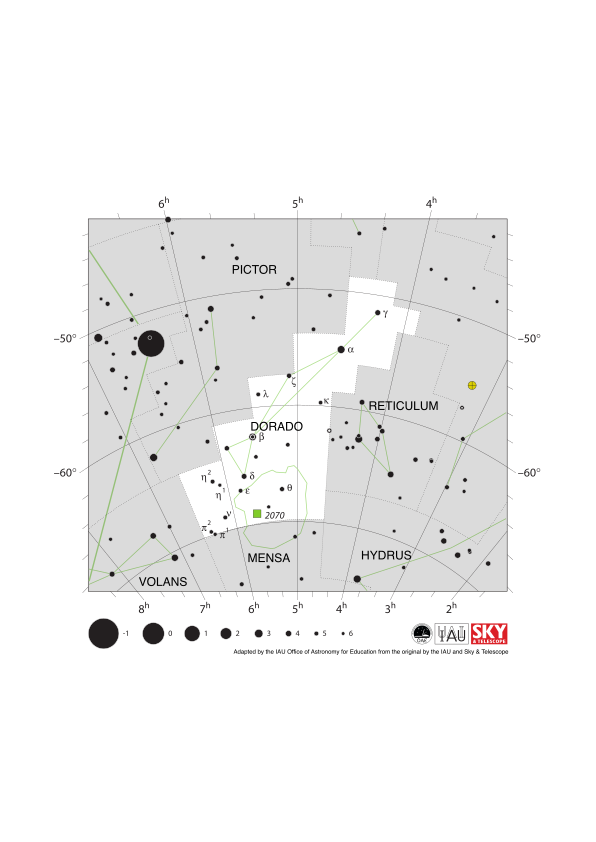
الشرح: The constellation Dorado with its bright stars and surrounding constellations. Dorado is surrounded by (going clockwise from the top): Pictor, Caelum, Horologium, Reticulum, Hydrus, Mensa and Volans.
Dorado is a southern constellation and thus the whole constellation is visible at some point in the year from the whole southern hemisphere. The whole constellation is also visible to equatorial regions of the northern hemisphere. Dorado is circumpolar for temperate and antarctic regions of the southern hemisphere. This constellation is best viewed in the northern hemisphere winter and southern hemisphere summer.
The Large Magellanic Cloud (LMC), a satellite galaxy of the Milky Way, lies in Dorado and the neighboring constellation Mensa. The outline of the Large Magellanic Cloud is marked here as a roughly circular loop in green. The open cluster NGC 2070 lies at the heart of the Tarantula Nebula. This is marked here with a green square.
The y-axis of this diagram is in degrees of declination with north as up and the x-axis is in hours of right ascension with east to the left. The sizes of the stars marked here relate to the star's apparent magnitude, a measure of its apparent brightness. The larger dots represent brighter stars. The Greek letters mark the brightest stars in the constellation. These are ranked by brightness with the brightest star being labeled alpha, the second brightest beta, etc., although this ordering is not always followed exactly. The dotted boundary lines mark the IAU's boundaries of the constellations and the solid green lines mark one of the common forms used to represent the figures of the constellations. Neither the constellation boundaries, nor the lines joining the stars appear on the sky.
المصدر: Adapted by the IAU Office of Astronomy for Education from the original by the IAU and Sky & Telescope
رابط المصدر
مصطلحات المعجم:
القدرالظاهري , الإحداثيات السماوية , النجوم القطبية , مجموعة نجمية او حشد نجمى , الميل , السديم , المطلع المستقيم , العنقود المفتوح , سحابة ماجلان الكبرى
فئات:
علم الفلك بالعين المجردة
الترخيص: المشاع الإبداعي نَسب المُصنَّف 4.0 دولي (CC BY 4.0) المشاع الإبداعي نَسب المُصنَّف 4.0 دولي (CC BY 4.0) أيقونات
ملف
( صورة
94.49 kB)
ملف PDF
(PDF file
155.00 kB)