المستندات والموارد - نتائج البحث
نتائج البحث

خريطة كوكبة ليرا
صورة
الشرح: كوكبة ليرا بنجومها اللامعة والمجموعات النجمية المحيطة بها. تحيط بكوكبة ليرا (في اتجاه عقارب الساعة من الأعلى): دراكو، وهرقل، وفولبيكولا، وسقنوس. يهيمن على القيثارة نجمها الأكثر لمعاناً فيجا الذي يُستخدم لتحديد نقطة الصفر لأحد أكثر مقاييس المقادير استخداماً للسطوع النجمي. تُشكِّل فيجا أحد رؤوس النجوم البارزة في المثلث الصيفي البارز الذي يمكن رؤيته في أمسيات الصيف في نصف الكرة الشمالي.
تُعد ليرا كوكبة شمالية وبالتالي فهي مرئية في وقت ما من السنة في جميع أنحاء نصف الكرة الشمالي. يمكن رؤية الكوكبة بأكملها أيضاً من جميع المناطق الاستوائية وبعض المناطق المعتدلة في نصف الكرة الجنوبي. يمكن رؤية أجزاء من الكوكبة من المناطق المعتدلة الجنوبية المتبقية. أفضل الاوقات لمشاهدة القيثارة في المساء في فصل الصيف في نصف الكرة الشمالي والشتاء في نصف الكرة الجنوبي.
يقع السديم الكوكبي الشهير M57، المعروف باسم السديم الدائري، في كوكبة القيثارة. وقد تم تمييزه هنا بدائرة خضراء متراكبة على علامة زائد. ويقع الحشد النجمى الكرى M56 أيضاً في القيثارة ومُحدّد هنا بدائرة صفراء عليها علامة زائد.
المحور y فى هذا الرسم البياني يمثل الارتفاع ويقاس بالدرجات مع اعتبار ان وضع الشمال في الأعلى والمحور x هو مقياس زاوية المطلع المستقيم ويقاس بالساعات ويقاس من الشرق الى الغرب. وتعبر أحجام النجوم المُحدَّدة هنا بالقدر الظاهري للنجم، وهو مقياس لسطوعه الظاهري. تمثل النقاط الأكبر حجماً النجوم الأكثر سطوعاً. تشير الحروف اليونانية إلى ألمع النجوم في الكوكبة. وهي مُرتَّبة حسب السطوع حيث يُسمَّى النجم الأكثر سطوعًا ألفا، وثاني ألمع نجم بيتا، إلخ، على الرغم من أن هذا الترتيب لا يُتَّبع دائمًا بدقة. تشير خطوط الحدود المنقطة إلى الحدود التي وضعها الاتحاد الفلكي الدولي للمجموعات النجمية والخطوط الخضراء المتصلة تشير إلى أحد الأشكال الشائعة المستخدمة لتمثيل أشكال المجموعات النجمية. وبالطبع فإن هذه الحدود حول الكوكبات والخطوط التي تربط بين النجوم لاترى على صفحة السماء.
المصدر: بتصرف من قبل مكتب الاتحاد الفلكي الدولي للاتحاد الفلكي الدولي للتعليم من النسخة الأصلية للاتحاد الفلكي الدولي والاتحاد الفلكي الدولي وسكاي آند تليسكوب
رابط المصدر
مصطلحات المعجم:
القدرالظاهري , الإحداثيات السماوية , مجموعة نجمية او حشد نجمى , الميل , العنقود النجمي الكروي , السديم الكوكبي , المطلع المستقيم , المجمة
فئات:
علم الفلك بالعين المجردة
الترخيص: المشاع الإبداعي نَسب المُصنَّف 4.0 دولي (CC BY 4.0) المشاع الإبداعي نَسب المُصنَّف 4.0 دولي (CC BY 4.0) أيقونات
ملف
( صورة
80.00 kB)
ملف PDF
(PDF file
184.01 kB)

Tucana Constellation Map
صورة
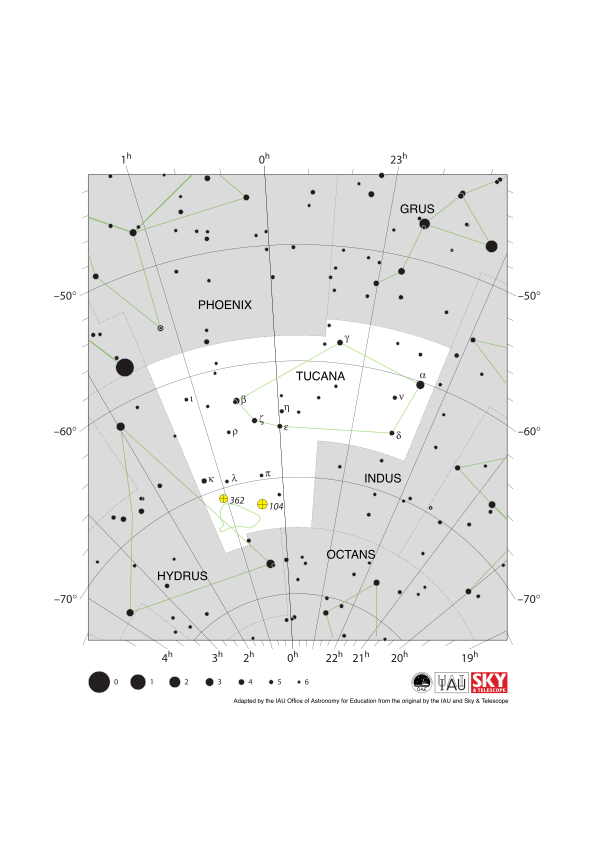
الشرح: The constellation Tucana with its bright stars and surrounding constellations. Tucana is surrounded by (going clockwise from the top): Grus, Indus, Octans, Hydrus, Eridanus and Phoenix.
Tucana is a southern constellation and thus the whole constellation is visible at some point in the year throughout the southern hemisphere. The whole constellation is visible to some equatorial regions of the northern hemisphere with parts of the constellation visible to the remaining northern equatorial regions. Tucana is best viewed in the northern hemisphere autumn and southern hemisphere spring.
The Small Magellanic Cloud (SMC), a satellite galaxy of the Milky Way lies in Tucana with a small part spilling over into the neighbouring constellation of Hydrus. The SMC is marked here with a green loop in the south east of Tucana. The globular clusters NGC 104, also known as 47 Tucanae or 47 Tuc, and NGC 362 lie in Tucana and are marked here with yellow circles with plus signs superimposed on them. While these two clusters appear close to the SMC on the sky, they are both significantly closer than that satellite galaxy.
The y-axis of this diagram is in degrees of declination with north as up and the x-axis is in hours of right ascension with east to the left. The sizes of the stars marked here relate to the star's apparent magnitude, a measure of its apparent brightness. The larger dots represent brighter stars. The Greek letters mark the brightest stars in the constellation. These are ranked by brightness with the brightest star being labeled alpha, the second brightest beta, etc., although this ordering is not always followed exactly. The dotted boundary lines mark the IAU's boundaries of the constellations and the solid green lines mark one of the common forms used to represent the figures of the constellations. Neither the constellation boundaries, nor the lines joining the stars appear on the sky.
المصدر: Adapted by the IAU Office of Astronomy for Education from the original by the IAU and Sky & Telescope
رابط المصدر
مصطلحات المعجم:
القدرالظاهري , الإحداثيات السماوية , مجموعة نجمية او حشد نجمى , الميل , العنقود النجمي الكروي , المطلع المستقيم , سحابة ماجلان الصغيرى
فئات:
علم الفلك بالعين المجردة
الترخيص: المشاع الإبداعي نَسب المُصنَّف 4.0 دولي (CC BY 4.0) المشاع الإبداعي نَسب المُصنَّف 4.0 دولي (CC BY 4.0) أيقونات
ملف
( صورة
113.87 kB)
ملف PDF
(PDF file
161.52 kB)
Cygnus Constellation Map
صورة
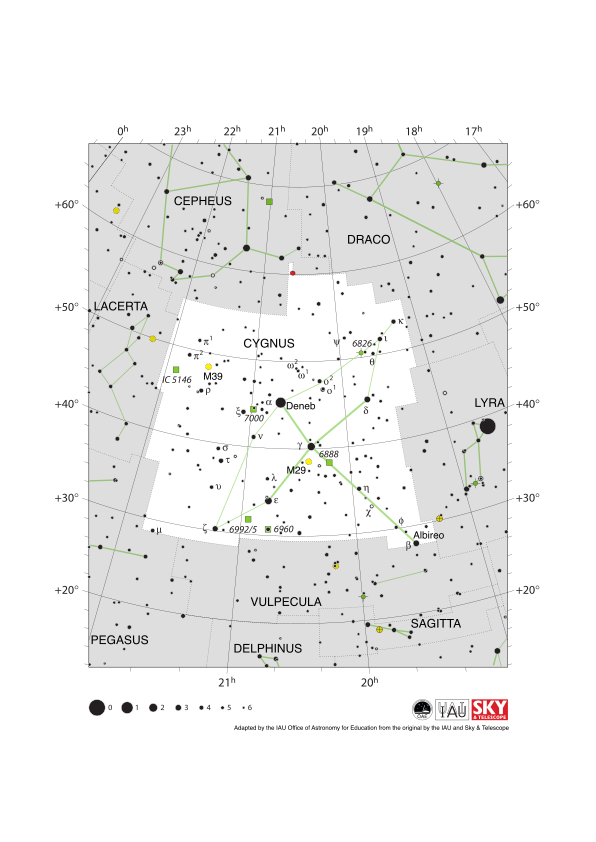
الشرح: The constellation Cygnus with its bright stars and surrounding constellations. Cygnus is surrounded by (going clockwise from the top): Cepheus, Draco, Lyra, Vulpecula, Pegasus and Lacerta. Cygnus is notable for its brightest star Deneb. This forms one vertex of the prominent Summer Triangle asterism that is visible in northern hemisphere summer evenings.
Cygnus is a northern constellation and thus the whole of the constellation is visible at some point in the year in the whole northern hemisphere. The whole constellation is also visible from equatorial regions of the southern hemisphere with parts of the constellation visible from temperate southern regions.
The plane of the Milky Way runs through Cygnus and thus the constellation is rich in nebulae and star clusters. These include the North America Nebula (NGC 7000) and the Crescent Nebula (NGC 6888). The Veil Nebula is a huge supernova remnant, parts of which are marked here as NGC 6960 and NGC 6992/5. All of the previously-mentioned nebulae are marked with green squares. The planetary nebula NGC 6826 is marked here with a green circle superimposed on a plus sign. The open star clusters M29 and M39 are marked here with yellow circles.
The y-axis of this diagram is in degrees of declination with north as up and the x-axis is in hours of right ascension with east to the left. The sizes of the stars marked here relate to the star's apparent magnitude, a measure of its apparent brightness. The larger dots represent brighter stars. The Greek letters mark the brightest stars in the constellation. These are ranked by brightness with the brightest star being labeled alpha, the second brightest beta, etc., although this ordering is not always followed exactly. The dotted boundary lines mark the IAU's boundaries of the constellations and the solid green lines mark one of the common forms used to represent the figures of the constellations. Neither the constellation boundaries, nor the lines joining the stars appear on the sky.
المصدر: Adapted by the IAU Office of Astronomy for Education from the original by the IAU and Sky & Telescope
رابط المصدر
مصطلحات المعجم:
القدرالظاهري , الإحداثيات السماوية , مجموعة نجمية او حشد نجمى , الميل , درب التبانة , السديم , السديم الكوكبي , المطلع المستقيم , المجمة , العنقود المفتوح , بقايا المستعر الأعظم
فئات:
علم الفلك بالعين المجردة
الترخيص: المشاع الإبداعي نَسب المُصنَّف 4.0 دولي (CC BY 4.0) المشاع الإبداعي نَسب المُصنَّف 4.0 دولي (CC BY 4.0) أيقونات
ملف
( صورة
150.09 kB)
ملف PDF
(PDF file
216.56 kB)

Puppis Constellation Map
صورة
الشرح: The constellation Puppis with its bright stars and surrounding constellations. Puppis is surrounded by (going clockwise from the top): Monoceros, Canis Major, Columba, Pictor, Carina, Vela, Pyxis and Hydra.
Puppis is a southern constellation and thus the whole constellation is visible at some point in the year throughout the southern hemisphere. The whole constellation is also visible to equatorial and some temperate regions of the northern hemisphere with parts of the constellation visible to all but the most arctic regions. Puppis is best viewed in the evenings in the northern hemisphere winter and southern hemisphere summer.
The open clusters M46, M93 and NGC 2477 lie in Puppis and are marked here with yellow circles. The globular cluster M47 also lies in Puppis and is marked here with a yellow circle with a cross superimposed on it.
The y-axis of this diagram is in degrees of declination with north as up and the x-axis is in hours of right ascension with east to the left. The sizes of the stars marked here relate to the star's apparent magnitude, a measure of its apparent brightness. The larger dots represent brighter stars. The Greek letters mark the brightest stars in the constellation. These are ranked by brightness with the brightest star being labeled alpha, the second brightest beta, etc., although this ordering is not always followed exactly. Puppis was previously part of the larger Argo Navis constellation along with Vela and Carina. As the letter designations for stars were created before this division took place, Greek letter designations are now divided between the three constellations with Puppis having stars designated epsilon and zeta but no alpha, beta, gamma or delta. The dotted boundary lines mark the IAU's boundaries of the constellations and the solid green lines mark one of the common forms used to represent the figures of the constellations. Neither the constellation boundaries, nor the lines joining the stars appear on the sky.
المصدر: Adapted by the IAU Office of Astronomy for Education from the original by the IAU and Sky & Telescope
رابط المصدر
مصطلحات المعجم:
القدرالظاهري , الإحداثيات السماوية , مجموعة نجمية او حشد نجمى , الميل , المطلع المستقيم
فئات:
علم الفلك بالعين المجردة
الترخيص: المشاع الإبداعي نَسب المُصنَّف 4.0 دولي (CC BY 4.0) المشاع الإبداعي نَسب المُصنَّف 4.0 دولي (CC BY 4.0) أيقونات
ملف
( صورة
145.30 kB)
ملف PDF
(PDF file
218.05 kB)

Vela Constellation Map
صورة
الشرح: The constellation Vela with its bright stars and surrounding constellations. Vela is surrounded by (going clockwise from the top): Pyxis, Puppis, Carina, Crux, Centaurus and Antlia.
Vela is a southern constellation and thus the whole constellation is visible at some point in the year throughout the southern hemisphere. The whole constellation is also visible from equatorial regions of the northern hemisphere with parts of the constellation visible from most temperate northern hemisphere regions. Vela is best viewed in the evening in the northern hemisphere spring and southern hemisphere autumn.
The planetary nebula NGC 3132 lies in Vela and is marked here with a green circle superimposed on a plus sign. The globular cluster NGC 3201 also lies in Vela and is marked here with a yellow circle with a plus sign superimposed on it. A yellow circle marks the position of the open cluster IC 2391.
The y-axis of this diagram is in degrees of declination with north as up and the x-axis is in hours of right ascension with east to the left. The sizes of the stars marked here relate to the star's apparent magnitude, a measure of its apparent brightness. The larger dots represent brighter stars. The Greek letters mark the brightest stars in the constellation. These are ranked by brightness with the brightest star being labeled alpha, the second brightest beta, etc., although this ordering is not always followed exactly. Vela was previously part of the larger Argo Navis constellation along with Puppis and Carina. As the letter designations for stars were created before this division took place, Greek letter designations are now divided between the three constellations with Vela having stars designated gamma and delta but no alpha or beta. The dotted boundary lines mark the IAU's boundaries of the constellations and the solid green lines mark one of the common forms used to represent the figures of the constellations. Neither the constellation boundaries, nor the lines joining the stars appear on the sky.
المصدر: Adapted by the IAU Office of Astronomy for Education from the original by the IAU and Sky & Telescope
رابط المصدر
مصطلحات المعجم:
القدرالظاهري , الإحداثيات السماوية , مجموعة نجمية او حشد نجمى , الميل , المطلع المستقيم
فئات:
علم الفلك بالعين المجردة
الترخيص: المشاع الإبداعي نَسب المُصنَّف 4.0 دولي (CC BY 4.0) المشاع الإبداعي نَسب المُصنَّف 4.0 دولي (CC BY 4.0) أيقونات
ملف
( صورة
122.85 kB)
ملف PDF
(PDF file
196.41 kB)