المستندات والموارد - نتائج البحث
نتائج البحث

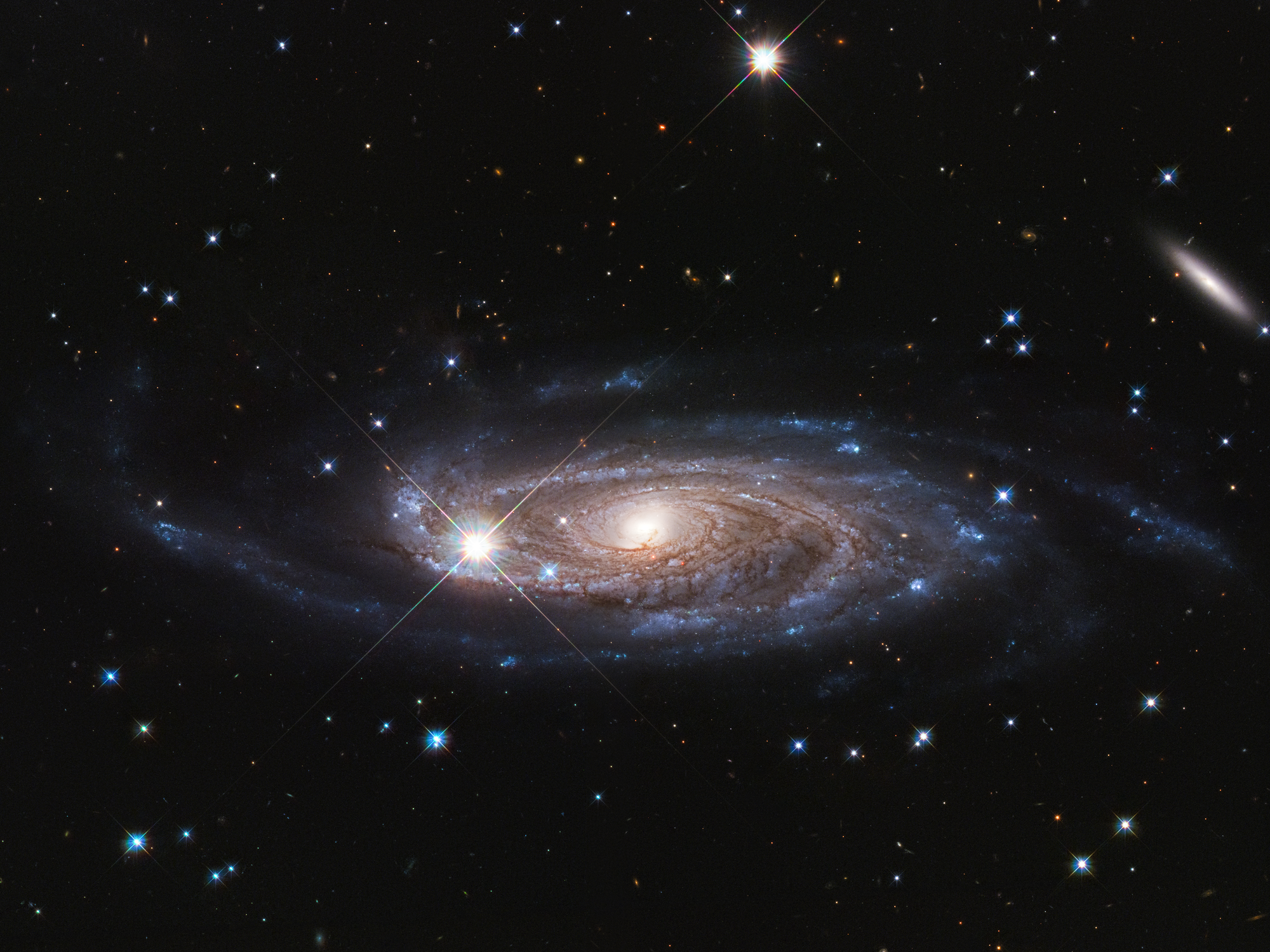
Spiral Galaxy UGC 2885
صورة
الشرح: This image shows UGC 2885, a spiral galaxy located in the constellation Perseus, about 230 million light-years from Earth. Spiral galaxies have rotating disks of stars, gas, and dust, with spiral arms extending outward from the central region. In UGC 2885, these arms are very broad and faint, revealing the galaxy’s large size. This galaxy is tilted at an angle to the observer on Earth, meaning it does not appear as the circular "grand design" spiral it would look like if viewed face-on, nor as the thin line with a central bulge it would appear as if viewed edge-on.
UGC 2885 is remarkable because it is roughly twice the diameter of the Milky Way. It was studied by astronomer Vera Rubin, whose observations of how galaxies rotate — including systems like this one — played a key role in the search for dark matter.
The bright star which appears to the left of the galaxy's center is a foreground object not related to the galaxy.
المصدر: NASA, ESA, Benne Holwerda (University of Louisville)
رابط المصدر
مصطلحات المعجم:
المجرة القرصية , المجرة الحلزونية
الترخيص: الملكية العامة الملكية العامة أيقونات
ملف
( صورة
4.87 MB)

Pioneer Plaques
صورة
الشرح: The Pioneer 10 and 11 spacecraft are the first human-made objects to leave the solar system and venture into interstellar space. To inform potentially intelligent species about our existence, they both carry small metal plaques identifying their time, place of origin and information about their builders. They provide the location of our solar system in the Milky Way by depicting the Solar System's position relative to 14 pulsars, with radiating lines that include information about their frequencies. A model of a hydrogen atom undergoing one particular atomic transition is depicted. The wavelength and frequency of this transition are used to express sizes and frequencies of the other items shown in the plaque. A more detailed view of Earth's position in the solar system, with the spacecraft's trajectory moving away from Earth, passing Mars and Jupiter is displayed at the bottom. The plaque also depicts a naked man and woman alongside the spacecraft to provide a sense of scale. The man’s hand is raised as a friendly gesture.
The 6-inch by 9-inch gold-anodized aluminum plate has the design engraved on it. It was attached to the support struts of the spacecraft's antenna to try to to protect it from erosion by any interstellar dust the spacecraft may encounter on its journey. Designed by Carl Sagan and Frank Drake, with artwork by Linda Salzman Sagan, these plaques are meant to communicate the origin of the spacecraft to any extraterrestrial life that might encounter them.
While Pioneer 10 is on a course towards the star Aldebaran in the Taurus constellation, which will take about two million years to reach, Pioneer 11 is heading in a different direction towards the constellation of Aquila. It will take approximately four million years to pass close to some of the constellation’s stars.
المصدر: NASA Ames
رابط المصدر
مصطلحات المعجم:
ذكاء من خارج الأرض
فئات:
علم الفلك والمجتمع
, الكواكب الخارجية وعلم الأحياء الفلكية
, استكشاف الفضاء
الترخيص: الملكية العامة الملكية العامة أيقونات
ملف
( صورة
5.94 MB)
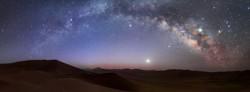
Milky Way Arch over Lut Desert, Iran, by Amirreza Kamkar, Iran (Islamic Republic of)
صورة
أُنشئ لصالح OAE
الشرح: Second place in the 2021 IAU OAE Astrophotography Contest, category Wide star fields.
This panoramic dawn image shows the majestic band of the Milky Way – our home Galaxy – made up of a few hundred billion stars, among other structures, most of which are not detectable by our eyes, or in some cases even directly with telescopes. The appearance of the band is because the Milky Way is a disc-shaped galaxy, and we (Earth/Solar System) are situated within the disc.
Diverse cultures and traditions around the world each have their own name and cultural stories for the Milky Way. The dark regions visible in the Milky Way are large, dense, cool nebulae (clouds of dust and gas), which obscure the light from stars in the Milky Way. The Indigenous Australians associate stories with the dark patches of the Milky Way, one of the most prominent being the Emu in the Sky (called Tchingal in Wotjobaluk country). In and around the band of the Milky Way there are a vast range of star clusters, two familiar ones are M6 (Butterfly cluster) and M7 (Ptolemy’s cluster).
The bright point just above the horizon is the planet Venus (known to the Boorong people of Indigenous Australia as Chargee Gnowee, elder sister of the Sun). Within the band of the Milky Way the brightest point in the image is the planet Jupiter (called Ginabongbearp, the Sulphur-crested white cockatoo by the Boorong). The planet Saturn is the bright point between Venus and Jupiter (closer to Venus than Jupiter).
There are two constellations and one asterism that can be easily discerned in the image: Aquila, Scorpio (Maui’s Hook), and Teapot (asterism in Sagittarius). In this image, the center of the Milky Way at an approximate distance of 26,000 light years from Earth, is located roughly to the top right of the Teapot spout.
The bright red-orange point to the right of Jupiter is the red supergiant star Antares and is part of the constellation Scorpio (known as Maui’s Hook in Māori and Polynesian cultures). This variation in the colour of stars is the result of temperature of the stars (lower temperature stars are redder, higher temperatures stars are bluer).
المصدر: Amirreza Kamkar/IAU OAE
مصطلحات المعجم:
درب التبانة , سحابة الغبار
فئات:
درب التبانة والوسط بين النجمي
, علم الفلك بالعين المجردة
الترخيص: المشاع الإبداعي نَسب المُصنَّف 4.0 دولي (CC BY 4.0) المشاع الإبداعي نَسب المُصنَّف 4.0 دولي (CC BY 4.0) أيقونات
هذا الملف على Zenodo ( صورة 2.85 MB)

Halley's Comet
صورة
الشرح: Halley’s Comet, is a well-known periodic comet, named after the English astronomer Edmond Halley. It has an orbital period of approximately 75 years and is visible from Earth with the naked eye when it passes through the inner solar system.
The image shows Halley’s Comet, officially designated 1P/Halley, with a tail of gas and dust streaming away from the Sun. It was taken from the La-Silla-Observatory in Chile in 1986 during Halley's Comet's last visit to the inner solar system. The stars in this image appear elongated or as lines of three different colored dots as image was created from three separate observations in different colors of light and the telescope was tracking the comet, which was moving very slightly compared to the background stars. Note that the comets tail does not point in exactly the same direction as the elongation of the stars. This shows us that the comet tail is not always behind the comet, but instead pointing away from the Sun.
The comet passes its perihelion (closest distance to the Sun) at a distance of around 0.59 astronomical units, right between the orbits of Mercury and Venus. Beyond Neptune, it reaches its aphelion (furthest distance from the Sun) at a distance of approximately 35 astronomical units. Halley's Comet reached aphelion in December 2023 and is now moving inwards again. It is expected to be seen with the naked eye from Earth again in mid-2061.
المصدر: ESO
رابط المصدر
مصطلحات المعجم:
الأوج , المذنب , ذيل المذنب , مذنب هالي , الحضيض الشمسي
الترخيص: المشاع الإبداعي نَسب المُصنَّف 4.0 دولي (CC BY 4.0) المشاع الإبداعي نَسب المُصنَّف 4.0 دولي (CC BY 4.0) أيقونات
ملف
( صورة
5.23 MB)

Milky Way Arch over La Palma
صورة
أُنشئ لصالح OAE
الشرح: Winner in the 2022 IAU OAE Astrophotography Contest, category Still images of celestial patterns.
This image, which shows the majestic band of the Milky Way and a range of culturally significant patterns, was taken in May 2022 at a very high altitude from the Roque de los Muchachos Observatory in La Palma, from which one can see the clouds below. Some prominent star patterns include Scorpius, Sagittarius, Lyra, Cygnus, Aquila, the Summer Triangle asterism, and the Teapot asterism.
As the Canary Islands used to be a starting point for European sailors to explore the world, we use this place to point to the many indigenous cultures they encountered. Most notably it is the dark patterns within the band of the Milky Way that hold significance for many Indigenous cultures around the world. The dark patterns are in fact dense, cool clouds of gas and dust that block the light from stars. Indigenous people see caves, waterways and various patterns associated with the dark regions of the Milky Way.
The constellations and patterns hold different cultural significance and interpretations for different people. For example, the constellation Scorpius is referred to by Polynesian people as the demigod Maui’s Fishhook. The Yolnu people of Arnhem Land associate Scorpius with a crocodile called Ingalpir. Some Indigenous Australian groups associate stories with individual stars within Scorpius, most notably Antares, the orange-red star in the top right of the image above the band of the Milky Way. Next to the Scorpion and above the bright centre of the Milky Way, there is a prominent dark cloud that is called the Pipe Nebula by modern astrophotographers. The smoke of this pipe goes up to rho Ophiuchi. This and all the other dark clouds in the Milky Way together form the backbone of heaven for some tribes, and an animal with black-and-white skin for South African Zulu people.
The nomenclature of bright stars also has cross-cultural roots. For example, Vega (the bright blue star towards the top of the image) comes from the Arabic waqi, from al-nasr al-waqi, the Eagle who throws himself down (in order to hunt). This contrasts with the Flying Eagle, Altair, also derived from Arabic. Antares is a Greek word meaning “the one similar to Mars”, referring to its colour. The star name Shaula in the stinger of the Scorpion is a modern version of the Babylonian or even Sumerian star name.
المصدر: Amirreza Kamkar/IAU OAE
مصطلحات المعجم:
مجموعة نجمية او حشد نجمى , الغبار , درب التبانة , كوكبة العقرب , المجمة , سحابة الغبار , الاعتتام بين النجوم , القوس
فئات:
درب التبانة والوسط بين النجمي
, علم الفلك بالعين المجردة
, التلسكوبات والأجهزة والمراصد
الترخيص: المشاع الإبداعي نَسب المُصنَّف 4.0 دولي (CC BY 4.0) المشاع الإبداعي نَسب المُصنَّف 4.0 دولي (CC BY 4.0) أيقونات
هذا الملف على Zenodo ( صورة 3.31 MB)