المستندات والموارد - نتائج البحث
نتائج البحث
Microscopium Constellation Map
صورة
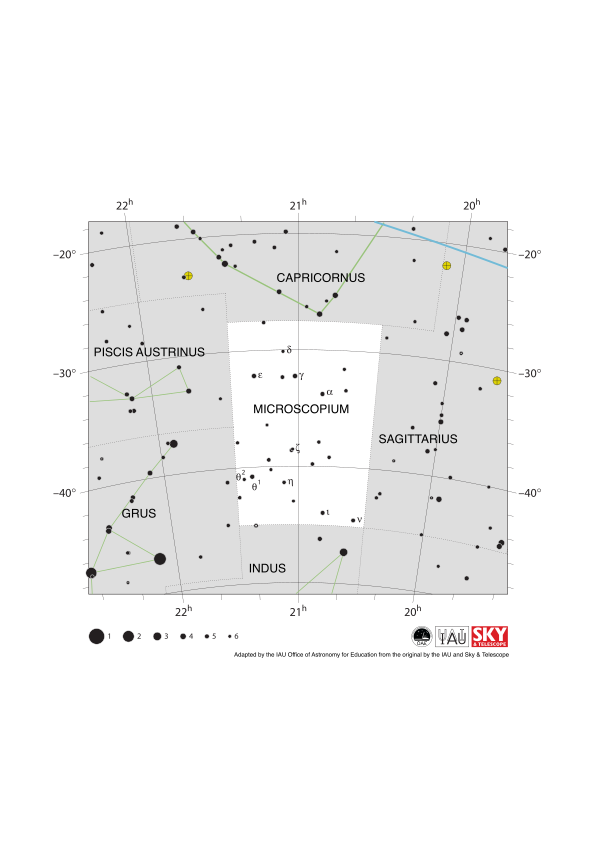
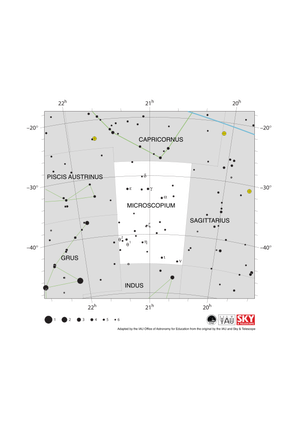
الشرح: The constellation Microscopium with its brighter stars and surrounding constellations. Microscopium is surrounded by (going clockwise from the top): Capricornus, Sagittarius, Telescopium, Indus, Grus and Piscis Austrinus. Microscopium is a faint constellation with relatively few bright stars.
Microscopium is a southern constellation and thus the whole constellation is visible at some point in the year throughout the southern hemisphere. The whole constellation is also visible in equatorial and some temperate regions of the northern hemisphere with parts of the constellation visible from other northern temperate regions. Microscopium is best viewed in the evening in the northern hemisphere autumn and southern hemisphere spring.
The y-axis of this diagram is in degrees of declination with north as up and the x-axis is in hours of right ascension with east to the left. The sizes of the stars marked here relate to the star's apparent magnitude, a measure of its apparent brightness. The larger dots represent brighter stars. The Greek letters mark the brightest stars in the constellation. These are ranked by brightness with the brightest star being labeled alpha, the second brightest beta, etc., although this ordering is not always followed exactly. The dotted boundary lines mark the IAU's boundaries of the constellations and the solid green lines mark one of the common forms used to represent the figures of the constellations. Neither the constellation boundaries, nor the line marking the ecliptic, nor the lines joining the stars appear on the sky. The ecliptic is marked with a blue line in the top right.
المصدر: Adapted by the IAU Office of Astronomy for Education from the original by the IAU and Sky & Telescope
رابط المصدر
مصطلحات المعجم:
القدرالظاهري , كوكبة الجدي , الإحداثيات السماوية , مجموعة نجمية او حشد نجمى , الميل , مسار البروج , المطلع المستقيم , القوس
فئات:
علم الفلك بالعين المجردة
الترخيص: المشاع الإبداعي نَسب المُصنَّف 4.0 دولي (CC BY 4.0) المشاع الإبداعي نَسب المُصنَّف 4.0 دولي (CC BY 4.0) أيقونات
ملف
( صورة
77.31 kB)
ملف PDF
(PDF file
147.46 kB)

Sextans Constellation Map
صورة
الشرح: The constellation Sextans with its brighter stars and surrounding constellations. Sextans is surrounded by (going clockwise from the top): Leo, Hydra and Crater. Sextans is a small constellation with relatively few bright stars.
Sextans spans the celestial equator and thus parts of the constellation are visible at some point in the year across the Earth. The whole constellation is visible in all but the most arctic and most antarctic regions. Sextans is best viewed in the evening in the northern hemisphere spring and southern hemisphere autumn.
The lenticular galaxy NGC 3115 lies in Sextans. It is marked here with a red ellipse.
The y-axis of this diagram is in degrees of declination with north as up and the x-axis is in hours of right ascension with east to the left. The sizes of the stars marked here relate to the star's apparent magnitude, a measure of its apparent brightness. The larger dots represent brighter stars. The Greek letters mark the brightest stars in the constellation. These are ranked by brightness with the brightest star being labeled alpha, the second brightest beta, etc., although this ordering is not always followed exactly. The dotted boundary lines mark the IAU's boundaries of the constellations and the solid green lines mark one of the common forms used to represent the figures of the constellations. The blue line at the top of the diagram marks the ecliptic. Neither the constellation boundaries, nor the lines joining the stars, nor the ecliptic, appear on the sky.
المصدر: Adapted by the IAU Office of Astronomy for Education from the original by the IAU and Sky & Telescope
رابط المصدر
مصطلحات المعجم:
القدرالظاهري , الإحداثيات السماوية , خط الاستواء السماوي , مجموعة نجمية او حشد نجمى , الميل , مسار البروج , كوكبة الأسد , المطلع المستقيم , المجرة العدسية
فئات:
علم الفلك بالعين المجردة
الترخيص: المشاع الإبداعي نَسب المُصنَّف 4.0 دولي (CC BY 4.0) المشاع الإبداعي نَسب المُصنَّف 4.0 دولي (CC BY 4.0) أيقونات
ملف
( صورة
73.40 kB)
ملف PDF
(PDF file
153.02 kB)
Aries Constellation Map
صورة
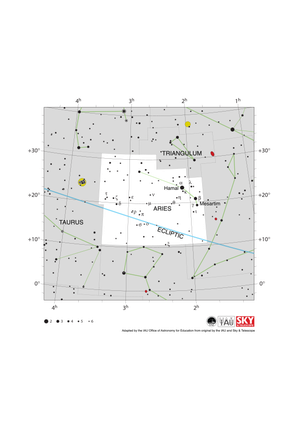
الشرح: The constellation Aries along with its bright stars and surrounding constellations. Aries is surrounded by (going clockwise from the top) Triangulum, Pisces, Cetus, Taurus and Perseus. Aries lies on the ecliptic (shown here as a blue line), this is the path the Sun appears to take across the sky over the course of a year. The Sun is in Aries from mid April to mid May. The other planets of the Solar System can often be found in Aries.
Aries lies just north of the celestial equator and is thus visible at some time in the year from all of planet Earth except for the most antarctic regions of the world. Aries is most visible in the evenings in the northern hemisphere winter and southern hemisphere summer.
The y-axis of this diagram is in degrees of declination with north as up and the x-axis is in hours of right ascension with east to the left. The sizes of the stars marked here relate to the star's apparent magnitude, a measure of its apparent brightness. The larger dots represent brighter stars. The Greek letters mark the brightest stars in the constellation. These are ranked by brightness with the brightest star being labeled alpha, the second brightest beta, etc., although this ordering is not always followed exactly. The dotted boundary lines mark the IAU's boundaries of the constellations and the solid green lines mark one of the common forms used to represent the figures of the constellations. Neither the constellation boundaries, nor the line marking the ecliptic, nor the lines joining the stars appear on the sky.
المصدر: Adapted by the IAU Office of Astronomy for Education from the original by IAU/Sky & Telescope
رابط المصدر
مصطلحات المعجم:
القدرالظاهري , برج الحمل , الإحداثيات السماوية , مجموعة نجمية او حشد نجمى , الميل , مسار البروج , برج الحوت , المطلع المستقيم , برج الثور , دائرة البروج
فئات:
علم الفلك بالعين المجردة
الترخيص: المشاع الإبداعي نَسب المُصنَّف 4.0 دولي (CC BY 4.0) المشاع الإبداعي نَسب المُصنَّف 4.0 دولي (CC BY 4.0) أيقونات
ملف
( صورة
96.59 kB)
ملف PDF
(PDF file
178.36 kB)

Triangulum Constellation Map
صورة
الشرح: The constellation Triangulum with its bright stars and surrounding constellations. Triangulum is surrounded by (going clockwise from the top): Andromeda, Pisces, Aries and Perseus.
Triangulum is a northern constellation and thus the whole constellation is visible at some point in the year throughout the northern hemisphere. The whole constellation is also visible from equatorial and most temperate regions of the southern hemisphere. Triangulum is best viewed in the evening in the northern hemisphere winter and southern hemisphere summer.
The Triangulum Galaxy M33 lies in the constellation. This spiral galaxy is the third largest member of the local group of galaxies after the Andromeda Galaxy and Milky Way. It is marked here with a red ellipse.
The y-axis of this diagram is in degrees of declination with north as up and the x-axis is in hours of right ascension with east to the left. The sizes of the stars marked here relate to the star's apparent magnitude, a measure of its apparent brightness. The larger dots represent brighter stars. The Greek letters mark the brightest stars in the constellation. These are ranked by brightness with the brightest star being labeled alpha, the second brightest beta, etc., although this ordering is not always followed exactly. The dotted boundary lines mark the IAU's boundaries of the constellations and the solid green lines mark one of the common forms used to represent the figures of the constellations. The blue line at the bottom left of the diagram marks the ecliptic. Neither the constellation boundaries, nor the lines joining the stars, nor the ecliptic, appear on the sky.
المصدر: Adapted by the IAU Office of Astronomy for Education from the original by the IAU and Sky & Telescope
رابط المصدر
مصطلحات المعجم:
المرأة المسلسلة , مجرة المرأة المسلسلة , القدرالظاهري , برج الحمل , الإحداثيات السماوية , مجموعة نجمية او حشد نجمى , الميل , درب التبانة , برج الحوت , المطلع المستقيم , المجرة الحلزونية
فئات:
علم الفلك بالعين المجردة
الترخيص: المشاع الإبداعي نَسب المُصنَّف 4.0 دولي (CC BY 4.0) المشاع الإبداعي نَسب المُصنَّف 4.0 دولي (CC BY 4.0) أيقونات
ملف
( صورة
81.19 kB)
ملف PDF
(PDF file
150.67 kB)

Monoceros Constellation Map
صورة
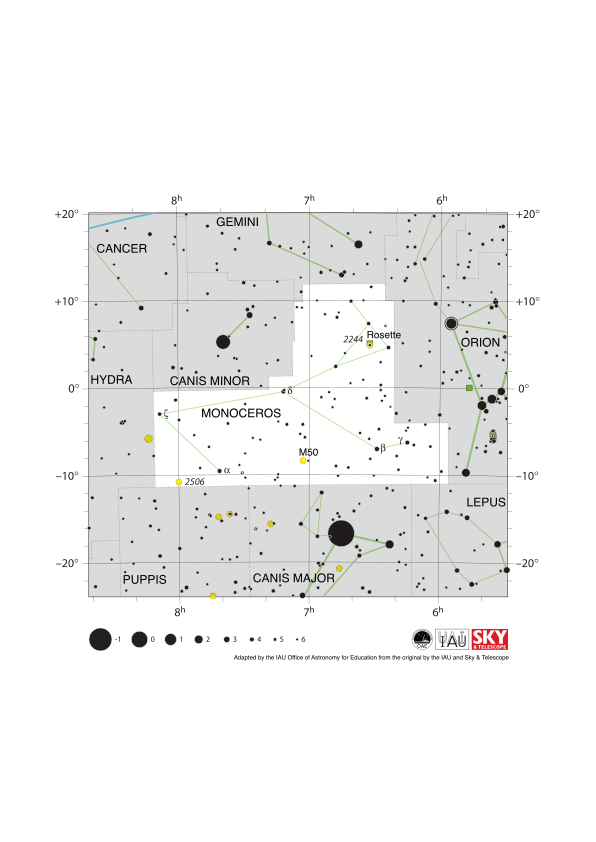
الشرح: The constellation Monoceros with its bright stars and surrounding constellations. Monoceros is surrounded by (going clockwise from the top): Gemini, Orion, Lepus, Canis Major, Puppis, Hydra and Canis Minor.
Monoceros spans the celestial equator and thus parts of the constellation are visible everywhere on the Earth at some point in the year. The whole constellation is visible to all but the most arctic and antarctic regions. Monoceros is best viewed in the evening in the northern hemisphere winter and southern hemisphere summer.
The star-forming Rosette Nebula is marked here with a green square. The open cluster of young stars NGC 2244, which is associated with the Rosette Nebula, is marked with a yellow circle just below it. The other open clusters M50 and NGC 2506 are also marked here with yellow circles.
The y-axis of this diagram is in degrees of declination with north as up and the x-axis is in hours of right ascension with east to the left. The sizes of the stars marked here relate to the star's apparent magnitude, a measure of its apparent brightness. The larger dots represent brighter stars. The Greek letters mark the brightest stars in the constellation. These are ranked by brightness with the brightest star being labeled alpha, the second brightest beta, etc., although this ordering is not always followed exactly. The dotted boundary lines mark the IAU's boundaries of the constellations and the solid green lines mark one of the common forms used to represent the figures of the constellations. The blue line at the top left of the diagram marks the ecliptic. Neither the constellation boundaries, nor the line marking the ecliptic, nor the lines joining the stars appear on the sky.
المصدر: Adapted by the IAU Office of Astronomy for Education from the original by the IAU and Sky & Telescope
رابط المصدر
مصطلحات المعجم:
القدرالظاهري , الإحداثيات السماوية , مجموعة نجمية او حشد نجمى , الميل , المطلع المستقيم
فئات:
علم الفلك بالعين المجردة
الترخيص: المشاع الإبداعي نَسب المُصنَّف 4.0 دولي (CC BY 4.0) المشاع الإبداعي نَسب المُصنَّف 4.0 دولي (CC BY 4.0) أيقونات
ملف
( صورة
103.71 kB)
ملف PDF
(PDF file
184.71 kB)