المستندات والموارد - نتائج البحث
نتائج البحث

The Kingdom of Orion
صورة
أُنشئ لصالح OAE
الشرح: Winner in the 2022 IAU OAE Astrophotography Contest, category Still images of celestial patterns.
This image, taken in January 2022, pictures a landscape from Navarra, a province in the north of Spain with ruins from old civilizations in the foreground. Above that, we see a partially cloudy and starry sky with the most prominent stars belonging to the star pattern Orion. Composed of many bright stars with several interesting deep sky objects within its boundaries, Orion is one of the 88 officially recognised IAU constellations. It originates from Greek mythology where the hero Orion is the son of the sea god Poseidon. Orion is characterised as a giant hunter lurking just before he attacks an animal (it is unclear which animal he attacks, but, in the original Babylonian version of the Gilgamesh saga, it is the Bull of Heaven depicted as the constellation Taurus). The modern planetarium interpretation depicts him as a Roman warrior raising up his shield, but the two accompanying dogs, represented by the constellations of Canis Major and Canis Minor, are reminiscent of the Greek hunter.
Located at the celestial equator, the star pattern is visible all over the world and is interpreted differently in various mythologies, for example as three fishermen at a campfire in parts of Australia, as a butterfly in some parts of Africa, and as a stairway for the souls of ancestors in parts of South America. As Spain belonged to the Roman empire, the original constellations from earlier times are not known. There are some cave paintings on the Iberian peninsula that could possibly have astronomical references. However, there is uncertainty as to whether these painted figures on rocks depict star patterns.
Orion is best visible from November to January. Its most recognisable feature is the “belt”, an asterism composed of three bright, aligned stars (Alnitak, Alnilam and Mintaka), also recognised by different cultures. Just below this belt is the Orion Nebula, a famous and widely studied star-forming region located about 1500 light-years from Earth. The constellation's brightest stars are Rigel — a blue supergiant which is one of the brightest stars in the sky — and Betelgeuse — a massive red supergiant. The former serves as the left foot, and the latter as the right shoulder of the hunter. While Rigel is in the middle of its life, Betelgeuse is expected to explode within the next few tens of thousands of years. The Orionids, a meteor shower with typical rates of dozens of meteors per hour, whose parent body is Halley’s Comet, can be seen every year in the area of Orion, next to the border with the constellation of Gemini during the month of October.
المصدر: Carlos Zudaire/IAU OAE
مصطلحات المعجم:
مجموعة نجمية او حشد نجمى , العملاق الفائق الأحمر , الجَبّار
فئات:
علم الفلك بالعين المجردة
, النجوم
الترخيص: المشاع الإبداعي نَسب المُصنَّف 4.0 دولي (CC BY 4.0) المشاع الإبداعي نَسب المُصنَّف 4.0 دولي (CC BY 4.0) أيقونات
هذا الملف على Zenodo ( صورة 2.07 MB)
Orion Rises Over Mount Etna
صورة
أُنشئ لصالح OAE
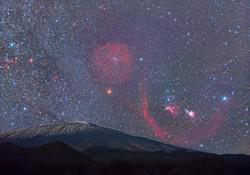
الشرح: Honourable mention in the 2022 IAU OAE Astrophotography Contest, category Still images of celestial patterns.
Taken in February 2021, this image is a composite of an astronomy picture in the background and Mount Etna, the famous volcano in Sicily, Italy, in the foreground. Prominently, we see the red hydrogen clouds in space in the area of Orion. Barnard’s Loop is the gigantic bow with the Great Orion Nebula and the Horsehead Nebula in its centre. The deeper-coloured Horse Head is below the southernmost stars in Orion’s Belt, which is the line of white stars above the red nebula. Clearly visible is also the division between the Small and the Great Orion Nebula, the circular and the trapezium-shaped structure in light pink within which one of the nearest star-forming regions is located. The nebula is only a bit more than a thousand light-years away.
In the middle-left, close to the edge of the image, the small red structure is the Monkey Head Nebula still in the constellation Orion. It hosts a young star cluster and the deep red colour of this hydrogen cloud indicates its potential to build new stars in the future if the material is compressed again. All these reddish objects are strongly processed in this image, as they are not visible to the unaided eye.
Still, this image provides an interesting feature; the red supergiant star Betelgeuse lies in the middle of the image and it seems to be directly above the active volcano Mount Etna. At the foot of this volcano is an ancient settlement, the city of Catania. We consider both Betelgeuse and Mount Etna somehow dangerous — but which of them will erupt first?
Ok, we know that Etna occasionally erupts. Normally it exhibits only small eruptions, but the bigger ones happen every few centuries. We also know that Betelgeuse as a giant star will become a supernova in the future. Astronomers call the timescale for the potential supernova short, implying that it will be only 10 000 or maybe 100 000 years until this star explodes. This is “soon” for astronomers, meaning that on Earth, two to four precession cycles will pass by (with the consequence that the Sahara will turn green and dry again two to four times), continental drift will take Africa further north and cause the Alps to grow in height, the Niagara falls in America will wash the rock completely away and only after all this (and much more) happening on Earth will Betelgeuse explode as a supernova. Mount Etna is much more dangerous for the people in Sicily, and Catania in particular, because it will erupt sooner.
المصدر: Dario Giannobile/IAU OAE
مصطلحات المعجم:
مجموعة نجمية او حشد نجمى , الوسط بين النجمي , الجَبّار
فئات:
علم الفلك بالعين المجردة
, النجوم
الترخيص: المشاع الإبداعي نَسب المُصنَّف 4.0 دولي (CC BY 4.0) المشاع الإبداعي نَسب المُصنَّف 4.0 دولي (CC BY 4.0) أيقونات
هذا الملف على Zenodo ( صورة 15.44 MB)
Romanian Orion
صورة
أُنشئ لصالح OAE
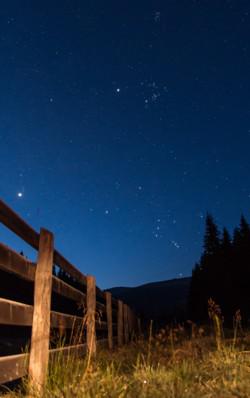
الشرح: Winner in the 2022 IAU OAE Astrophotography Contest, category Still images of celestial patterns.
Taken in Romania in August 2012, this image shows two of the most recognisable constellations in the sky, Orion and Taurus.
Orion, the Hunter, is found near the horizon. The most prominent star visible in this image is Betelgeuse, while the asterism of Orion’s belt is formed by three aligned bright stars. Just above Orion we can find Taurus, one of the constellations of the Zodiac. As the Zodiac is inherited from Babylon, The Bull of Heaven represents a mighty but dangerous creature that was defeated by King Gilgamesh and his friend Enkidu. They cut the Bull in half and sacrificed the animal to the gods in order to protect their people. Taurus is also home to the star cluster Pleiades, also known as the Seven Sisters. Two planets are visible: Venus, the bright spot near the fence, and Jupiter, the bright spot at the top, next to the Bull’s face.
Different cultures have included the stars of these constellations in their own mythology. The Romanians, for instance, after Christianisation identified four other constellations using some of the stars of Orion and others surrounding it. One such constellation is called Trisfetitele (the Three Saints), which is associated with the three stars comprising Orion's Belt, representing the Three Hierarchs Basil, Gregory and John. This same asterism is also called Three Wise Men, Kings from the East or just Three Kings — all of these names being rooted in the Christian religion.
The agricultural calendar, in contrast, led farmers to define two other constellations, the Little Plough and the Sickle. Both are seen in the southern half of the Orion rectangle; the Little Plough is drawn by connecting the southern quadrilateral with Orion’s left shoulder, and the Sickle is formed by connecting Orion’s left foot (Rigel) with the belt stars, forming an arch and completing the form of a hoe. In the cultural calendar, these constellations were used to announce the harvest of wheat/grain. Finally, the fourth Romanian constellation is the Great Auger, where Orion’s belt represents the handle of the auger, and Betelgeuse is the tip, facing towards Pollux in Gemini. This constellation is associated with treasure, as Romanian peasants believe that the Auger points to the treasure when they approach the end of the world.
Most of the official star names in Orion are Arabic; Mintaka (meaning “belt”) is at the waist; Alnitak (meaning “girdle”) and Alnilam (meaning “string”) are at the belt; and Rigel (meaning foot) is at the left foot. The star on the left shoulder is named Bellatrix, the Latin term for a female warrior. The star at the right leg is called Saiph, for the sword or sabre of the Arabic Orion.
المصدر: Alex Conu/IAU OAE
مصطلحات المعجم:
مجموعة نجمية او حشد نجمى , الجوزاء , المشتري , برج الثور , كوكب الزهرة , المجمة , الجَبّار , الثريا
فئات:
علم الفلك بالعين المجردة
الترخيص: المشاع الإبداعي نَسب المُصنَّف 4.0 دولي (CC BY 4.0) المشاع الإبداعي نَسب المُصنَّف 4.0 دولي (CC BY 4.0) أيقونات
هذا الملف على Zenodo ( صورة 6.37 MB)

The Hunter in the Forest
صورة
أُنشئ لصالح OAE
الشرح: Honourable mention in the 2022 IAU OAE Astrophotography Contest, category Still images of celestial patterns.
Taken in December 2016, this image shows a clear and starry sky over the Masaya Volcano National Park in Nicaragua.
The constellation Orion is the most prominent pattern in this image. Orion is associated with a great hunter according to Greek culture, and is seen here right in the middle. The reddish star in the centre is Betelgeuse, the second-brightest in this constellation and one of the brightest in the night sky. Above and to the right of Betelgeuse we find Bellatrix, another bright star, forming the right shoulder of the hunter. Extending a line from Bellatrix to the right, we find a crookedly aligned group of faint stars comprising Orion’s bow. We can also easily see a group of three aligned bright stars forming the belt of the hunter, an asterism recognised by many different cultures. Just below his belt we can see the silverish glittering that was interpreted as the metal of Orion’s sword or knife by the Greco-Roman tradition. It was alternatively interpreted as a fish roasted on a campfire by some cultures in Australia. In its centre, with binoculars we can see the Small and the Great Orion Nebula, together forming a giant cloud of dust and gas where new stars are being formed. To the lower-left of the silverish compound of tiny stars and nebulae, there is a bright star called Saiph, the Arabic term for “Sword” or “Sabre” because it was considered the tip of a huge knife with a curved upper part. To the right of this, there is the bright bluish star Rigel, an Arabic term which designates it as The Foot of Orion.
Orion’s Belt points up towards Aldebaran at the edge of the photograph and down towards Sirius among the branches of the trees; it is the brightest star in the night sky and is located in the constellation Canis Major. Earth’s atmosphere makes the bright Sirius twinkle in all colours. Seen from space it is pure white, but as its light travels through the air, it is scattered and distorted by the molecules. Therefore, the star appears to change colour like a diamond.
A line connecting the two shoulders of Orion points to another bright star in the lower-left corner of the photograph. This is Procyon, located in the constellation Canis Minor. Procyon has been used by the ancient Babylonians to indicate the heliacal rise of Cancer (whose stars are faint, and invisible in twilight) and to predict the rising of Sirius. Thus, for a very long time in ancient history Procyon was considered a single-star asterism. Perhaps only in Roman times were more stars used to create a constellation in this area of the sky, although this constellation has never been clearly recognisable.
المصدر: René Antonio Urroz Álvarez/IAU OAE
مصطلحات المعجم:
مجموعة نجمية او حشد نجمى , الجَبّار
فئات:
علم الفلك بالعين المجردة
, النجوم
الترخيص: المشاع الإبداعي نَسب المُصنَّف 4.0 دولي (CC BY 4.0) المشاع الإبداعي نَسب المُصنَّف 4.0 دولي (CC BY 4.0) أيقونات
هذا الملف على Zenodo ( صورة 2.04 MB)
Constellations from the World
فيديو
أُنشئ لصالح OAE
الشرح: Third place in the 2022 IAU OAE Astrophotography Contest, category Time lapses of celestial patterns.
This video tries to cover a huge variety of phenomena in the night sky from different locations — Iceland and China — and is designed like a theatre play, starring mother nature herself.
It starts with a blue twilight sky that dims and unveils the starry night sky on the stage with terrestrial clouds on a beautiful landscape. The impressive parts of the southern Milky Way between Scorpius and Crux, with the pointer stars Alpha and Beta Centaurus, are shown passing by majestically. The terrestrial clouds blur the stars and allow us to recognise their colours even more clearly.
The first act presents the starry sky in human culture. One scene shows the Pleiades rising over the top of a hill, while a human moves hastily with a flashlight below. At the very moment that the Pleiades rises behind the hill, the beam of the flashlight hits the camera. There is some humour in this remarkable scene referencing the human relationship to the rise of the Pleiades in cultural history.
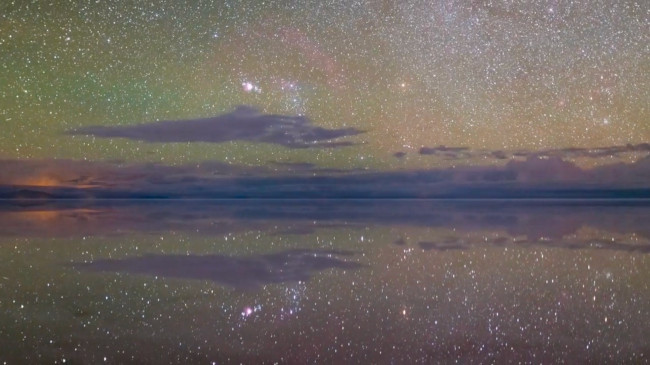
The next scene shows The Big Dipper, Ursa Major, as a typical northern constellation, with an arch of aurora below it. The aurora evolves and moves but does not change much fundamentally. In northern human cultures, aurorae were often interpreted as the ghosts of ancestors, but this play does not spend any time on human beliefs, instead moving the view southwards in the subsequent scenes. First we see some stars rising shortly before sunrise. The lightcone of Zodiacal light appears in Gemini/Taurus and the horizon gets brighter. In the next scene, at about 1 minute and 13 seconds, we see Orion setting over water, so that the water surface mirrors the celestial scene. Some clouds crossing the image prove that the videos were really taken on our beautiful planet, and, since Orion’s shoulder and foot are seen to set almost simultaneously, this sequence must have been captured almost at the equator. In this area, the bright stars of Orion look like a huge butterfly, with Orion’s Belt forming the body, and the quadrilateral of four bright stars interpreted as the wings.
As in a real theatre, we now see a curtain before the next act of the heavenly play, an aurora curtain. The next act presents several bright stars in original scenes: the Chinese asterisms of The Tail (of the Azure Dragon), the Winnowing Basket and the Southern Dipper, which are seen in the modern constellations Scorpius and Sagittarius. The striking shape of Corona Borealis that has been recognised as an asterism in many cultures all over the globe, is also shown, as are some planets, the stars Vega and Deneb with adjacent areas, Altair, the Milky Way, and the characteristic W shape of Cassiopeia that has also been an asterism for many cultures on Earth.
The outro presents two more scenes with a smooth and silent night sky.
المصدر: Stephanie Ye Ziyi/IAU OAE
مصطلحات المعجم:
المغرفة الكبرى , مجموعة نجمية او حشد نجمى , درب التبانة , الجَبّار
فئات:
درب التبانة والوسط بين النجمي
, علم الفلك بالعين المجردة
الترخيص: المشاع الإبداعي نَسب المُصنَّف 4.0 دولي (CC BY 4.0) المشاع الإبداعي نَسب المُصنَّف 4.0 دولي (CC BY 4.0) أيقونات
هذا الملف على Zenodo ( فيديو 46.52 MB)