المستندات والموارد - نتائج البحث
نتائج البحث
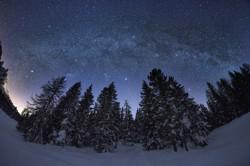
Winter Milky Way
صورة
أُنشئ لصالح OAE
الشرح: Winner in the 2022 IAU OAE Astrophotography Contest, category Still images of celestial patterns.
Taken near Lake Misurina in the Veneto region of Italy in February 2019, this image shows a clear and starry sky over a winter landscape.
We can see part of the Milky Way arc. From the left side, towards the south-east, we see Sirius, "The Burner" in Greek, the brightest star in the night sky. It is part of the constellation Canis Major, The Great Dog, one of the dogs of Orion, the great hunter, in Greek mythology. Orion’s other dog, Canis Minor, the Small Dog, is represented by the bright star Procyon and its fainter neighbours. The Greek star name means “The One [rising] before The Dog” and the star is seen at the top left side of the image just above the arc of the Galaxy. Orion lies to the right of Canis Major. We can spot its characteristic “belt”, an asterism composed of three bright stars aligned in a straight line.
Above the treetops to the right of Orion, the open star clusters of the Hyades and the Pleiades in the constellation Taurus, the Bull, are visible. According to ancient lore, these two clusters form a Celestial Gate directly next to the intersection of the great circles of the ecliptic and the Milky Way. In Greco-Roman mythology, Taurus is associated with the god Zeus who is said to have used a bull to seduce the Phoenician princess Europa.
Above the constellation Taurus, we can see a bright star just above the arc of the Galaxy. This is Capella, the brightest star of the constellation Auriga, The Charioteer. This is one of the 88 modern constellations and is associated with the Greek hero Erichthonius of Athens. Hindu astronomy considers Capella as the heart of Brahma, one of the three major gods. The indigenous people of Bororo in Brazil have a constellation representing a cayman, comprising some of the stars of Auriga and some stars from neighbouring constellations.
To the right of Taurus, we find the modern constellation Perseus with the bright double star cluster h+chi Perseii, which represents the metal of Perseus’s sabre in Greek mythology. Perseus is the hero who was sent out to prove himself, and happened to rescue Andromeda from the sea monster Cetus as the Roman poet Ovid wrote. We can also see the constellation Cassiopeia, associated with the queen and mother of Andromeda in Greek mythology. It is composed of five bright stars in the shape of a W, which was considered the asterism of The Key by the Greeks according to the poet Aratus. The recognisable shape is also associated with other mythologies: for instance, it represents the princess Sharmishtha in Hindu astronomy, a bat in Thailand, and a camel in native Arabic astronomy.
In the gap between the trees, the Andromeda Galaxy is visible.
المصدر: Giorgia Hofer/IAU OAE
مصطلحات المعجم:
مجرة المرأة المسلسلة , درب التبانة , برج الثور , الثريا
فئات:
المجرات
, درب التبانة والوسط بين النجمي
, علم الفلك بالعين المجردة
الترخيص: المشاع الإبداعي نَسب المُصنَّف 4.0 دولي (CC BY 4.0) المشاع الإبداعي نَسب المُصنَّف 4.0 دولي (CC BY 4.0) أيقونات
هذا الملف على Zenodo ( صورة 1.18 MB)
Warm Winter Night Over Spiš Region
صورة
أُنشئ لصالح OAE
الشرح: Winner in the 2022 IAU OAE Astrophotography Contest, category Still images of celestial patterns.
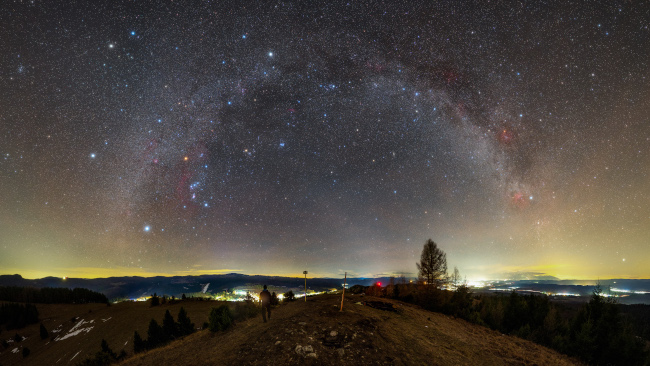
This image, taken in Slovakia in January 2022, shows regions of the Milky Way and a rich variety of constellations. The summer constellations of the northern hemisphere are very low in the sky towards the bottom-right. The bright stars of Cygnus and Lyra shine through the artificial lights at the horizon. The huge array of northern winter and autumn constellations with many bright stars are associated with diverse cultural stories.
For the Lakota people in North America the belt of the Orion constellation represents the spine of a bison (“Tayamnicankh”). Orion, the Hunter of Greek mythology, is sometimes described chasing the Seven Sisters, the Pleiades. The Arabs transformed this view by considering the follower of the Pleiades only one star instead of a constellation. Aldebaran, the star in the right eye of Taurus, the Bull, comes from this interpretation, because the name Aldebaran derives from al-dabaran, The Follower.
At the bottom-right, on the horizon, we can see the milky lightcone of the Zodiacal light stretching from the constellation Pisces through Aries, almost reaching the Pleiades, indicating the path of the planets and the Moon in this area. The Pleiades and the Hyades together form a gate on this path, where the heavenly bodies occasionally pass before entering the Milky Way. The planets were considered sheep in ancient Babylon and the modern constellation Orion was considered the “True Shepherd” of the Sky, with his shepherd’s tool reaching the ecliptic. In Roman tradition, the bright white star above the Pleiades and the Milky Way is called Capella, the Goat, which can be traced back to an Egyptian constellation in this area.
Above the treetop in the middle-right part of the image, we see the autumn square, the Andromeda Galaxy and the W-shaped pattern of Cassiopeia. To the left of this group, in the central part of the visible Milky Way, is the constellation Perseus, with Cepheus in the dark area above Cassiopeia completing the celestial family. The Andromeda saga is a Greek story from the area that is now called Israel, and is rooted in Syrian traditions. The location of Andromeda was considered by the ancient Babylonians as the location of the goddess of sexual love, and by the Syrians as the location of the goddess of fertility. According to the saga, Andromeda was chained to a rock at the coast of Jaffa (Tel Aviv) in order to protect her land from a sea monster. The name of the hero who rescued her is Perseus, probably meaning “from Persia” (today’s Iran).
Noticeable in the valley are the lights from towns. The yellow light above the horizon indicates larger cities there, which are given away by their light pollution.
المصدر: Robert Barsa/IAU OAE
مصطلحات المعجم:
مجموعة نجمية او حشد نجمى , درب التبانة , برج الحوت , برج الثور , الجَبّار , الثريا
فئات:
درب التبانة والوسط بين النجمي
, علم الفلك بالعين المجردة
الترخيص: المشاع الإبداعي نَسب المُصنَّف 4.0 دولي (CC BY 4.0) المشاع الإبداعي نَسب المُصنَّف 4.0 دولي (CC BY 4.0) أيقونات
هذا الملف على Zenodo ( صورة 37.27 MB)
The Geminid Fireball
صورة
أُنشئ لصالح OAE
الشرح: Honorable mention in the 2023 IAU OAE Astrophotography Contest, category of Still images taken exclusively with smartphones/mobile devices.
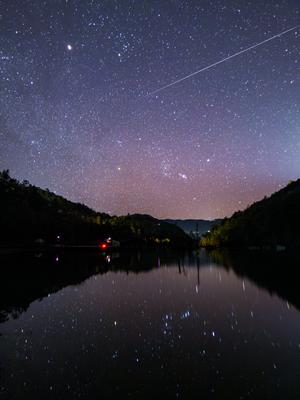
Captured with a smartphone on 13 December 2022, a Geminid meteor illuminated the sky above Blue Moon Valley in Yunnan, China, casting a breathtaking display against the serene backdrop of the Jade Dragon Snow Mountain. Renowned for their dazzling brightness and vivid hues, the Geminids are among the most vibrant meteor showers, originating from the asteroid 3200 Phaethon. Each year, as our planet traverses Phaethon’s debris trail, fragments of dust and rock vaporise in the atmosphere, creating the stunning phenomenon of the Geminid meteor shower. In this stunning night sky image, the twin stars of Gemini (Castor and Pollux) are obscured by the silhouetted trees on the left. Mirrored in the calm waters are the stars that make up the constellation of Orion, which can be seen rising towards the bottom-centre of the image, while the radiant Mars retains its brilliance as the foremost celestial beacon in the scene, all before the moonrise takes over.
المصدر: Jianfeng Dai/IAU OAE (CC BY 4.0)
مصطلحات المعجم:
الجوزاء , الشهاب
فئات:
علم الفلك بالعين المجردة
, النظام الشمسي
وسوم:
astrophotography
الترخيص: المشاع الإبداعي نَسب المُصنَّف 4.0 دولي (CC BY 4.0) المشاع الإبداعي نَسب المُصنَّف 4.0 دولي (CC BY 4.0) أيقونات
هذا الملف على Zenodo ( صورة 15.06 MB)

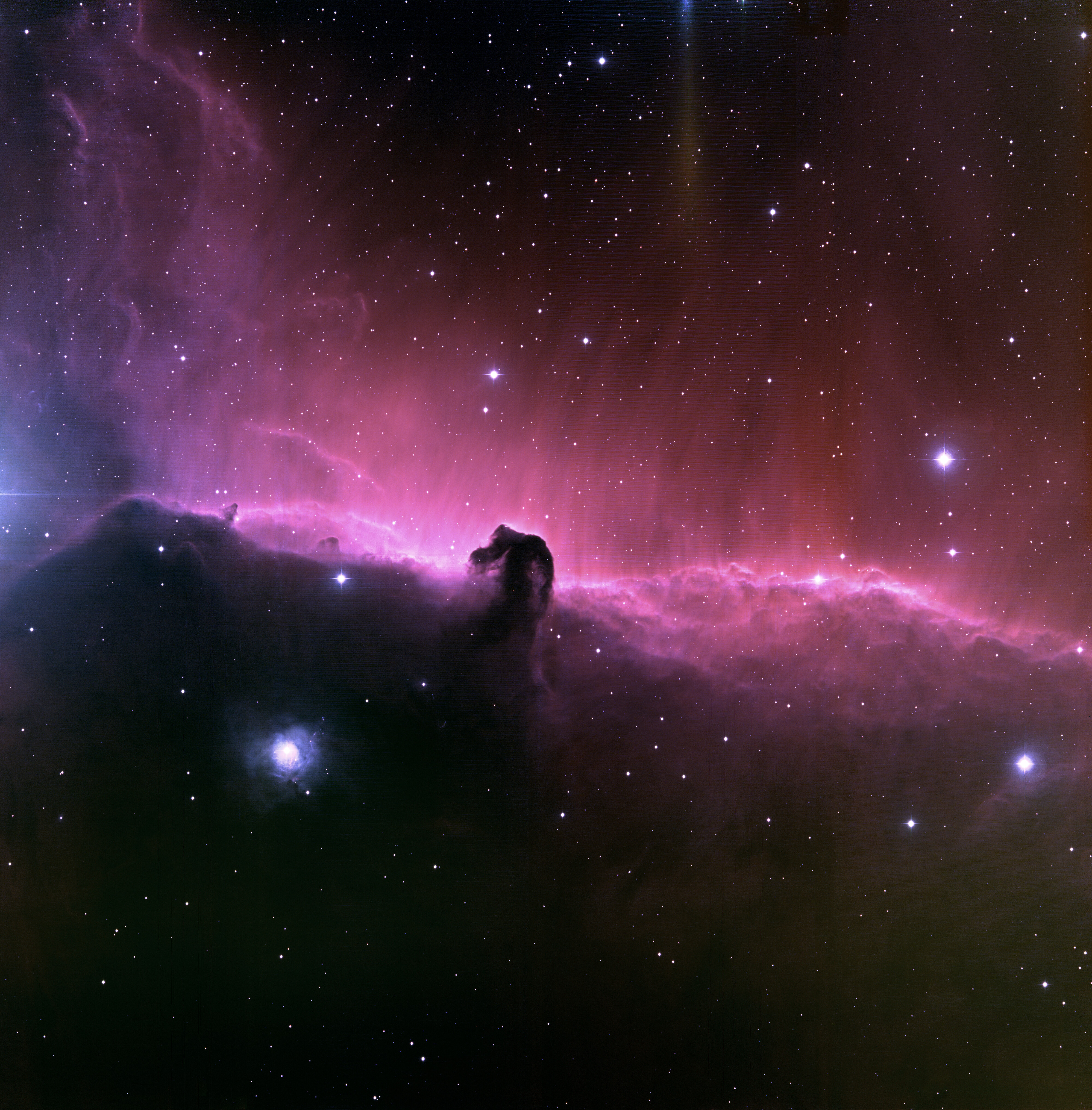
The Horsehead Nebula
صورة
الشرح: This image shows the Horsehead Nebula, located at a distance of about 1,300 light-years from Earth in the Orion constellation, one of the most iconic examples of a dark nebula. A dark nebula is a dense cloud of interstellar dust and cold gas that absorbs and scatters visible light, preventing background stars and glowing gas from reaching our eyes. This false-color image combines data captured through multiple narrowband filters, each isolating light from different elements in the nebula. The dark, horse-shaped silhouette appears sharply outlined against the luminous nebula behind it, where energetic radiation from nearby young stars causes the gas to glow. The uneven distribution of visible stars in this image is not random: regions rich in dust in the lower part of this image appear almost empty, while clearer areas reveal many background stars. The dust acts like a cosmic curtain, hiding stars that lie behind it while allowing stars in front of the cloud to remain visible. Studying such regions helps astronomers understand how nebulae serve as environments where new stars can form.
المصدر: T.A.Rector (NOIRLab/NSF/AURA) and Hubble Heritage Team (STScI/AURA/NASA)
رابط المصدر
مصطلحات المعجم:
السديم المظلم , الغبار , السديم , الفضاء
الترخيص: المشاع الإبداعي نَسب المُصنَّف 4.0 دولي (CC BY 4.0) المشاع الإبداعي نَسب المُصنَّف 4.0 دولي (CC BY 4.0) أيقونات
ملف
( صورة
23.89 MB)

The red supergiant Betelgeuse
صورة
الشرح: The image shows Betelgeuse, a red supergiant in the constellation Orion, observed by the Atacama Large Millimeter/submillimeter Array (ALMA). ALMA consists of many antennae spread across a plain in Northern Chile. The observations from all of these receivers is synthesised together by a central computer to form an image. The wide distances between the antennae mean that is can resolve very fine details.
Most stars we observe are just seen as points of light, but Betelgeuse is so large (with a radius about 1,400 times larger than the Sun) and is sufficiently nearby that it is one of the few stars to have been resolved to show it as an extended object.
Betelgeuse is a massive star, more than 14 times the mass of the Sun and is relatively young for a star (less than 14 million years old). However, its high mass led to it having a very hot core which burned through its hydrogen fuel quickly. It has since evolved through many stages and now appears as a red supergiant, it's final stage before exploding as a supernova. When such an explosion will happen is not known for certain, but it could be in around 100,000 years. Such an explosion would be visible from Earth, even during the day.
المصدر: ALMA (ESO/NAOJ/NRAO)/E. O’Gorman/P. Kervella
رابط المصدر
مصطلحات المعجم:
النجم العملاق , العملاق الأحمر , العملاق الفائق الأحمر , نجم فائق الضخامة , نجمة من النوع M
فئات:
النجوم
الترخيص: المشاع الإبداعي نَسب المُصنَّف 4.0 دولي (CC BY 4.0) المشاع الإبداعي نَسب المُصنَّف 4.0 دولي (CC BY 4.0) أيقونات
ملف
( صورة
4.86 MB)