المستندات والموارد - نتائج البحث
نتائج البحث
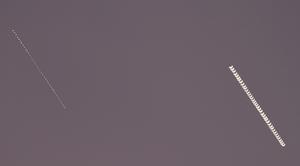
Venus and Mercury Trails
صورة
أُنشئ لصالح OAE
الشرح: Honorable mention in the 2023 IAU OAE Astrophotography Contest, category of Still images of phases of Venus.
In this composite image, both Mercury (left) and Venus (right) can be seen heading into the sunset. The phases of each are beautifully captured as they descend. Not all planets or moons in the Solar System show phases as viewed from Earth. This phenomenon occurs because the orbits of Venus and Mercury are positioned between Earth’s orbit and the Sun, sometimes allowing us to see only part of the illuminated portion of each planet. These phases are similar to the phases we see of our own Moon.
المصدر: Marcella Giulia Pace (CC BY 4.0)
مصطلحات المعجم:
الزئبق , الطَّوْر , كوكب الزهرة
فئات:
النظام الشمسي
وسوم:
astrophotography
الترخيص: المشاع الإبداعي نَسب المُصنَّف 4.0 دولي (CC BY 4.0) المشاع الإبداعي نَسب المُصنَّف 4.0 دولي (CC BY 4.0) أيقونات
هذا الملف على Zenodo ( صورة 4.86 MB)

A total solar eclipse over the La Silla Observatory, Chile
فيديو
الشرح: A real-time video showing the total solar eclipse on the 2nd of July 2019 over the La Silla Observatory in Chile. This video covers the moments before totality, the just under two minutes of totality, and the moments after totality. Note that at the start of the video the Sun was already almost completely obscured by the Moon, it is just hard to see due to the brightness of the Sun and the exposure of the camera. Indeed the Moon started partially eclipsing the Sun roughly an hour before the start of this recording and would continue to partially obscure the Sun for roughly the same time afterwards.
At the point of totality one can see the faint glow of the Sun’s diffuse outer regions and on the horizon one can also see the glow from the parts of the surrounding areas on Earth that are not experiencing totality.
المصدر: ESO/A. Santerne
رابط المصدر
مصطلحات المعجم:
الكسوف الشمسي , الكسوف الكلي للشمس
فئات:
كوكب الأرض
, النظام الشمسي
الترخيص: المشاع الإبداعي نَسب المُصنَّف 4.0 دولي (CC BY 4.0) المشاع الإبداعي نَسب المُصنَّف 4.0 دولي (CC BY 4.0) أيقونات
ملف
( فيديو
255.13 MB)

The Crab Nebula
صورة
الشرح: The Crab Nebula is situated 6500 light years away in the constellation Taurus. This is remnant of a supernova explosion caused by a massive star at the end of its life. This happened several thousand years ago but the light from this explosion only reached the Earth in the year 1054. This celestial event was viewed by people across the world with many different societies noting it in their records.
The force of the supernova explosion has pushed pushed the outer layers of the star out into the surrounding gas. Here we see this as the bubbly orange structure as the force of the explosions ploughs into the surrounding gas. At its heart lies the Crab Nebula Pulsar, a neutron star that is the remains of the exploded star. This neutron star has a strong magnetic field. Electrons in nebula dance in this magnetic field, emitting the diffuse blue light we see inside the orange bubble.
المصدر: NASA, ESA, J. Hester and A. Loll (Arizona State University)
رابط المصدر
مصطلحات المعجم:
بقايا المستعر الأعظم
فئات:
درب التبانة والوسط بين النجمي
, النجوم
الترخيص: الملكية العامة الملكية العامة أيقونات
ملف
( صورة
24.55 MB)
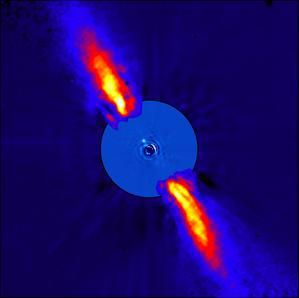
beta Pictoris b
صورة
الشرح: This composite of two images shows the planet beta Pictoris b and a disk of material both of which orbit the young star beta Pictoris. Both are taken in infrared light. The inner image was one of the first pictures taken of a planet around another star (an exoplanet). This image was made using a technique called adaptive optics which removes the blurring effect of the Earth's atmosphere that spreads out a star's light. The star's light is then concentrated tightly enough that it can be hidden behind a blocking circle (shown here in black) called a coronagraph. The ripples around this are artifacts of the imaging process. Beta Pictoris b, a gas giant planet about twelve times the mass of Jupiter, appears as a dot above and to the left of the black circle.
The outer image shows the thermal emission from the warm disk of material surrounding the young star beta Pictoris. As we are viewing this disk edge-on it appears as a line. This disk of gas and dust provided the material to form beta Pictoris b.
المصدر: ESO/A.-M. Lagrange et al.
رابط المصدر
مصطلحات المعجم:
الكوكب الخارجي , تكوُّن الكواكب , البصريات المكيفة
فئات:
الكواكب الخارجية وعلم الأحياء الفلكية
الترخيص: المشاع الإبداعي نَسب المُصنَّف 4.0 دولي (CC BY 4.0) المشاع الإبداعي نَسب المُصنَّف 4.0 دولي (CC BY 4.0) أيقونات
ملف
( صورة
128.05 kB)
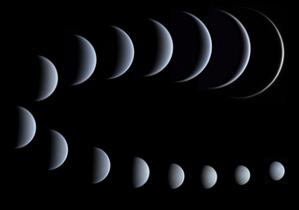
A Matter of Perspective
صورة
أُنشئ لصالح OAE
الشرح: Second place winner in the 2023 IAU OAE Astrophotography Contest, category of Still images of phases of Venus.
This exquisite series of images, captured from Santo Domingo, Dominican Republic, between 17 December 2019 and 25 May 2020, shows the phases of Venus as seen from Earth. As Venus and Earth orbit the Sun, we observe different portions of Venus’s sunlit half, similar to the Moon’s phases. The sequence clearly shows Venus as distant, small, bright and gibbous in the lower frames, and ends with Venus reaching the biggest apparent size of all planets (upper frames), very close to the Sun with a small elongation, and appearing as a thin crescent. In the last frame, only 2.8% of the planet’s surface is illuminated.
المصدر: Christofer Baez/IAU OAE (CC BY 4.0)
مصطلحات المعجم:
الطَّوْر , كوكب الزهرة
فئات:
النظام الشمسي
وسوم:
astrophotography
الترخيص: المشاع الإبداعي نَسب المُصنَّف 4.0 دولي (CC BY 4.0) المشاع الإبداعي نَسب المُصنَّف 4.0 دولي (CC BY 4.0) أيقونات
هذا الملف على Zenodo ( صورة 339.56 kB)





