المستندات والموارد - نتائج البحث
نتائج البحث
Camelopardalis Constellation Map
صورة
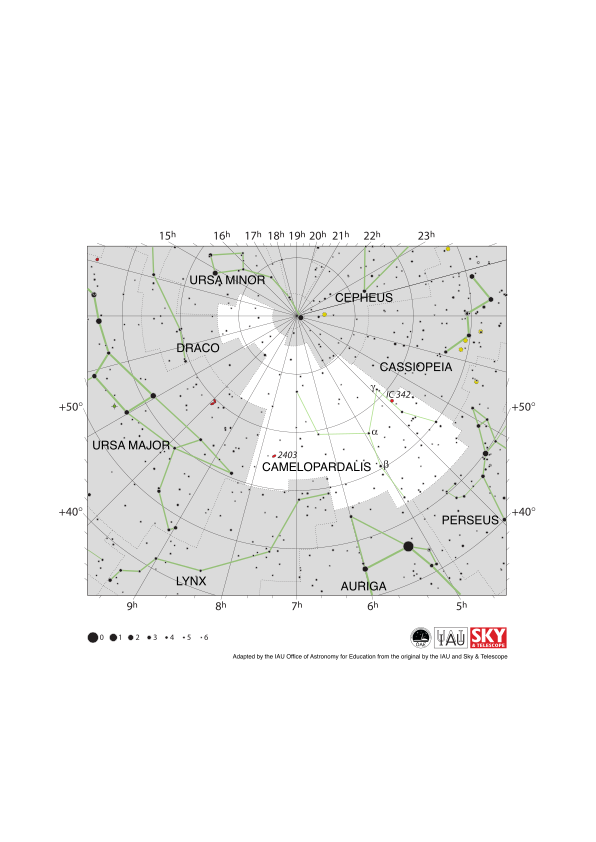
الشرح: The constellation Camelopardalis with its bright stars and surrounding constellations. Camelopardalis is surrounded by (going clockwise from the top): Cepheus, Cassiopea, Perseus, Auriga, Lynx, Ursa Major, Draco and Ursa Minor. Camelopardalis is a large constellation but contains relatively few bright stars.
Camelopardalis is a northern constellation and as such the whole constellation is visible for the whole northern hemisphere at some point in the year. It is also visible from equatorial parts of the southern hemisphere with some parts visible to temperate southern regions. The whole constellation is circumpolar for all arctic and more northerly temperate regions of the northern hemisphere. Camelopardalis is best viewed in the evening in the late northern hemisphere winter and late southern hemisphere summer.
The spiral galaxies NGC 2403 and IC 342 lie in Camelopardalis and are marked here with red ellipses.
This diagram maps an area around the north celestial pole. Here lines of constant right ascension converge. The right ascension values of these lines are marked on the x-axis above and below the diagram. Some of the lines of constant declination are marked on the y-axis. The sizes of the stars marked here relate to the star's apparent magnitude, a measure of its apparent brightness. The larger dots represent brighter stars. The Greek letters mark the brightest stars in the constellation. These are ranked by brightness with the brightest star being labeled alpha, the second brightest beta, etc., although this ordering is not always followed exactly. The dotted boundary lines mark the IAU's boundaries of the constellations and the solid green lines mark one of the common forms used to represent the figures of the constellations. Neither the constellation boundaries, nor the lines joining the stars appear on the sky.
المصدر: Adapted by the IAU Office of Astronomy for Education from the original by the IAU and Sky & Telescope
رابط المصدر
مصطلحات المعجم:
القدرالظاهري , الإحداثيات السماوية , النجوم القطبية , مجموعة نجمية او حشد نجمى , الميل , القطب السماوي الشمالي , المطلع المستقيم , المجرة الحلزونية
فئات:
علم الفلك بالعين المجردة
الترخيص: المشاع الإبداعي نَسب المُصنَّف 4.0 دولي (CC BY 4.0) المشاع الإبداعي نَسب المُصنَّف 4.0 دولي (CC BY 4.0) أيقونات
ملف
( صورة
138.40 kB)
ملف PDF
(PDF file
215.25 kB)
Cetus Constellation Map
صورة
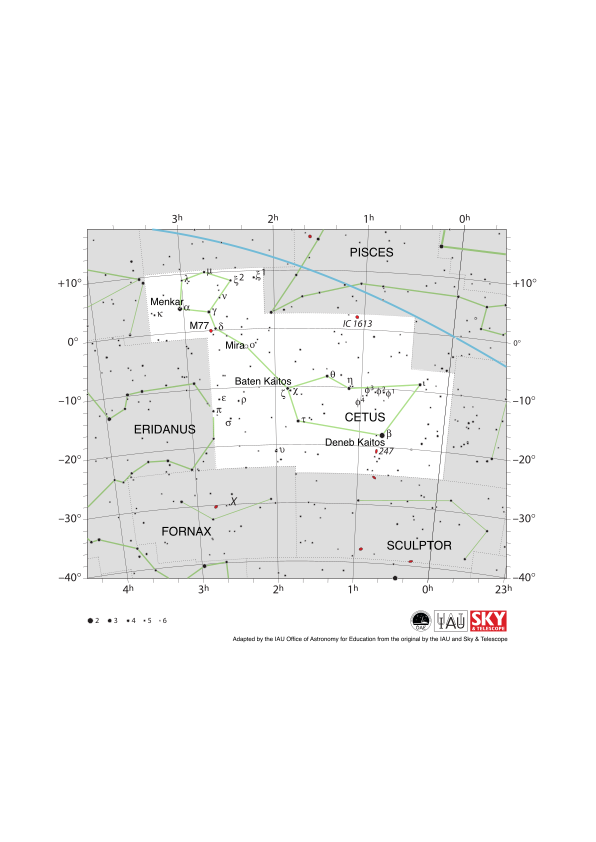
الشرح: The constellation Cetus along with its bright stars and surrounding constellations. Cetus is surrounded by (going clockwise from the top): Pisces, Aquarius, Sculptor, Fornax, Eridanus, Taurus and Aries. Cetus lies just south of the ecliptic (shown here as a blue line), this is the path the Sun appears to take across the sky over the course of a year. While the Sun does not pass through Cetus, the other planets of the solar system and the Moon can sometimes be found in Cetus. The star Omicron Ceti or Mira is a famous variable star. This red giant varies in brightness by a factor of 600 over the course of its eleven month period.
Cetus spans the celestial equator, thus some part of the constellation is visible from all the the Earth at some point in the year. The full constellation is visible from equatorial and temperate regions of both hemispheres. Cetus is most visible in the evenings in the northern hemisphere late autumn and the southern hemisphere late spring.
The barred spiral galaxy M77 lies in Cetus as does the spiral galaxy NGC 247 and the dwarf irregular galaxy IC 1613. All three are marked here with red ellipses.
The y-axis of this diagram is in degrees of declination with north as up and the x-axis is in hours of right ascension with east to the left. The sizes of the stars marked here relate to the star's apparent magnitude, a measure of its apparent brightness. The larger dots represent brighter stars. Mira is marked with an open circle as it is a variable star not always visible to the naked eye. The Greek letters mark the brightest stars in the constellation. These are ranked by brightness with the brightest star being labeled alpha, the second brightest beta, etc., although this ordering is not always followed exactly. The dotted boundary lines mark the IAU's boundaries of the constellations and the solid green lines mark one of the common forms used to represent the figures of the constellations. Neither the constellation boundaries, nor the line marking the ecliptic, nor the lines joining the stars appear on the sky.
المصدر: Adapted by the IAU Office of Astronomy for Education from the original by IAU/Sky & Telescope
رابط المصدر
مصطلحات المعجم:
القدرالظاهري , الإحداثيات السماوية , مجموعة نجمية او حشد نجمى , الميل , مسار البروج , المطلع المستقيم , دائرة البروج , النجم المتغير
فئات:
علم الفلك بالعين المجردة
الترخيص: المشاع الإبداعي نَسب المُصنَّف 4.0 دولي (CC BY 4.0) المشاع الإبداعي نَسب المُصنَّف 4.0 دولي (CC BY 4.0) أيقونات
ملف
( صورة
106.77 kB)
ملف PDF
(PDF file
206.60 kB)
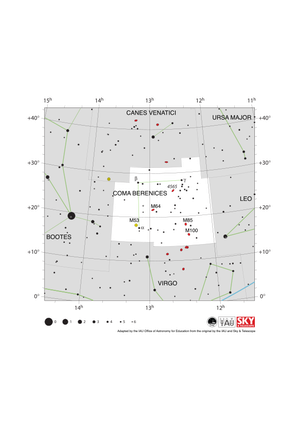
Coma Berenices Constellation Map
صورة
الشرح: The constellation Coma Berenices with its brighter stars and surrounding constellations. Coma Berenices is surrounded by (going clockwise from the top): Canes Venatici, Ursa Major, Leo, Virgo and Boötes. This constellation has relatively few bright stars.
Coma Berenices is a northern constellation close to the celestial equator. As such the whole constellation is visible at some point in the year everywhere on Earth except the most antarctic regions. The constellation is best viewed in the evening in the northern hemisphere late spring and southern hemisphere late autumn.
Coma Berenices is home to a large cluster of galaxies known as the Coma Supercluster. However none of the galaxies in this cluster are marked on this diagram as they are too faint to observe with most amateur telescopes. The elliptical galaxy M85 and the spiral galaxy M100 are members of the nearer Virgo cluster of galaxies. These are marked with red ellipses as are the even nearer M64 and NGC 4565, both of which are spiral galaxies. The globular cluster M53, marked here with a yellow circle with a plus sign superimposed on it, also lies in Coma Berenices.
The y-axis of this diagram is in degrees of declination with north as up and the x-axis is in hours of right ascension with east to the left. The sizes of the stars marked here relate to the star's apparent magnitude, a measure of its apparent brightness. The larger dots represent brighter stars. The Greek letters mark the brightest stars in the constellation. These are ranked by brightness with the brightest star being labeled alpha, the second brightest beta, etc., although this ordering is not always followed exactly. The dotted boundary lines mark the IAU's boundaries of the constellations and the solid green lines mark one of the common forms used to represent the figures of the constellations. The blue line at the bottom right of the diagram marks the ecliptic. Neither the constellation boundaries, nor the line marking the ecliptic, nor the lines joining the stars appear on the sky.
المصدر: Adapted by the IAU Office of Astronomy for Education from the original by the IAU and Sky & Telescope
رابط المصدر
مصطلحات المعجم:
القدرالظاهري , الإحداثيات السماوية , عنقود المجرات , مجموعة نجمية او حشد نجمى , الميل , مسار البروج , المجرة البيضوية , كوكبة الأسد , المطلع المستقيم , المجرة الحلزونية , العذراء
فئات:
علم الفلك بالعين المجردة
الترخيص: المشاع الإبداعي نَسب المُصنَّف 4.0 دولي (CC BY 4.0) المشاع الإبداعي نَسب المُصنَّف 4.0 دولي (CC BY 4.0) أيقونات
ملف
( صورة
87.27 kB)
ملف PDF
(PDF file
161.42 kB)
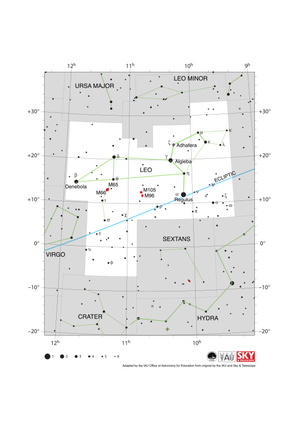
Leo Constellation Map
صورة
الشرح: The zodiac constellation Leo and its surrounding constellations. Starting from the top of the diagram and going clockwise, these are Leo Minor, Cancer, Sextans, Hydra, Crater, Virgo and Ursa Major. The brightest star in Leo, Regulus, lies almost exactly on the ecliptic (shown here as a blue line): the path the Sun appears to take across the sky over the course of a year. The Sun spends the period from mid August to mid September in Leo. The other planets in the Solar System can often be found in Leo.
Leo spans the celestial equator and is thus part of it is visible at some time in the year from all of planet Earth with some of the constellation obscured for the most arctic and antarctic regions of the world. Leo is most visible in the evenings in the northern hemisphere spring and southern hemisphere autumn.
Several objects can be seen in Leo, including M65 and M66 – two galaxies in the Leo Triplet, a trio of galaxies including NGC 3628, not listed here. In addition, M96, a spiral galaxy, can be seen as a fuzzy object using a small telescope, and Messier 105, an elliptical galaxy. Each of these objects are labelled on the map as red ellipses.
The y-axis of this diagram is in degrees of declination with north as up and the x-axis is in hours of right ascension with east to the left. The sizes of the stars marked here relate to the star's apparent magnitude, a measure of its apparent brightness. The larger dots represent brighter stars. The Greek letters mark the brightest stars in the constellation. These are ranked by brightness with the brightest star being labelled alpha, the second brightest beta, etc., although this ordering is not always followed exactly. The dotted boundary lines mark the IAU's boundaries of the constellations and the solid green lines mark one of the common forms used to represent the figures of the constellations. Neither the constellation boundaries, nor the line marking the ecliptic, nor the lines joining the stars appear on the sky.
المصدر: Adapted by the IAU Office of Astronomy for Education from the original by IAU/Sky & Telescope
رابط المصدر
مصطلحات المعجم:
القدرالظاهري , الإحداثيات السماوية , مجموعة نجمية او حشد نجمى , الميل , مسار البروج , المجرة البيضوية , المجرة , كوكبة الأسد , المطلع المستقيم , المجرة الحلزونية , دائرة البروج , كوكبة السرطان , العذراء
فئات:
علم الفلك بالعين المجردة
الترخيص: المشاع الإبداعي نَسب المُصنَّف 4.0 دولي (CC BY 4.0) المشاع الإبداعي نَسب المُصنَّف 4.0 دولي (CC BY 4.0) أيقونات
ملف
( صورة
114.25 kB)
ملف PDF
(PDF file
186.50 kB)
خريطة كوكبة سنتوروس او قنطورس
الشرح: كوكبة سنتوروس بنجومها اللامعة والمجموعات النجمية المحيطة بها. تحيط بكوكبة سنتوروس (في اتجاه عقارب الساعة من الأعلى): هيدرا وأنتيليا وفيلا وكارينا وكارينا وموسكا وكروكس وسيركوس ولوبس والميزان. سنتوروس هي كوكبة كبيرة تشتهر بألمع نجومها ألفا سنتوري. ألفا سنتوري هو نظام نجمي ثلاثي وهو أقرب نظام نجمي إلى النظام الشمسي. عند النظر إليه بالعين المجردة، يظهر ألمع نجمين من ألفا سنتوري كنجم واحد. ويجعل الضوء المنبعث من هذين النجمين معاً ألفا سنتوري يبدو كثالث ألمع نجم في سماء الليل. أما المكوِّن الثالث من نظام ألفا سنتوري بروكسيما سنتوري، وهو أقرب نجم إلى الشمس، فهو خافت للغاية بحيث لا يمكن رؤيته بالعين المجردة.
سنتوروس هو كوكبة جنوبية، وبالتالي فإن الكوكبة بأكملها مرئية من نصف الكرة الجنوبي في وقت ما من السنة. يمكن رؤية الكوكبة بأكملها أيضًا من المناطق الاستوائية في نصف الكرة الشمالي مع رؤية أجزاء من الكوكبة من المناطق الشمالية المعتدلة. من الأفضل رؤية الكوكبة في المساء في أواخر الربيع في نصف الكرة الشمالي وأواخر الخريف في نصف الكرة الجنوبي.
يقع الحشد الكروي أوميغا سنتوري، المعروف أيضاً باسم NGC 5319، في كوكبة سنتوروس. كان هذا العنقود ساطعًا بما يكفي لرؤيته بالعين المجردة، وقد أُعطي في البداية تسمية نجم في الكوكبة قبل أن تتضح طبيعته الحقيقية. وقد تم تمييزه هنا بدائرة صفراء عليها علامة زائد. وكذلك الحشد الكروي NGC 5286. تم تمييز الحشد النجمى المفتوح NGC 3766 هنا بدائرة صفراء. NGC 5128، المعروف أيضًا باسم Centaurus A، هو أقرب مجرة نشطة إلى الأرض. ويطلق الثقب الأسود فائق الكتلة في قلب هذه المجرة نفاثتين ضخمتين من المادة تنبعث منهما أطوال موجية مختلفة بما في ذلك الأشعة السينية والانبعاثات الراديوية. تم تمييز المجرة NGC 5128 بعلامة بيضاوية حمراء هنا، وكذلك المجرة الحلزونية NGC 4945.
المحور y في هذا الرسم البياني يمثل المطلع المستقيم وهو الزاويه المحصوره بين الدائره الساعيه لجرم سماوى و الدائره الساعيه لنقطة الاعتدال الربيعى. المطلع المستقيم يقاس بالساعات ويمثل قوس دائره الاستواء السماويه من نقطه الاعتدال الربيعى الى نقطه تقاطع الدائره الساعيه لجرم سماوى مع دائره الاستواء السماويه.
والمحور X يمثل الميل و يقاس بالدرجات وهو قيمة الزاويه بين أى جسم سماوى و خط الاستواء السماوى. لو وقع النجم شمال خط الاستواء السماوى تكون قيمة الميل بالموجب ولو وقع النجم جنوب خط الاستواء السماوى تكون قيمة بالميل بالسالب.
يوضح الشكل أحجام النجوم المحددة هنا بالقدر الظاهري للنجم، وهو مقياس لسطوعه الظاهري. تمثل النقاط الأكبر حجماً النجوم الأكثر سطوعاً. تشير الحروف اليونانية إلى ألمع النجوم في الكوكبة. وهي مُرتَّبة حسب السطوع حيث يُسمَّى النجم الأكثر سطوعًا ألفا، وثاني ألمع نجم بيتا، إلخ، على الرغم من أن هذا الترتيب لا يُتَّبع دائمًا بدقة. تشير خطوط الحدود المنقطة إلى الحدود التي وضعها الاتحاد الفلكي الدولي للمجموعات النجمية والخطوط الخضراء المتصلة تشير إلى أحد الأشكال الشائعة المستخدمة لتمثيل أشكال المجموعات النجمية. وبالطبع فإن حدود الكوكبات و الخطوط التي تربط بين النجوم فى هذا الشكل لاتظهر على صفحة السماء.
المصدر: بتصرف من قبل مكتب الاتحاد الفلكي الدولي للاتحاد الفلكي الدولي للتعليم من النسخة الأصلية للاتحاد الفلكي الدولي والاتحاد الفلكي الدولي وسكاي آند تليسكوب
رابط المصدر
مصطلحات المعجم:
القدرالظاهري , الإحداثيات السماوية , مجموعة نجمية او حشد نجمى , الميل , العنقود النجمي الكروي , المطلع المستقيم , العنقود المفتوح , رجل القنطور
فئات:
علم الفلك بالعين المجردة
الترخيص: المشاع الإبداعي نَسب المُصنَّف 4.0 دولي (CC BY 4.0) المشاع الإبداعي نَسب المُصنَّف 4.0 دولي (CC BY 4.0) أيقونات