المستندات والموارد - نتائج البحث
نتائج البحث
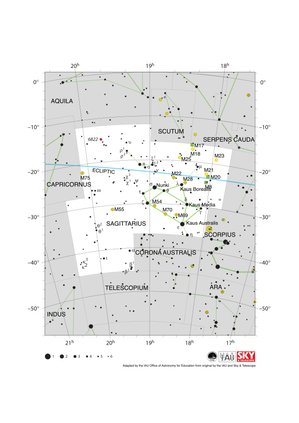
Sagittarius Constellation Map
صورة
الشرح: The constellation Sagittarius along with its bright stars and surrounding constellations. Sagittarius is surrounded by (going clockwise from the top) Aquila, Scutum, Serpens Cauda, Ophiuchus, Scorpius, Corona Australis, Telescopium, Microscopium and Capricornus. The brighter stars in Sagittarius form a distinctive teapot shape. Sagittarius lies on the ecliptic (shown here as a blue line), this is the path the Sun appears to take across the sky over the course of a year. The Sun is in Sagittarius from mid December to mid January. The other planets of the Solar System can often be found in Sagittarius.
Sagittarius lies south of the celestial equator. The famous teapot asterism is visible for all but the most arctic regions of the world but the most southerly parts of the constellation are not visible in northern parts of Asia, Europe and North America. Sagittarius is most visible in the evenings in the northern hemisphere summer and southern hemisphere winter.
The supermassive black hole Sagittarius A* which lies at the center of our Milky Way Galaxy is sits on the western (here right-hand) edge of Sagittarius. Due to it covering an area at the center of our Galaxy, Sagittarius is home to many star clusters including open clusters (marked here with yellow circles) and globular clusters (marked here with yellow circles with + signs superimposed on them). Three nebulae are also marked here with green squares.
The y-axis of this diagram is in degrees of declination with north as up and the x-axis is in hours of right ascension with east to the left. The sizes of the stars marked here relate to the star's apparent magnitude, a measure of its apparent brightness. The larger dots represent brighter stars. The Greek letters mark the brightest stars in the constellation. These are ranked by brightness with the brightest star being labeled alpha, the second brightest beta, etc., although this ordering is not always followed exactly. The dotted boundary lines mark the IAU's boundaries of the constellations and the solid green lines mark one of the common forms used to represent the figures of the constellations. Neither the constellation boundaries, nor the line marking the ecliptic, nor the lines joining the stars appear on the sky.
المصدر: Adapted by the IAU Office of Astronomy for Education from the original by IAU/Sky & Telescope
رابط المصدر
مصطلحات المعجم:
القدرالظاهري , كوكبة الجدي , الإحداثيات السماوية , مجموعة نجمية او حشد نجمى , الميل , مسار البروج , العنقود النجمي الكروي , درب التبانة , السديم , المطلع المستقيم , القوس أ* , كوكبة العقرب , ثقب أسود فائق الكتلة , دائرة البروج , المجمة , العنقود المفتوح , القوس
فئات:
علم الفلك بالعين المجردة
الترخيص: المشاع الإبداعي نَسب المُصنَّف 4.0 دولي (CC BY 4.0) المشاع الإبداعي نَسب المُصنَّف 4.0 دولي (CC BY 4.0) أيقونات
ملف
( صورة
150.62 kB)
ملف PDF
(PDF file
219.78 kB)

Sextans Constellation Map
صورة
الشرح: The constellation Sextans with its brighter stars and surrounding constellations. Sextans is surrounded by (going clockwise from the top): Leo, Hydra and Crater. Sextans is a small constellation with relatively few bright stars.
Sextans spans the celestial equator and thus parts of the constellation are visible at some point in the year across the Earth. The whole constellation is visible in all but the most arctic and most antarctic regions. Sextans is best viewed in the evening in the northern hemisphere spring and southern hemisphere autumn.
The lenticular galaxy NGC 3115 lies in Sextans. It is marked here with a red ellipse.
The y-axis of this diagram is in degrees of declination with north as up and the x-axis is in hours of right ascension with east to the left. The sizes of the stars marked here relate to the star's apparent magnitude, a measure of its apparent brightness. The larger dots represent brighter stars. The Greek letters mark the brightest stars in the constellation. These are ranked by brightness with the brightest star being labeled alpha, the second brightest beta, etc., although this ordering is not always followed exactly. The dotted boundary lines mark the IAU's boundaries of the constellations and the solid green lines mark one of the common forms used to represent the figures of the constellations. The blue line at the top of the diagram marks the ecliptic. Neither the constellation boundaries, nor the lines joining the stars, nor the ecliptic, appear on the sky.
المصدر: Adapted by the IAU Office of Astronomy for Education from the original by the IAU and Sky & Telescope
رابط المصدر
مصطلحات المعجم:
القدرالظاهري , الإحداثيات السماوية , خط الاستواء السماوي , مجموعة نجمية او حشد نجمى , الميل , مسار البروج , كوكبة الأسد , المطلع المستقيم , المجرة العدسية
فئات:
علم الفلك بالعين المجردة
الترخيص: المشاع الإبداعي نَسب المُصنَّف 4.0 دولي (CC BY 4.0) المشاع الإبداعي نَسب المُصنَّف 4.0 دولي (CC BY 4.0) أيقونات
ملف
( صورة
73.40 kB)
ملف PDF
(PDF file
153.02 kB)

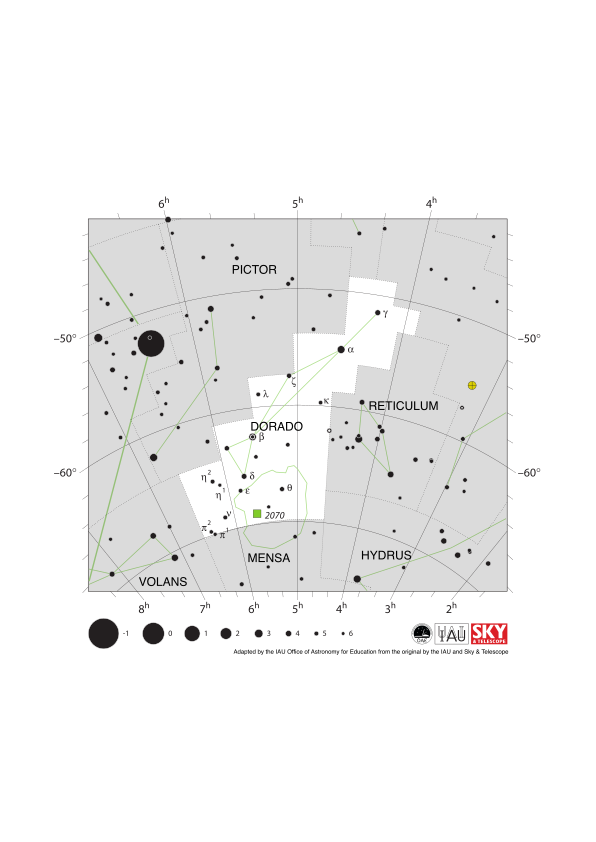
Dorado Constellation Map
صورة
الشرح: The constellation Dorado with its bright stars and surrounding constellations. Dorado is surrounded by (going clockwise from the top): Pictor, Caelum, Horologium, Reticulum, Hydrus, Mensa and Volans.
Dorado is a southern constellation and thus the whole constellation is visible at some point in the year from the whole southern hemisphere. The whole constellation is also visible to equatorial regions of the northern hemisphere. Dorado is circumpolar for temperate and antarctic regions of the southern hemisphere. This constellation is best viewed in the northern hemisphere winter and southern hemisphere summer.
The Large Magellanic Cloud (LMC), a satellite galaxy of the Milky Way, lies in Dorado and the neighboring constellation Mensa. The outline of the Large Magellanic Cloud is marked here as a roughly circular loop in green. The open cluster NGC 2070 lies at the heart of the Tarantula Nebula. This is marked here with a green square.
The y-axis of this diagram is in degrees of declination with north as up and the x-axis is in hours of right ascension with east to the left. The sizes of the stars marked here relate to the star's apparent magnitude, a measure of its apparent brightness. The larger dots represent brighter stars. The Greek letters mark the brightest stars in the constellation. These are ranked by brightness with the brightest star being labeled alpha, the second brightest beta, etc., although this ordering is not always followed exactly. The dotted boundary lines mark the IAU's boundaries of the constellations and the solid green lines mark one of the common forms used to represent the figures of the constellations. Neither the constellation boundaries, nor the lines joining the stars appear on the sky.
المصدر: Adapted by the IAU Office of Astronomy for Education from the original by the IAU and Sky & Telescope
رابط المصدر
مصطلحات المعجم:
القدرالظاهري , الإحداثيات السماوية , النجوم القطبية , مجموعة نجمية او حشد نجمى , الميل , السديم , المطلع المستقيم , العنقود المفتوح , سحابة ماجلان الكبرى
فئات:
علم الفلك بالعين المجردة
الترخيص: المشاع الإبداعي نَسب المُصنَّف 4.0 دولي (CC BY 4.0) المشاع الإبداعي نَسب المُصنَّف 4.0 دولي (CC BY 4.0) أيقونات
ملف
( صورة
94.49 kB)
ملف PDF
(PDF file
155.00 kB)

Mensa Constellation Map
صورة
الشرح: The constellation Mensa with its brighter stars and surrounding constellations. Mensa is surrounded by (going clockwise from the top): Dorado, Hydrus, Octans, Chamaeleon and Volans. Mensa is a faint constellation with relatively few bright stars.
Mensa lies close to the south celestial pole and thus the whole constellation is visible at some point in the year throughout the southern hemisphere. The whole constellation is visible to a thin strip of the northern hemisphere around the equator with parts of the constellation visible to some other northern equatorial regions. Mensa is circumpolar in temperate, antarctic and some equatorial regions of the southern hemisphere. Mensa is best viewed in the evenings in the northern hemisphere winter and southern hemisphere summer.
The Large Magellanic Cloud (LMC), a satellite galaxy of the Milky Way, lies in Mensa and the neighboring constellation Dorado. The outline of the Large Magellanic Cloud is marked here as a roughly circular loop in green.
This diagram maps an area around the south celestial pole. Here lines of constant right ascension converge. The right ascension values of these lines are marked on the x-axis above and below the diagram. The solid circle around the pole marks a line of -80° declination with the larger, incomplete circle to the right marking -70° declination. The sizes of the stars marked here relate to the star's apparent magnitude, a measure of its apparent brightness. The larger dots represent brighter stars. The Greek letters mark the brightest stars in the constellation. These are ranked by brightness with the brightest star being labeled alpha, the second brightest beta, etc., although this ordering is not always followed exactly. The dotted boundary lines mark the IAU's boundaries of the constellations and the solid green lines mark one of the common forms used to represent the figures of the constellations. Neither the constellation boundaries, nor the lines joining the stars appear on the sky.
المصدر: Adapted by the IAU Office of Astronomy for Education from the original by the IAU and Sky & Telescope
رابط المصدر
مصطلحات المعجم:
القدرالظاهري , الإحداثيات السماوية , مجموعة نجمية او حشد نجمى , الميل , المطلع المستقيم
فئات:
علم الفلك بالعين المجردة
الترخيص: المشاع الإبداعي نَسب المُصنَّف 4.0 دولي (CC BY 4.0) المشاع الإبداعي نَسب المُصنَّف 4.0 دولي (CC BY 4.0) أيقونات
ملف
( صورة
135.16 kB)
ملف PDF
(PDF file
172.00 kB)
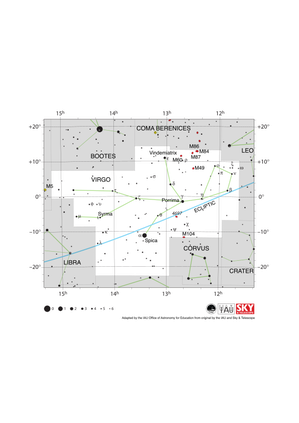
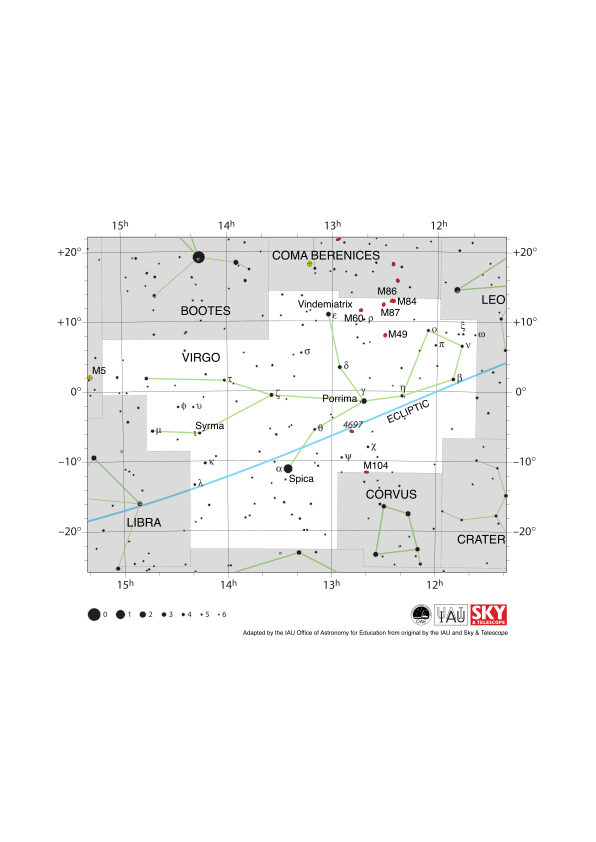
Virgo Constellation Map
صورة
الشرح: The zodiac constellation Virgo and its surrounding constellations. Starting from the top of the diagram and going clockwise, these are Coma Berenices, Leo, Crater, Corvus, Libra, and Bootes. The brightest star in Virgo, Spica, lies just below the ecliptic (shown here as a blue line) in the middle of the map. One way of locating this star in the night sky is to follow the handle of the Big Dipper to the star Arcturus in Bootes and go along a line straight down to Spica (“arc to Arcturus and spike to Spica”). This star lies just below the ecliptic. The ecliptic is the path the Sun appears to take across the sky over the course of a year. The Sun is in Virgo from mid September to late October. The other planets of the Solar System can often be found in Virgo.
Virgo spans the celestial equator and is thus part of it is visible at some time in the year from all of planet Earth with some of the constellation obscured for the most arctic and antarctic regions of the world. Virgo is most visible in the evenings in the northern hemisphere spring and southern hemisphere autumn.
The constellation Virgo appears as a person lying with their back roughly against the ecliptic, arms outstretched, and feet pointed east. Several deep-sky objects are visible in Virgo, including NGC4697, M49, M87, M86, M84, and M60, all of which are labelled as red ellipses on the map. These are all spiral and elliptical galaxies located several millions of lightyears from Earth. Most notably, M87 is host to the supermassive black hole (Pōwehi) that was imaged by the Event Horizon Telescope in 2019. All of these galaxies are members of the Virgo Cluster, the nearest cluster of galaxies to the Milky Way.
The y-axis of this diagram is in degrees of declination with north as up and the x-axis is in hours of right ascension with east to the left. The sizes of the stars marked here relate to the star's apparent magnitude, a measure of its apparent brightness. The larger dots represent brighter stars. The Greek letters mark the brightest stars in the constellation. These are ranked by brightness with the brightest star being labelled alpha, the second brightest beta, etc., although this ordering is not always followed exactly. The dotted boundary lines mark the IAU's boundaries of the constellations and the solid green lines mark one of the common forms used to represent the figures of the constellations. Neither the constellation boundaries, nor the line marking the ecliptic, nor the lines joining the stars appear on the sky.
المصدر: Adapted by the IAU Office of Astronomy for Education from the original by IAU/Sky & Telescope
رابط المصدر
مصطلحات المعجم:
القدرالظاهري , المغرفة الكبرى , الإحداثيات السماوية , عنقود المجرات , مجموعة نجمية او حشد نجمى , الميل , مسار البروج , المجرة البيضوية , كوكبة الأسد , الميزان , المطلع المستقيم , المجرة الحلزونية , ثقب أسود فائق الكتلة , دائرة البروج , العذراء
فئات:
علم الفلك بالعين المجردة
الترخيص: المشاع الإبداعي نَسب المُصنَّف 4.0 دولي (CC BY 4.0) المشاع الإبداعي نَسب المُصنَّف 4.0 دولي (CC BY 4.0) أيقونات
ملف
( صورة
94.70 kB)
ملف PDF
(PDF file
188.33 kB)