Dokumente & Ressourchen - Suchergebnisse
Suchergebnisse

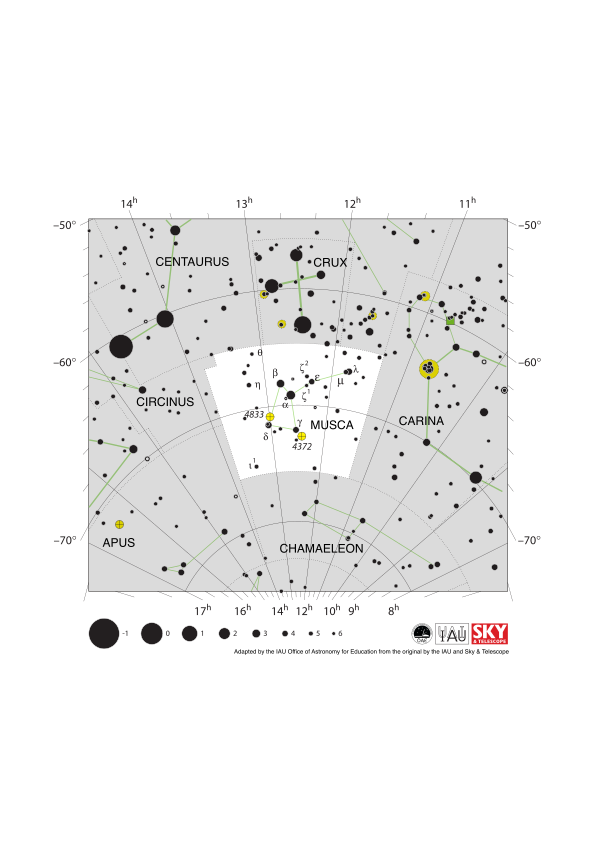
Musca Constellation Map
Bild
Unterschrift: The constellation Musca with its bright stars and surrounding constellations. Musca is surrounded by (going clockwise from the top): Crux, Centaurus, Carina, Chamaeleon, Apus and Circinus.
Musca is a southern constellation and thus the whole constellation is visible at some point in the year throughout the southern hemisphere. The whole constellation is visible to a thin strip of the northern hemisphere near the equator with parts of the constellation visible to other northern equatorial regions. Musca is circumpolar in temperate and antarctic regions of the southern hemisphere. Musca is best viewed in the evening in the northern hemisphere late spring and southern hemisphere late autumn.
The globular clusters NGC 4372 and NGC 4833 lie in Musca and are marked here with yellow circles with plus signs superimposed on them.
The y-axis of this diagram is in degrees of declination with north as up and the x-axis is in hours of right ascension with east to the left. The sizes of the stars marked here relate to the star's apparent magnitude, a measure of its apparent brightness. The larger dots represent brighter stars. The Greek letters mark the brightest stars in the constellation. These are ranked by brightness with the brightest star being labeled alpha, the second brightest beta, etc., although this ordering is not always followed exactly. The dotted boundary lines mark the IAU's boundaries of the constellations and the solid green lines mark one of the common forms used to represent the figures of the constellations. Neither the constellation boundaries, nor the lines joining the stars appear on the sky.
Bild: Adapted by the IAU Office of Astronomy for Education from the original by the IAU and Sky & Telescope
Link zur Quelle
Glossar-Begriffe:
Scheinbare Helligkeit , Himmelskoordinaten , Zirkumpolarsterne , Sternbild , Deklination , Rektaszension (RA) , Kreuz des Südens
Kategorien:
Astronomie mit bloßem Auge
Lizenz: Creative Commons Namensnennung 4.0 International (CC BY 4.0) Creative Commons Namensnennung 4.0 International (CC BY 4.0) Symbole
Datei
( Bild
122.56 kB)
PDF-Datei
(PDF file
177.89 kB)

Triangulum Constellation Map
Bild
Unterschrift: The constellation Triangulum with its bright stars and surrounding constellations. Triangulum is surrounded by (going clockwise from the top): Andromeda, Pisces, Aries and Perseus.
Triangulum is a northern constellation and thus the whole constellation is visible at some point in the year throughout the northern hemisphere. The whole constellation is also visible from equatorial and most temperate regions of the southern hemisphere. Triangulum is best viewed in the evening in the northern hemisphere winter and southern hemisphere summer.
The Triangulum Galaxy M33 lies in the constellation. This spiral galaxy is the third largest member of the local group of galaxies after the Andromeda Galaxy and Milky Way. It is marked here with a red ellipse.
The y-axis of this diagram is in degrees of declination with north as up and the x-axis is in hours of right ascension with east to the left. The sizes of the stars marked here relate to the star's apparent magnitude, a measure of its apparent brightness. The larger dots represent brighter stars. The Greek letters mark the brightest stars in the constellation. These are ranked by brightness with the brightest star being labeled alpha, the second brightest beta, etc., although this ordering is not always followed exactly. The dotted boundary lines mark the IAU's boundaries of the constellations and the solid green lines mark one of the common forms used to represent the figures of the constellations. The blue line at the bottom left of the diagram marks the ecliptic. Neither the constellation boundaries, nor the lines joining the stars, nor the ecliptic, appear on the sky.
Bild: Adapted by the IAU Office of Astronomy for Education from the original by the IAU and Sky & Telescope
Link zur Quelle
Glossar-Begriffe:
Andromeda , Andromedagalaxie , Scheinbare Helligkeit , Widder , Himmelskoordinaten , Sternbild , Deklination , Milchstraße , Fische , Rektaszension (RA) , Spiralgalaxie
Kategorien:
Astronomie mit bloßem Auge
Lizenz: Creative Commons Namensnennung 4.0 International (CC BY 4.0) Creative Commons Namensnennung 4.0 International (CC BY 4.0) Symbole
Datei
( Bild
81.19 kB)
PDF-Datei
(PDF file
150.67 kB)
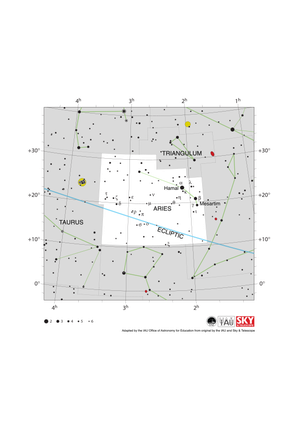
Aries Constellation Map
Bild
Unterschrift: The constellation Aries along with its bright stars and surrounding constellations. Aries is surrounded by (going clockwise from the top) Triangulum, Pisces, Cetus, Taurus and Perseus. Aries lies on the ecliptic (shown here as a blue line), this is the path the Sun appears to take across the sky over the course of a year. The Sun is in Aries from mid April to mid May. The other planets of the Solar System can often be found in Aries.
Aries lies just north of the celestial equator and is thus visible at some time in the year from all of planet Earth except for the most antarctic regions of the world. Aries is most visible in the evenings in the northern hemisphere winter and southern hemisphere summer.
The y-axis of this diagram is in degrees of declination with north as up and the x-axis is in hours of right ascension with east to the left. The sizes of the stars marked here relate to the star's apparent magnitude, a measure of its apparent brightness. The larger dots represent brighter stars. The Greek letters mark the brightest stars in the constellation. These are ranked by brightness with the brightest star being labeled alpha, the second brightest beta, etc., although this ordering is not always followed exactly. The dotted boundary lines mark the IAU's boundaries of the constellations and the solid green lines mark one of the common forms used to represent the figures of the constellations. Neither the constellation boundaries, nor the line marking the ecliptic, nor the lines joining the stars appear on the sky.
Bild: Adapted by the IAU Office of Astronomy for Education from the original by IAU/Sky & Telescope
Link zur Quelle
Glossar-Begriffe:
Scheinbare Helligkeit , Widder , Himmelskoordinaten , Sternbild , Deklination , Ekliptik , Fische , Rektaszension (RA) , Stier , Tierkreis
Kategorien:
Astronomie mit bloßem Auge
Lizenz: Creative Commons Namensnennung 4.0 International (CC BY 4.0) Creative Commons Namensnennung 4.0 International (CC BY 4.0) Symbole
Datei
( Bild
96.59 kB)
PDF-Datei
(PDF file
178.36 kB)

Circinus Constellation Map
Bild
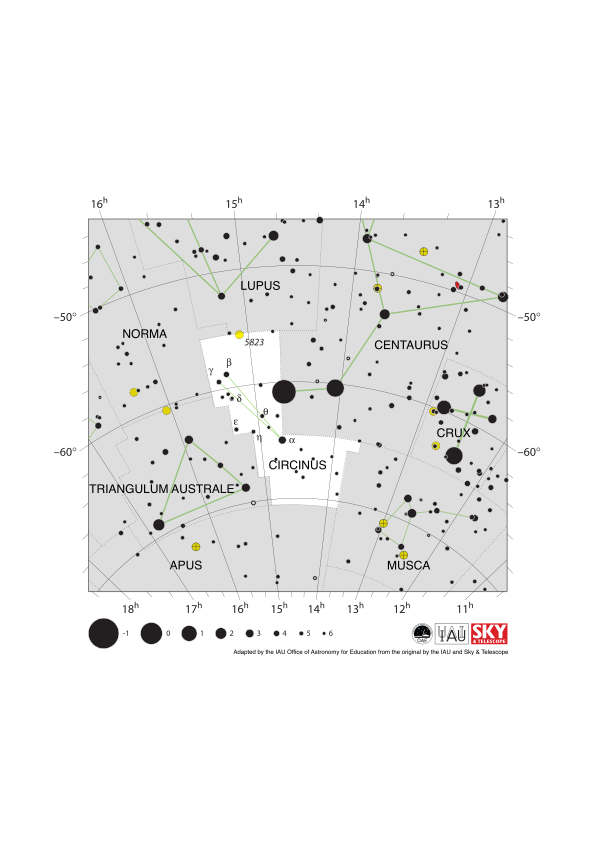
Unterschrift: The constellation Circinus with its brighter stars and surrounding constellations. Circinus is surrounded by (going clockwise from the top): Lupus, Centaurus, Musca, Apus, Triangulum Australe and Norma. Circinus is a relatively small constellation with few bright stars.
Circinus is a southern constellation and is thus the whole constellation is visible from the whole southern hemisphere at some point in the year. The whole constellation can also be seen from some equatorial regions of the northern hemisphere with parts of the constellation visible from the remaining equatorial regions and some northern hemisphere temperate locations. The constellation is circumpolar for all antarctic and some southern hemisphere temperate regions. Circinus is best viewed in the evening in the northern hemisphere summer and southern hemisphere winter.
The open cluster NGC 5823 lies in Circinus and is marked here with a yellow circle.
The y-axis of this diagram is in degrees of declination with north as up and the x-axis is in hours of right ascension with east to the left. The sizes of the stars marked here relate to the star's apparent magnitude, a measure of its apparent brightness. The larger dots represent brighter stars. The Greek letters mark the brightest stars in the constellation. These are ranked by brightness with the brightest star being labeled alpha, the second brightest beta, etc., although this ordering is not always followed exactly. The dotted boundary lines mark the IAU's boundaries of the constellations and the solid green lines mark one of the common forms used to represent the figures of the constellations. Neither the constellation boundaries, nor the lines joining the stars appear on the sky.
Bild: Adapted by the IAU Office of Astronomy for Education from the original by the IAU and Sky & Telescope
Link zur Quelle
Glossar-Begriffe:
Scheinbare Helligkeit , Himmelskoordinaten , Zirkumpolarsterne , Sternbild , Deklination , Rektaszension (RA)
Kategorien:
Astronomie mit bloßem Auge
Lizenz: Creative Commons Namensnennung 4.0 International (CC BY 4.0) Creative Commons Namensnennung 4.0 International (CC BY 4.0) Symbole
Datei
( Bild
115.43 kB)
PDF-Datei
(PDF file
169.32 kB)
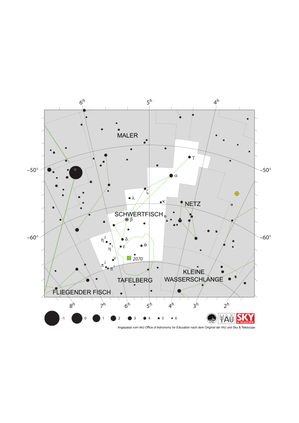
Schwertfisch-Sternkarte
Bild
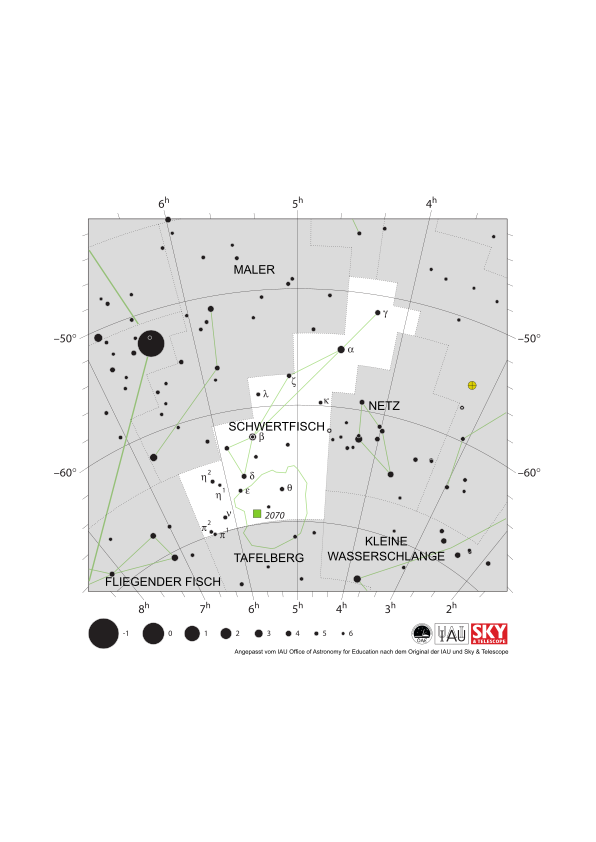
Unterschrift: Das Sternbild Schwertfisch mit seinen hellen Sternen und den umliegenden Sternbildern. Im Uhrzeigersinn von oben gehend ist Dorado umgeben von dem Maler, dem Grabstichel, der Pendeluhr, dem Netz, der Kleinen Wasserschlange, dem Tafelberg und dem Fliegenden Fisch.
Da der Schwertfisch ein südliches Sternbild ist, ist das gesamte Sternbild im Laufe des Jahres irgendwann von der gesamten südlichen Hemisphäre aus sichtbar. Das Sternbild ist auch in den äquatorialen Regionen der nördlichen Hemisphäre sichtbar. Dorado ist zirkumpolar für die gemäßigten und antarktischen Regionen der südlichen Hemisphäre. Dieses Sternbild ist am besten im Winter der Nordhalbkugel und im Sommer der Südhalbkugel zu sehen.
Die Große Magellansche Wolke (LMC), eine Satellitengalaxie der Milchstraße, liegt in dem Schwertfisch und dem benachbarten Sternbild des Tafelberges. Der Umriss der Großen Magellanschen Wolke ist hier als grob kreisförmige Schleife in Grün markiert. Der offene Sternhaufen NGC 2070 liegt im Herzen des Tarantelnebels. Dieser ist hier mit einem grünen Quadrat markiert.
Die y-Achse dieses Diagramms ist in Deklinationsgraden mit Norden nach oben und die x-Achse ist in Rektaszensionsstunden mit Osten nach links. Die Größe der hier markierten Sterne bezieht sich auf die scheinbare Helligkeit des Sterns. Je größer die Punkte, desto heller scheinen die Sterne die sie darstellen. Die griechischen Buchstaben kennzeichnen die hellsten Sterne des Sternbildes. Diese sind nach Helligkeit geordnet, wobei der hellste Stern mit Alpha, der zweithellste mit Beta usw. bezeichnet wird, obwohl diese Reihenfolge nicht immer genau eingehalten wird. Die gepunkteten Begrenzungslinien markieren die IAU-Grenzen der Sternbilder und die durchgezogenen grünen Linien markieren eine der üblichen Formen, die zur Darstellung der Sternbilder verwendet werden. Weder die Grenzen der Sternbilder noch die Linien, die die Sterne verbinden, sind am Himmel sichtbar.
Bild: Angepasst vom IAU Office of Astronomy for Education nach dem Original von IAU und Sky & Telescope
Link zur Quelle
Glossar-Begriffe:
Scheinbare Helligkeit , Himmelskoordinaten , Zirkumpolarsterne , Sternbild , Deklination , Nebel , Rektaszension (RA) , Offener Sternhaufen , Große Magellansche Wolke (LMC oder GMW)
Kategorien:
Astronomie mit bloßem Auge
Lizenz: Creative Commons Namensnennung 4.0 International (CC BY 4.0) Creative Commons Namensnennung 4.0 International (CC BY 4.0) Symbole
Datei
( Bild
97.58 kB)
PDF-Datei
(PDF file
165.37 kB)