Dokumente & Ressourchen - Suchergebnisse
Suchergebnisse
Walfisch-Sternkarte
Bild
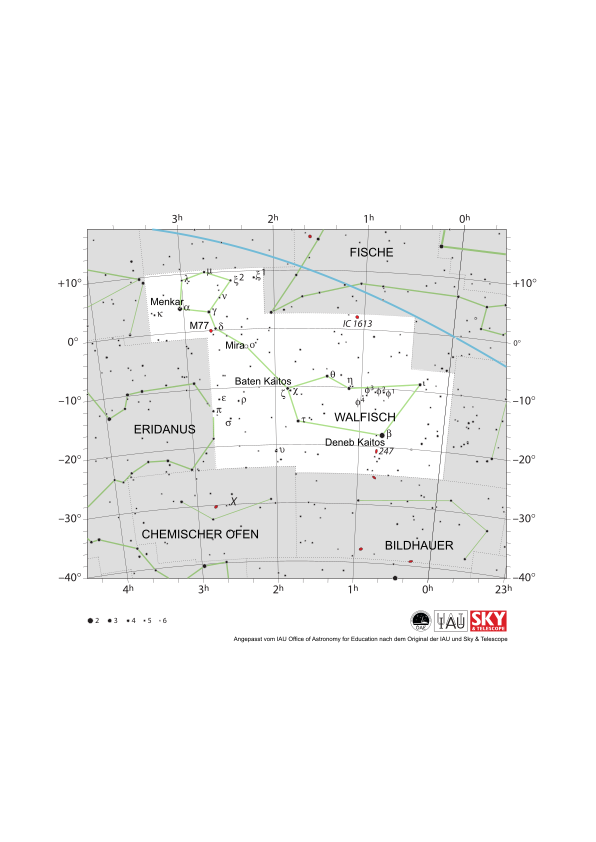
Unterschrift: Das Sternbild Walfisch mit seinen hellen Sternen und den umliegenden Sternbildern. Im Urzeigersinn von oben gesehen ist der Walfisch umgeben von Fischen, dem Wassermann, Bildhauer, Chemischen Ofen, Eridanus, Stier und Widder. Der Walfisch liegt genau südlich der Ekliptik (hier als blaue Linie dargestellt), also dem Weg, den die Sonne im Laufe eines Jahres über den Himmel zu nehmen scheint. Während die Sonne nicht durch den Walfisch läuft, können die anderen Planeten des Sonnensystems und der Mond manchmal im Walfisch gefunden werden. Der Stern Omicron Ceti oder Mira ist ein berühmter veränderlicher Stern. Dieser rote Riese variiert seine Helligkeit im Laufe seiner elfmonatigen Periode um das 600-fache.
Der Walfisch erstreckt sich über den Himmelsäquator, so dass ein Teil des Sternbildes im Laufe des Jahres von der ganzen Erde aus sichtbar ist. Die gesamte Konstellation ist von den äquatorialen und gemäßigten Regionen beider Hemisphären aus sichtbar. Am besten ist der Walfisch abends im Spätherbst auf der Nordhalbkugel und im Spätfrühling auf der Südhalbkugel zu sehen.
Die Balkenspiralgalaxie M77 liegt im Walfisch, ebenso wie die Spiralgalaxie NGC 247 und die unregelmäßige Zwerggalaxie IC 1613. Alle drei sind hier mit roten Ellipsen markiert.
Die y-Achse dieses Diagramms ist in Deklinationsgraden mit Norden nach oben und die x-Achse ist in Rektaszensionsstunden mit Osten nach links angegeben. Die Größe der hier markierten Sterne bezieht sich auf die scheinbare Helligkeit des Sterns. Je größer der Punkt, desto heller scheint der Stern den er darstellt. Mira ist mit einem offenen Kreis markiert, da es sich um einen veränderlichen Stern handelt, der nicht immer mit bloßem Auge sichtbar ist. Die griechischen Buchstaben kennzeichnen die hellsten Sterne des Sternbilds. Diese sind nach Helligkeit geordnet, wobei der hellste Stern mit Alpha, der zweithellste mit Beta usw. bezeichnet wird, obwohl diese Reihenfolge nicht immer genau eingehalten wird. Die gepunkteten Begrenzungslinien markieren die IAU-Grenzen der Sternbilder und die durchgezogenen grünen Linien markieren eine der üblichen Formen, die zur Darstellung der Sternbilder verwendet werden. Weder die Sternbildgrenzen, noch die Linie, die die Ekliptik markiert, noch die Linien, die die Sterne verbinden, sind am Himmel sichtbar.
Bild: Angepasst vom IAU Office of Astronomy for Education nach dem Original von IAU/Sky & Telescope
Link zur Quelle
Glossar-Begriffe:
Scheinbare Helligkeit , Himmelskoordinaten , Sternbild , Deklination , Ekliptik , Rektaszension (RA) , Tierkreis , Veränderlicher Stern
Kategorien:
Astronomie mit bloßem Auge
Lizenz: Creative Commons Namensnennung 4.0 International (CC BY 4.0) Creative Commons Namensnennung 4.0 International (CC BY 4.0) Symbole
Datei
( Bild
108.05 kB)
PDF-Datei
(PDF file
220.55 kB)
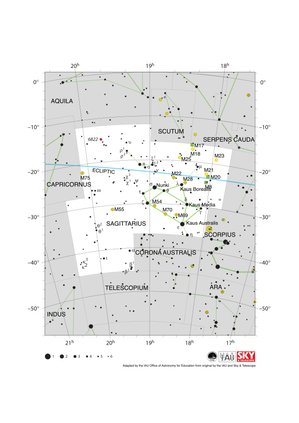
Sagittarius Constellation Map
Bild
Unterschrift: The constellation Sagittarius along with its bright stars and surrounding constellations. Sagittarius is surrounded by (going clockwise from the top) Aquila, Scutum, Serpens Cauda, Ophiuchus, Scorpius, Corona Australis, Telescopium, Microscopium and Capricornus. The brighter stars in Sagittarius form a distinctive teapot shape. Sagittarius lies on the ecliptic (shown here as a blue line), this is the path the Sun appears to take across the sky over the course of a year. The Sun is in Sagittarius from mid December to mid January. The other planets of the Solar System can often be found in Sagittarius.
Sagittarius lies south of the celestial equator. The famous teapot asterism is visible for all but the most arctic regions of the world but the most southerly parts of the constellation are not visible in northern parts of Asia, Europe and North America. Sagittarius is most visible in the evenings in the northern hemisphere summer and southern hemisphere winter.
The supermassive black hole Sagittarius A* which lies at the center of our Milky Way Galaxy is sits on the western (here right-hand) edge of Sagittarius. Due to it covering an area at the center of our Galaxy, Sagittarius is home to many star clusters including open clusters (marked here with yellow circles) and globular clusters (marked here with yellow circles with + signs superimposed on them). Three nebulae are also marked here with green squares.
The y-axis of this diagram is in degrees of declination with north as up and the x-axis is in hours of right ascension with east to the left. The sizes of the stars marked here relate to the star's apparent magnitude, a measure of its apparent brightness. The larger dots represent brighter stars. The Greek letters mark the brightest stars in the constellation. These are ranked by brightness with the brightest star being labeled alpha, the second brightest beta, etc., although this ordering is not always followed exactly. The dotted boundary lines mark the IAU's boundaries of the constellations and the solid green lines mark one of the common forms used to represent the figures of the constellations. Neither the constellation boundaries, nor the line marking the ecliptic, nor the lines joining the stars appear on the sky.
Bild: Adapted by the IAU Office of Astronomy for Education from the original by IAU/Sky & Telescope
Link zur Quelle
Glossar-Begriffe:
Scheinbare Helligkeit , Steinbock , Himmelskoordinaten , Sternbild , Deklination , Ekliptik , Kugelsternhaufen , Milchstraße , Nebel , Rektaszension (RA) , Sagittarius A* , Skorpion , Supermassereiches Schwarzes Loch , Tierkreis , Asterismus , Offener Sternhaufen , Schütze
Kategorien:
Astronomie mit bloßem Auge
Lizenz: Creative Commons Namensnennung 4.0 International (CC BY 4.0) Creative Commons Namensnennung 4.0 International (CC BY 4.0) Symbole
Datei
( Bild
150.62 kB)
PDF-Datei
(PDF file
219.78 kB)
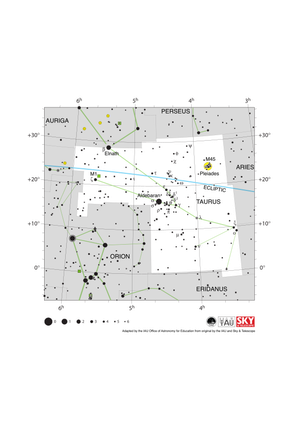
Taurus Constellation Map
Bild
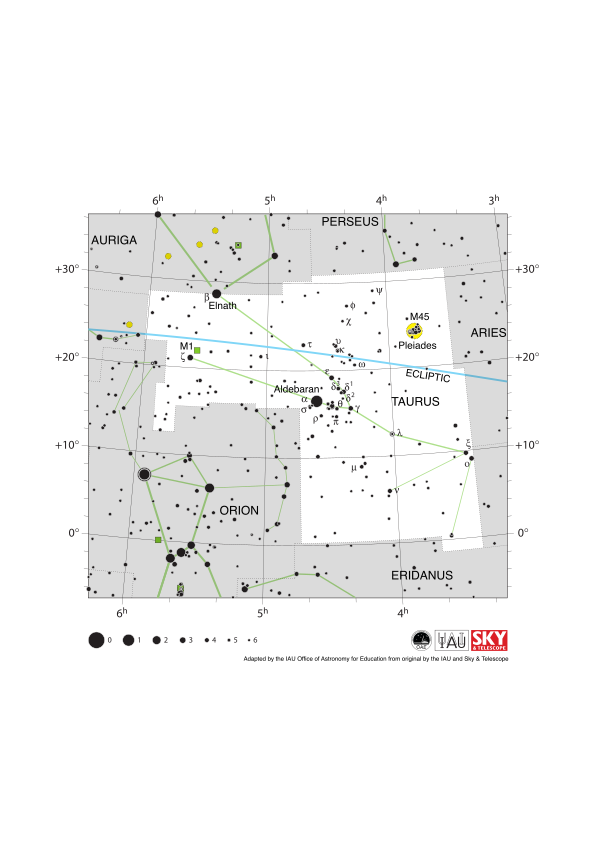
Unterschrift: The constellation Taurus along with its bright stars and surrounding constellations. Taurus is surrounded by (going clockwise from the top) Perseus, Aries, Cetus, Eridanus, Orion, Gemini and Auriga. Taurus’s brightest star Aldebaran appears in the middle of the constellation. Taurus lies on the ecliptic (shown here as a blue line), this is the path the Sun appears to take across the sky over the course of a year. The Sun is in Taurus from mid May to late June. The other planets of the Solar System can often be found in Taurus.
Taurus lies mostly north of the celestial equator with a small part in the celestial southern hemisphere. The whole constellation is visible at some point in the year to whole planet except for the Antarctic and a small region around the North Pole. Taurus is most visible in the evenings in the northern hemisphere winter and southern hemisphere summer.
In the eastern part of Taurus we can find the supernova remnant M1 (commonly known as the Crab Nebula), marked here with a green square. In Taurus’s north-east find one of the sky’s most famous open stars clusters M45 (the Pleiades), marked here with a yellow circle. Many of the stars near Aldebaran (but not) Aldebaran are members of another star cluster, the Hyades. However this cluster is close to the solar system so is too dispersed on the sky to have a Messier object designation like the Pleiades has.
The y-axis of this diagram is in degrees of declination with north as up and the x-axis is in hours of right ascension with east to the left. The sizes of the stars marked here relate to the star's apparent magnitude, a measure of its apparent brightness. The larger dots represent brighter stars. The Greek letters mark the brightest stars in the constellation. These are ranked by brightness with the brightest star being labeled alpha, the second brightest beta, etc., although this ordering is not always followed exactly. The dotted boundary lines mark the IAU's boundaries of the constellations and the solid green lines mark one of the common forms used to represent the figures of the constellations. Neither the constellation boundaries, nor the line marking the ecliptic, nor the lines joining the stars appear on the sky.
Bild: Adapted by the IAU Office of Astronomy for Education from the original by IAU/Sky & Telescope
Link zur Quelle
Glossar-Begriffe:
Scheinbare Helligkeit , Widder , Himmelskoordinaten , Sternbild , Deklination , Ekliptik , Zwillinge , Rektaszension (RA) , Stier , Tierkreis , Offener Sternhaufen , Orion , Plejaden , Supernova-Überrest
Kategorien:
Astronomie mit bloßem Auge
Lizenz: Creative Commons Namensnennung 4.0 International (CC BY 4.0) Creative Commons Namensnennung 4.0 International (CC BY 4.0) Symbole
Datei
( Bild
110.14 kB)
PDF-Datei
(PDF file
196.52 kB)

Piscis Austrinus Constellation Map
Bild
Unterschrift: The constellation Piscis Austrinus with its bright stars and surrounding constellations. Piscis Austrinus is surrounded by (going clockwise from the top): Aquarius, Capricornus, Microscopium, Grus and Sculptor.
Piscis Austrinus is a southern constellation and thus the whole constellation is visible at some point in the year throughout the southern hemisphere. The whole constellation is also visible to some equatorial regions of the northern hemisphere with parts of the constellation visible to the remaining equatorial and some temperate northern hemisphere regions. Piscis Austrinus is best viewed in the evening in the northern hemisphere autumn and southern hemisphere spring.
The y-axis of this diagram is in degrees of declination with north as up and the x-axis is in hours of right ascension with east to the left. The sizes of the stars marked here relate to the star's apparent magnitude, a measure of its apparent brightness. The larger dots represent brighter stars. The Greek letters mark the brightest stars in the constellation. These are ranked by brightness with the brightest star being labeled alpha, the second brightest beta, etc., although this ordering is not always followed exactly. The dotted boundary lines mark the IAU's boundaries of the constellations and the solid green lines mark one of the common forms used to represent the figures of the constellations. The blue line in the top right of the diagram marks the ecliptic. Neither the constellation boundaries, nor the lines joining the stars, nor the ecliptic, appear on the sky.
Bild: Adapted by the IAU Office of Astronomy for Education from the original by the IAU and Sky & Telescope
Link zur Quelle
Glossar-Begriffe:
Scheinbare Helligkeit , Steinbock , Himmelskoordinaten , Sternbild , Deklination , Ekliptik , Rektaszension (RA) , Wassermann
Kategorien:
Astronomie mit bloßem Auge
Lizenz: Creative Commons Namensnennung 4.0 International (CC BY 4.0) Creative Commons Namensnennung 4.0 International (CC BY 4.0) Symbole
Datei
( Bild
81.19 kB)
PDF-Datei
(PDF file
155.49 kB)
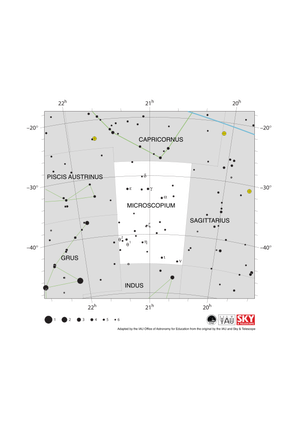
Microscopium Constellation Map
Bild
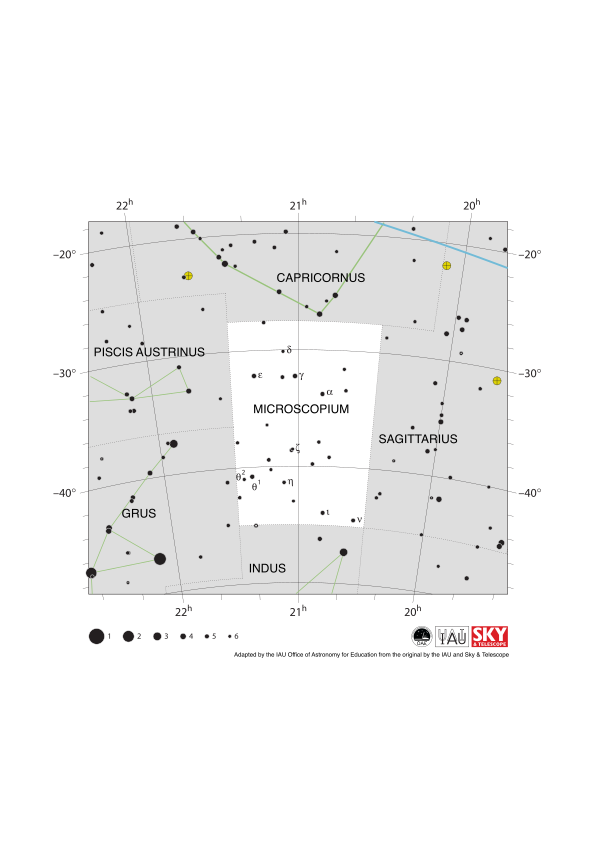
Unterschrift: The constellation Microscopium with its brighter stars and surrounding constellations. Microscopium is surrounded by (going clockwise from the top): Capricornus, Sagittarius, Telescopium, Indus, Grus and Piscis Austrinus. Microscopium is a faint constellation with relatively few bright stars.
Microscopium is a southern constellation and thus the whole constellation is visible at some point in the year throughout the southern hemisphere. The whole constellation is also visible in equatorial and some temperate regions of the northern hemisphere with parts of the constellation visible from other northern temperate regions. Microscopium is best viewed in the evening in the northern hemisphere autumn and southern hemisphere spring.
The y-axis of this diagram is in degrees of declination with north as up and the x-axis is in hours of right ascension with east to the left. The sizes of the stars marked here relate to the star's apparent magnitude, a measure of its apparent brightness. The larger dots represent brighter stars. The Greek letters mark the brightest stars in the constellation. These are ranked by brightness with the brightest star being labeled alpha, the second brightest beta, etc., although this ordering is not always followed exactly. The dotted boundary lines mark the IAU's boundaries of the constellations and the solid green lines mark one of the common forms used to represent the figures of the constellations. Neither the constellation boundaries, nor the line marking the ecliptic, nor the lines joining the stars appear on the sky. The ecliptic is marked with a blue line in the top right.
Bild: Adapted by the IAU Office of Astronomy for Education from the original by the IAU and Sky & Telescope
Link zur Quelle
Glossar-Begriffe:
Scheinbare Helligkeit , Steinbock , Himmelskoordinaten , Sternbild , Deklination , Ekliptik , Rektaszension (RA) , Schütze
Kategorien:
Astronomie mit bloßem Auge
Lizenz: Creative Commons Namensnennung 4.0 International (CC BY 4.0) Creative Commons Namensnennung 4.0 International (CC BY 4.0) Symbole
Datei
( Bild
77.31 kB)
PDF-Datei
(PDF file
147.46 kB)