Dokumente & Ressourchen - Suchergebnisse
Suchergebnisse

Cassiopeia Sternkarte
Bild
Unterschrift: Das Sternbild Kassiopeia mit seinen hellsten Sternen und den umliegenden Sternbildern. Cassiopeia ist (im Uhrzeigersinn von oben gesehen) umgeben von den Sternbildern: Cepheus, Andromeda, Perseus und Giraffe.
Kassiopeia ist ein nördliches Sternbild, das von der gesamten nördlichen Hemisphäre und den äquatorialen Regionen der südlichen Hemisphäre aus sichtbar ist. Am besten ist es abends im Spätherbst der nördlichen Hemisphäre und im späten Frühjahr der südlichen Hemisphäre zu sehen.
Die offenen Sternhaufen M52, M103, NGC 457 und NGC 663 liegen in diesem Sternbild und sind in der Karte mit gelben Kreisen markiert. Zwei elliptische Zwerggalaxien NGC 147 und NGC 185 liegen im südlichen Teil des Sternbildes. Sie sind mit roten Ellipsen markiert und gravitativ an die größere Andromedagalaxie gebunden, die südlich im gleichnamigen Sternbild liegt.
Die y-Achse dieses Diagramms ist in die Deklinationsachse, mit Norden am oberen Ende. Die x-Achse ist in die Rektaszensionsachse in Stunden (Osten nach links). Die Größe der hier markierten Sterne bezieht sich auf ihre scheinbare Helligkeit, wobei größeren Punkte für hellere Sterne stehen. Die hellsten Sterne des Sternbildes sind mit griechischen Buchstaben gekennzeichnet. Die so markierten Sterne sind nach Helligkeit geordnet, wobei der hellste Stern mit Alpha, der zweithellste mit Beta usw. bezeichnet wird, obwohl diese Reihenfolge nicht immer genau eingehalten wird. Die gepunkteten Begrenzungslinien markieren die IAU-Grenzen der Sternbilder und die durchgezogenen grünen Linien markieren eine der üblichen Formen, die zur Darstellung der Sternbilder verwendet wird. Weder die Grenzen der Sternbilder noch die Linien, die die Sterne verbinden, erscheinen am Himmel.
Bild: Angepasst vom IAU Office of Astronomy for Education nach dem Original von IAU/Sky & Telescope
Link zur Quelle
Glossar-Begriffe:
Andromeda , Andromedagalaxie , Scheinbare Helligkeit , Himmelskoordinaten , Zirkumpolarsterne , Sternbild , Deklination , Zwerggalaxie , Rektaszension (RA) , Offener Sternhaufen
Kategorien:
Astronomie mit bloßem Auge
Lizenz: Creative Commons Namensnennung 4.0 International (CC BY 4.0) Creative Commons Namensnennung 4.0 International (CC BY 4.0) Symbole
Datei
( Bild
124.65 kB)
PDF-Datei
(PDF file
205.99 kB)

Ursa Major Constellation Map
Bild
Unterschrift: The constellation Ursa Major along with its bright stars and its surrounding constellations. Ursa Major is surrounded by (going clockwise from the top): Draco, Camelopardalis, Lynx, Leo Minor, Leo, Coma Berenices, Canes Venatici and Boötes. Ursa Major is famous for the prominent asterism often known in English as the Big Dipper or the Plough. This prominent northern asterism has a wide variety of names from cultures across the world. While most constellations and asterisms are made up of unrelated stars that randomly appear close together on the sky, five of the stars in the Big Dipper are part of the Ursa Major Moving Group, a group of stars moving through space together that likely formed in the same location 300 million years ago. The two stars on the right-hand end of the Big Dipper on this diagram form a pair of pointer stars that can be used to locate Polaris, the northern pole star which lies in the constellation of Ursa Minor.
Ursa Major is a northern constellation and is visible from northern and equatorial regions. Parts of the constellation are visible from all but the most antarctic parts of the southern hemisphere but not all temperate regions of the southern hemisphere can see all of the Big Dipper. Conversely the Big Dipper and much of the rest of the constellation are circumpolar in arctic and many temperate regions of the northern hemisphere. Ursa Major is most visible in the evening in the northern hemisphere spring and southern hemisphere autumn.
Two prominent galaxies appear in the northern part of this constellation, the spiral galaxy M81 and M82, a possible spiral galaxy whose structure is difficult to observe from the Earth as it appears edge-on. Both are shown here as red ellipses. The planetary nebula M97 (the Owl Nebula) lies in the middle of the constellation and is marked by a green circle superimposed on a plus symbol.
The y-axis of this diagram is in degrees of declination with north as up and the x-axis is in hours of right ascension with east to the left. The sizes of the stars marked here relate to the star's apparent magnitude, a measure of its apparent brightness. The larger dots represent brighter stars. The Greek letters mark the brightest stars in the constellation. These are ranked by brightness with the brightest star being labeled alpha, the second brightest beta, etc., although this ordering is not always followed exactly. The dotted boundary lines mark the IAU's boundaries of the constellations and the solid green lines mark one of the common forms used to represent the figures of the constellations. Neither the constellation boundaries, nor the lines joining the stars appear on the sky.
Bild: Adapted by the IAU Office of Astronomy for Education from the original by IAU/Sky & Telescope
Link zur Quelle
Glossar-Begriffe:
Scheinbare Helligkeit , Großer Wagen , Himmelskoordinaten , Zirkumpolarsterne , Sternbild , Deklination , Löwe , Planetarischer Nebel , Rektaszension (RA) , Spiralgalaxie , Asterismus
Kategorien:
Astronomie mit bloßem Auge
Lizenz: Creative Commons Namensnennung 4.0 International (CC BY 4.0) Creative Commons Namensnennung 4.0 International (CC BY 4.0) Symbole
Datei
( Bild
143.67 kB)
PDF-Datei
(PDF file
215.83 kB)

Centaurus Constellation Map
Bild
Unterschrift: The constellation Centaurus with its bright stars and surrounding constellations. Centaurus is surrounded by (going clockwise from the top): Hydra, Antlia, Vela, Carina, Musca, Crux, Circinus, Lupus and Libra. Centaurus is a large constellation most notable for its brightest star Alpha Centauri. Alpha Centauri is a triple star system and is the nearest star system to the Solar System. When viewed with the naked eye, the two brightest components of Alpha Centauri appear as one star. The combined light from these two stars makes Alpha Centauri appear as the third brightest star in the night sky. The third component of the Alpha Centauri system Proxima Centauri, the nearest star to the Sun, is too faint to be viewed with the naked eye.
Centaurus is a southern constellation and thus the whole constellation is visible from the southern hemisphere at some point in the year. The whole constellation is also visible from equatorial regions of the northern hemisphere with parts of the constellation visible from temperate northern regions. The constellation is best viewed in the evening in the late northern hemisphere spring and late southern hemisphere autumn.
The globular cluster Omega Centauri, also known as NGC 5319, lies in Centaurus. Bright enough to be seen with the naked eye, this cluster was initially given a designation as a star in the constellation before its true nature was realised. It is marked here with a yellow circle with a plus sign superimposed on it. As is the globular cluster NGC 5286. The open cluster NGC 3766 is marked here with a yellow circle. NGC 5128, also known as Centaurus A, is the closest active galaxy to Earth. The supermassive black hole at the heart of this galaxy has launched two huge jets of matter which emit in many different wavelengths including x-ray and radio emission. NGC 5128 is marked with a red ellipse here, as is the edge-on spiral galaxy NGC 4945.
The y-axis of this diagram is in degrees of declination with north as up and the x-axis is in hours of right ascension with east to the left. The sizes of the stars marked here relate to the star's apparent magnitude, a measure of its apparent brightness. The larger dots represent brighter stars. The Greek letters mark the brightest stars in the constellation. These are ranked by brightness with the brightest star being labeled alpha, the second brightest beta, etc., although this ordering is not always followed exactly. The dotted boundary lines mark the IAU's boundaries of the constellations and the solid green lines mark one of the common forms used to represent the figures of the constellations. The blue line in the top left is the ecliptic. Neither the constellation boundaries, nor the line marking the ecliptic, nor the lines joining the stars appear on the sky.
Bild: Adapted by the IAU Office of Astronomy for Education from the original by the IAU and Sky & Telescope
Link zur Quelle
Glossar-Begriffe:
Scheinbare Helligkeit , Himmelskoordinaten , Sternbild , Deklination , Kugelsternhaufen , Rektaszension (RA) , Offener Sternhaufen , Alpha Centauri
Kategorien:
Astronomie mit bloßem Auge
Lizenz: Creative Commons Namensnennung 4.0 International (CC BY 4.0) Creative Commons Namensnennung 4.0 International (CC BY 4.0) Symbole
Datei
( Bild
152.88 kB)
PDF-Datei
(PDF file
255.96 kB)
Cepheus Constellation Map
Bild
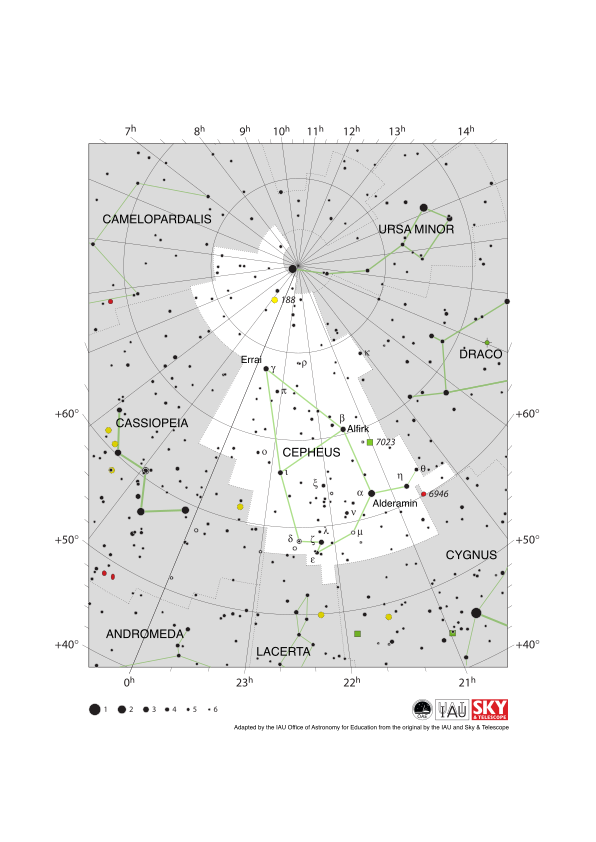
Unterschrift: The constellation Cepheus along with its bright stars and surrounding constellations. Cepheus is surrounded by (going clockwise from the top): Camelopardalis, Ursa Minor, Draco, Cygnus, Lacerta and Cassiopeia. Cepheus is a large constellation. Its most notable star is Delta Cephei, the prototype for the class of variable stars known as Cepheid variables. These are variable stars which can be used to estimate distances both within our galaxy and to nearby galaxies.
Cepheus lies close to the north celestial pole. As such it is circumpolar for arctic and temperate regions of the northern hemisphere. The whole of the constellation is also visible at some point in the year in equatorial regions of the northern hemisphere with parts of it visible in equatorial regions of the southern hemisphere. It is best viewed in the evening in the northern hemisphere late autumn and southern hemisphere late spring.
The open cluster NGC 188 lies in Cepheus and is marked here with a yellow circle. The nebula NGC 7023 also lies in the constellation and is marked with a green square. The red ellipse in the lower right marks the position of the spiral galaxy NGC 6946.
This diagram maps an area around the north celestial pole. Here lines of constant right ascension converge. The right ascension values of these lines are marked on the x-axis above and below the diagram. Some of the lines of constant declination are marked on the y-axis. The sizes of the stars marked here relate to the star's apparent magnitude, a measure of its apparent brightness. The larger dots represent brighter stars. The Greek letters mark the brightest stars in the constellation. Delta Cephei is marked with a circle around a dot as it is a variable star. Mu Cephei is also a variable star marked here as an open circle. These are ranked by brightness with the brightest star being labeled alpha, the second brightest beta, etc., although this ordering is not always followed exactly. The dotted boundary lines mark the IAU's boundaries of the constellations and the solid green lines mark one of the common forms used to represent the figures of the constellations. Neither the constellation boundaries, nor the lines joining the stars appear on the sky.
Bild: Adapted by the IAU Office of Astronomy for Education from the original by the IAU and Sky & Telescope
Link zur Quelle
Glossar-Begriffe:
Scheinbare Helligkeit , Himmelskoordinaten , Zirkumpolarsterne , Sternbild , Deklination , Nebel , Himmelsnordpol (NCP) , Rektaszension (RA) , Spiralgalaxie , Offener Sternhaufen
Kategorien:
Astronomie mit bloßem Auge
Lizenz: Creative Commons Namensnennung 4.0 International (CC BY 4.0) Creative Commons Namensnennung 4.0 International (CC BY 4.0) Symbole
Datei
( Bild
162.00 kB)
PDF-Datei
(PDF file
212.38 kB)
Hydra Constellation Map
Bild
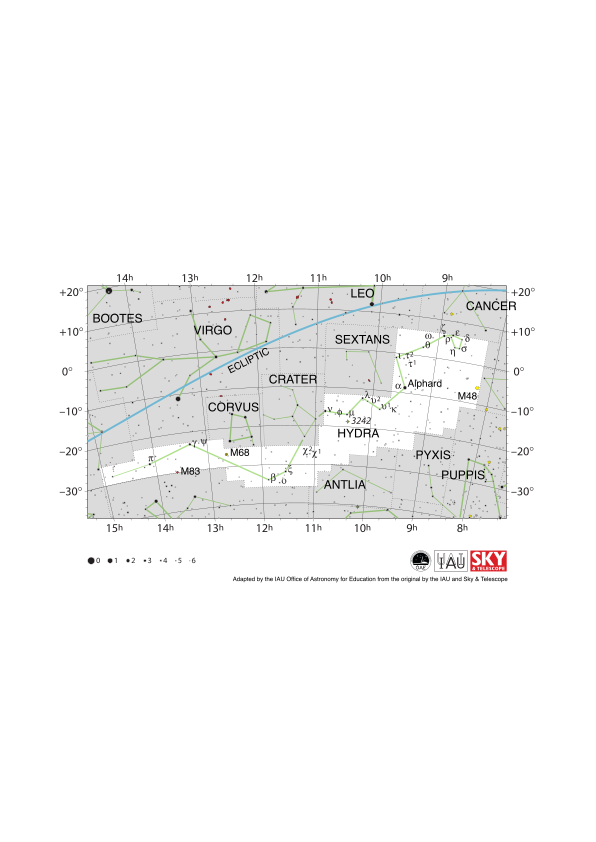
Unterschrift: The constellation Hydra with its bright stars and surrounding constellations. Hydra is surrounded by (going clockwise from the top): Leo, Cancer, Canis Minor, Monoceros, Puppis, Pyxis, Antlia, Centaurus, Lupus, Libra, Virgo, Corvus, Crater and Sextans.
Hydra is a large constellation that covers over a quarter of the celestial sphere in right ascension. It also spans the celestial equator and thus part of the constellation is visible from everywhere on the Earth at some point in the year. All parts of the constellation are visible at some point for all but the most antarctic parts of the southern hemisphere and to equatorial and most temperate regions of the northern hemisphere. However the wide span of the constellation means that all of it may not be visible at the same time in many of these regions. Hydra is best viewed in the northern hemisphere spring and southern hemisphere autumn.
The famous spiral galaxy M83, also known as the Pinwheel Galaxy, lies in Hydra. It is marked here with a red ellipse. The planetary nebula NGC 3242 can also be found in Hydra. It is marked here with a green circle with a plus sign superimposed on it. The open cluster M48 is marked here with a yellow circle while the globular cluster M68 is marked with a yellow circle with a plus sign superimposed on it.
The y-axis of this diagram is in degrees of declination with north as up and the x-axis is in hours of right ascension with east to the left. The sizes of the stars marked here relate to the star's apparent magnitude, a measure of its apparent brightness. The larger dots represent brighter stars. The Greek letters mark the brightest stars in the constellation. These are ranked by brightness with the brightest star being labeled alpha, the second brightest beta, etc., although this ordering is not always followed exactly. The dotted boundary lines mark the IAU's boundaries of the constellations and the solid green lines mark one of the common forms used to represent the figures of the constellations. The blue line on the diagram marks the ecliptic. Neither the constellation boundaries, nor the line marking the ecliptic, nor the lines joining the stars appear on the sky.
Bild: Adapted by the IAU Office of Astronomy for Education from the original by the IAU and Sky & Telescope
Link zur Quelle
Glossar-Begriffe:
Scheinbare Helligkeit , Himmelskoordinaten , Sternbild , Deklination , Ekliptik , Kugelsternhaufen , Waage , Planetarischer Nebel , Rektaszension (RA) , Spiralgalaxie , Krebs , Offener Sternhaufen , Jungfrau
Kategorien:
Astronomie mit bloßem Auge
Lizenz: Creative Commons Namensnennung 4.0 International (CC BY 4.0) Creative Commons Namensnennung 4.0 International (CC BY 4.0) Symbole
Datei
( Bild
114.60 kB)
PDF-Datei
(PDF file
253.49 kB)