Documentos y recursos - Buscar resultados
Buscar resultados
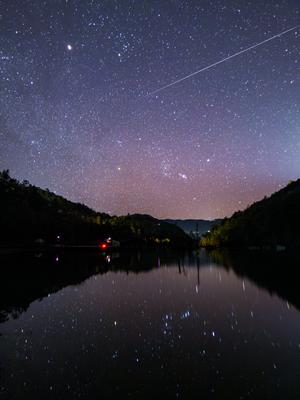
The Geminid Fireball
imagen
Creado para la OAE
Pie de foto: Honorable mention in the 2023 IAU OAE Astrophotography Contest, category of Still images taken exclusively with smartphones/mobile devices.
Captured with a smartphone on 13 December 2022, a Geminid meteor illuminated the sky above Blue Moon Valley in Yunnan, China, casting a breathtaking display against the serene backdrop of the Jade Dragon Snow Mountain. Renowned for their dazzling brightness and vivid hues, the Geminids are among the most vibrant meteor showers, originating from the asteroid 3200 Phaethon. Each year, as our planet traverses Phaethon’s debris trail, fragments of dust and rock vaporise in the atmosphere, creating the stunning phenomenon of the Geminid meteor shower. In this stunning night sky image, the twin stars of Gemini (Castor and Pollux) are obscured by the silhouetted trees on the left. Mirrored in the calm waters are the stars that make up the constellation of Orion, which can be seen rising towards the bottom-centre of the image, while the radiant Mars retains its brilliance as the foremost celestial beacon in the scene, all before the moonrise takes over.
Crédito: Jianfeng Dai/IAU OAE (CC BY 4.0)
Términos del glosario:
Géminis , Estrella fugaz
Categorías:
Astronomía a simple vista
, Sistema Solar
Etiquetas:
astrophotography
Licencia: Creative Commons Reconocimiento 4.0 Internacional (CC BY 4.0) Creative Commons Reconocimiento 4.0 Internacional (CC BY 4.0) íconos
Este archivo en Zenodo ( imagen 15.06 MB)

Lyrid of the Lake
imagen
Creado para la OAE
Pie de foto: Winner in the 2022 IAU OAE Astrophotography Contest, category Still images of celestial patterns.
Taken in the early hours of 24 April 2022, this image captures the sky of Yunnan Province, China, with a reflection on Lake Nian. The Milky Way is visible on the left side, while whitish Earth clouds are visible on the right. A Lyrid meteor crosses the sky along the Milky Way, its tail pointing back toward the shower's radiant in the constellation Lyra, which lies outside the image above the upper edge. The natural colours of the meteor are impressively clear.
A few constellations are also visible. In the top left corner we can recognise the small constellation of the Dolphin, in which five brightest stars comprise the asterism. This asterism forms the head-part of the larger Greek constellation of the Dolphin and was considered the Dolphin since Roman times, when Ptolemy formed the new constellation of Equuleus in the southern part of the original figure. In mediaeval China, this asterism was considered the Good and the Rotten Gourd, the good one being formed by the brighter rhombus on the top and the rotten one made of faint stars in the tail of the Roman dolphin.
The bright star to the right of the Dolphin and at the top of the image is Altair, the brightest star in the constellation Aquila. In Chinese uranology, Altair, together with some adjacent areas, forms the constellation of the Drum at the River. However, in Chinese folklore, the bright star stands for a boy in love with a girl, who is represented by the bright star Vega (in Lyra) on the other side of a huge celestial stream, the Milky Way. Vega is not visible in this image but the Lyrid meteor is like a teardrop of the unlucky girl who cannot reach her lover.
In the upper right of the image, the constellation Scorpius shines with its bright reddish star Antares. With some of its neighbouring stars, it was regarded in China as the asterism of The Heart, which was also one of the Lunar Mansions. It was considered the heart of the Azure Dragon, the super-constellation of spring, in ancient China.
Scorpius and Sagittarius, in the middle of the image, contain the brightest clouds of the Milky Way, the Galactic Centre, which also has clearly visible dark clouds in front of the bright ones.
There is no classical Greco-Roman constellation between Aquila and Scorpius, but in the 17th century, two Polish astronomers, the couple Jan and Elizabeta Hevelius, named this area of bright clouds in the Milky Way Scutum, the Shield, in memory of a Polish king. In China, however, this area directly outside the super-constellation (or heavenly enclosure) of the Celestial Market Place was seen as depicting Market Officers.
Crédito: Jianfeng Dai/IAU OAE
Términos del glosario:
Vía Láctea , Escorpio , Estrella fugaz , Sagitario
Categorías:
La Vía Láctea y el medio interestelar
, Astronomía a simple vista
Licencia: Creative Commons Reconocimiento 4.0 Internacional (CC BY 4.0) Creative Commons Reconocimiento 4.0 Internacional (CC BY 4.0) íconos
Este archivo en Zenodo ( imagen 7.19 MB)
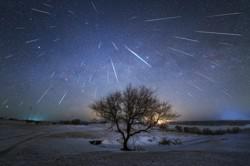
Geminid Meteor Shower from China, by Dai Jianfeng, China
imagen
Creado para la OAE
Pie de foto: First place in the 2021 IAU OAE Astrophotography Contest, category Meteor showers.
A meteor shower occurs when the Earth in its orbit around the Sun, passes through a debris trail left previously by a comet on its approach around the Sun. As the Earth enters this debris (small sand grain sized), they enter the atmosphere at high speeds and on parallel trajectories, burning completely leaving beautiful tracks (streaks) in the sky. These streaks can appear and disappear in the blink of an eye, or last much longer. On rare occasions the debris originates from asteroids, as in the case of the Geminid meteor shower, shown in this image, picturing many streaks of debris captured in the sky of China in 2017. Due to relative motions and perspective, the shower appears to come from one single point, known as the radiant point, beautifully pictured in this image. This is similar to driving in a car on a rainy day without any wind, looking out the front window it seems that the rain is coming directly towards the window, when in fact the rain is falling vertically downwards.
Crédito: Dai Jianfeng/IAU OAE
Términos del glosario:
Meteoroide , Estrella fugaz
Categorías:
Astronomía a simple vista
Licencia: Creative Commons Reconocimiento 4.0 Internacional (CC BY 4.0) Creative Commons Reconocimiento 4.0 Internacional (CC BY 4.0) íconos
Este archivo en Zenodo ( imagen 26.78 MB)
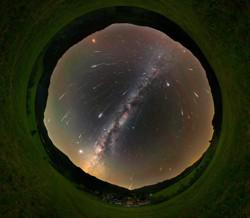
Perseids 2020 over Dark Sky Park Poloniny, by Tomáš Slovinský, Slovakia
imagen
Creado para la OAE
Pie de foto: Second place in the 2021 IAU OAE Astrophotography Contest, category Meteor showers.
A meteor shower occurs when the debris originated from comets or, on rare occasions, from asteroids enter the Earth’s atmosphere at high speed, leaving behind beautiful tracks in the sky due to friction with the atmosphere. This all-sky image taken in Slovakia in 2020 shows the Perseid meteor shower in a vivid way so one can really see the Perseids appearing all over the sky. This meteor shower is named so because the radiant point (the point on the sky where the meteors misleadingly seem to originate from) of the Perseid meteor shower is located in the constellation Perseus. This is a very prolific meteor shower, and a very popular phenomenon that can be observed from mid-July until mid-August, when the peak of activity happens. This is associated with the comet 109P/Swift–Tuttle, as Earth's orbit around the Sun crosses the debris left behind by this comet. This kind of image is very useful for full dome projections in planetariums, beautifully showing the Milky Way, our home Galaxy.
Crédito: Tomáš Slovinský/IAU OAE
Términos del glosario:
Estrella fugaz
Categorías:
Astronomía a simple vista
Licencia: Creative Commons Reconocimiento 4.0 Internacional (CC BY 4.0) Creative Commons Reconocimiento 4.0 Internacional (CC BY 4.0) íconos
Este archivo en Zenodo ( imagen 17.24 MB)
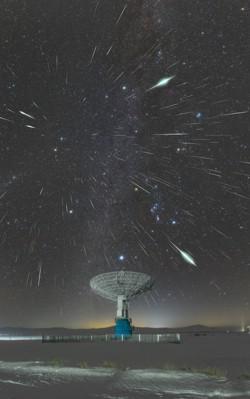
Lluvia de meteoros de las Geminínidas, de Hao Yin, China
imagen
Creado para la OAE
Pie de foto: Tercer puesto en el Concurso de Astrofotografía de la IAU OAE 2021, categoría «Lluvias de meteoros».
A medida que la Tierra orbita alrededor del Sol, puede cruzar la trayectoria de los restos dejados por un cometa o, con menor frecuencia, por un asteroide. Estos restos entran en la atmósfera a gran velocidad, produciendo hermosas estelas al quemarse en el cielo debido a la fricción con la atmósfera. La imagen captura la lluvia de meteoritos de las Gemínidas, llamada así porque el punto radiante se encuentra en el cielo, en la constelación de Géminis. Las partículas que componen la lluvia de meteoros viajan a una velocidad similar y en trayectorias paralelas, lo que provoca un efecto de perspectiva como si la estela se irradiara desde un único punto del cielo, conocido como punto radiante. Esta imagen, tomada en diciembre de 2020 en China, muestra claramente esta perspectiva. Se trata de una lluvia muy prolífica, hasta tal punto que en sus últimas apariciones se han podido observar más de cien meteoritos por hora. Esta lluvia de meteoritos es una de las pocas que no está asociada a un cometa, sino a un asteroide —el 3200 Faetón—, que podría ser un cometa que perdió todo su material volátil. Esta imagen muestra la gran cantidad de meteoros que se pueden observar en esta lluvia, que tiene lugar siempre en diciembre de cada año. La imagen también muestra una de las constelaciones más destacadas del cielo nocturno, Orión, fácilmente reconocible por las tres estrellas en diagonal que forman el Cinturón de Orión, y la estrella de color rojo anaranjado Betelgeuse. Justo encima de la antena hay un punto brillante: se trata de Sirio, la estrella más brillante del cielo nocturno y parte de la constelación de Canis Major. La mancha difusa de color azulado situada aproximadamente a las 2 en punto es el cúmulo estelar de las Pléyades.
Crédito: Hao Yin/IAU OAE
Términos del glosario:
Estrella fugaz
Categorías:
Astronomía a simple vista
Licencia: Creative Commons Reconocimiento 4.0 Internacional (CC BY 4.0) Creative Commons Reconocimiento 4.0 Internacional (CC BY 4.0) íconos
Este archivo en Zenodo ( imagen 9.78 MB)





