Documentos y recursos - Buscar resultados
Buscar resultados

Dark matter and Dark energy (Part 1) – Discovering the main components of the Universe Actividad educativa de astroEDU (enlaces a la página web de astroEDU) Origen: astroEDU Descripción: Lets' investigate gravity, dark matter and dark energy with some very simple experiments!
Términos del glosario:
Energía oscura , Materia oscura , Gravedad , Universo
Categorías:
Cosmología
, Física
Etiquetas:
Experiment
, Galaxies
Rango de edades:
12-14
, 14-16
, 16-19
, 19+
Nivel educativo:
Educación no forma
, Educación secundaria
Áreas de aprendizaje:
Aprendizaje por descubrimiento guiado
, Clase interactiva
, Modelización
, Basado en la observación
, Otros
, Resolución de problemas
Costos:
Bajo coste
Duración:
45 minutos
Tamaño del grupo:
Grupo
Competencias:
Elaborar explicaciones
, Desarrollar y utilizar modelos
, Participar en debates basados en pruebas
, Planificar y llevar a cabo investigaciones
Autores: Tran Dong Thai Han, Massimo Viola, Henk Hoekstra
Licencia: Creative Commons Reconocimiento 4.0 Internacional (CC BY 4.0) Creative Commons Reconocimiento 4.0 Internacional (CC BY 4.0) íconos

Dark matter & dark energy (Part 2) – Understanding the nature of dark matter and dark energy Actividad educativa de astroEDU (enlaces a la página web de astroEDU) Origen: astroEDU Descripción: Let's investigate the nature of dark matter and energy with gravitational lensing!
Términos del glosario:
Energía oscura , Materia oscura , Lente gravitacional , Gravedad , Universo
Categorías:
Cosmología
, Física
Etiquetas:
Experiment
, Invisible
Rango de edades:
12-14
, 14-16
, 16-19
, 19+
Nivel educativo:
Educación no forma
, Educación secundaria
Áreas de aprendizaje:
Aprendizaje por descubrimiento guiado
, Clase interactiva
, Modelización
, Resolución de problemas
Costos:
Coste medio
Duración:
45 minutos
Tamaño del grupo:
Grupo
Competencias:
Elaborar explicaciones
, Desarrollar y utilizar modelos
, Participar en debates basados en pruebas
Autores: Tran Dong Thai Han, Henk Hoekstra, Massimo Viola
Licencia: Creative Commons Reconocimiento 4.0 Internacional (CC BY 4.0) Creative Commons Reconocimiento 4.0 Internacional (CC BY 4.0) íconos
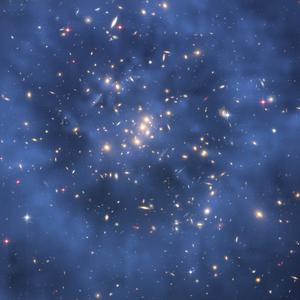
Dark matter
imagen
Pie de foto: This image of the galaxy cluster ZwCl0024+1652 is created using mathematical modelling, together with observations from the Hubble Space Telescope (HST).
The Hubble observations were taken in November 2004 by the Advanced Camera for Surveys (ACS). The exquisite resolution of the ACS, allowed very detailed measurements to be made of the gravitational lensing in the cluster. The blue nebulosity is a superimposed ""map"" of the dark matter distribution in the galaxy cluster and is not visible in the observations, but is a mathematical model created based on the gravitational lensing data.
The ""dark matter ring"" the is present in the image is one of the strongest pieces of evidence to date for the existence of dark matter. Observational data provides evidence that Dark matter makes up about 1/4 of the Universe, and is believed to make up the underlying structure of the cosmos. In addition, a large percentage the mass in galaxies and galaxy clusters is dark matter, which is not visible via direct observations.
Crédito: NASA, ESA, M.J. Jee and H. Ford (Johns Hopkins University)
Enlace del crédito
Términos del glosario:
Materia oscura
Categorías:
Cosmología
Licencia: Creative Commons Reconocimiento 4.0 Internacional (CC BY 4.0) Creative Commons Reconocimiento 4.0 Internacional (CC BY 4.0) íconos
Archivo
( imagen
12.30 MB)





