Documentos y recursos - Buscar resultados
Buscar resultados
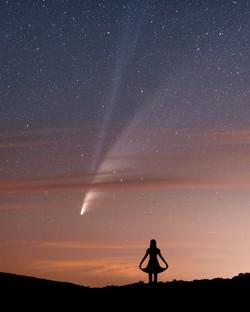
Hello Comet, shall we dance?, by Robert Barsa, Slovakia
imagen
Creado para la OAE
Pie de foto: Third place in the 2021 IAU OAE Astrophotography Contest, category Comets.
This beautiful and poetic image taken from Slovakia in July 2020 captures the comet C/2020 F3 (Neowise). The direction of the tails of the comet provides a clue as to the position of the Sun. In the past, the appearance of a comet in the skies could be accompanied by apprehension and even fear from those who did not know what these objects really are. Through careful observations and the applications of knowledge from physics, chemistry and geology, we now understand that comets are objects left over from the earliest days when the Solar System formed. The most distinctive features of a comet are the bluish ion (gas) tail, and whitish dust tail, which can extend for tens of millions of kilometres. These distinctive features, easily observable with the unaided eye together with an understanding of the science, are no longer cause for fear, rather they help us understand the history of our Solar System, and bring awe, joy and contemplation, as portrayed in this image.
Crédito: Robert Barsa/IAU OAE
Términos del glosario:
Cometa , Cola de un cometa
Categorías:
Astronomía a simple vista
, Sistema Solar
Licencia: Creative Commons Reconocimiento 4.0 Internacional (CC BY 4.0) Creative Commons Reconocimiento 4.0 Internacional (CC BY 4.0) íconos
Este archivo en Zenodo ( imagen 2.59 MB)
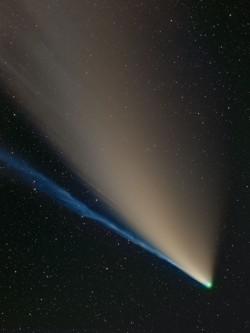
Comet C/2020F3 (Neowise) with separate dust and ion gas tails and a green glowing coma, by Dietmar Gutermuth, Germany
imagen
Creado para la OAE
Pie de foto: Second place in the 2021 IAU OAE Astrophotography Contest, category Comets.
Comets have a very interesting structure comprising of four main parts: the nucleus, composed of rock, dust and frozen gases, typically spanning a few kilometres, although bigger ones have been observed; a small atmosphere of gas surrounding the nucleus (only present when the comet approaches its closest point to the Sun), called coma; and the two distinctive cometary tails (there is at times third tail). The green colour of the coma is due to carbon and nitrogen present in the coma reacting with the Sun’s ultraviolet radiation. The tail that we are mostly used to observing – dust tail and is composed of micron sized dust particles, the second tail composed of charged particles – ion or gas tail. The tails are released only when the comet approaches the Sun at a distance where the heat and radiation emanating from our star is intense enough to vaporize the frozen gases. The dust tail is curved, while the gas tail is straight and always points away from the Sun as this is carried by the solar wind - flow of charged particles emitted by the Sun. As comets are formed by leftover material, they carry with them important information about the early stages of the Solar System’s formation. This beautiful image shows the comet C/2020 F3 (Neowise), as seen from Germany in July 2020, with three of the four structures clearly visible – coma, gas, and dust tail.
Crédito: Dietmar Gutermuth/IAU OAE
Términos del glosario:
Coma de un cometa , Cometa , Cola de un cometa
Categorías:
Sistema Solar
Licencia: Creative Commons Reconocimiento 4.0 Internacional (CC BY 4.0) Creative Commons Reconocimiento 4.0 Internacional (CC BY 4.0) íconos
Este archivo en Zenodo ( imagen 683.77 kB)
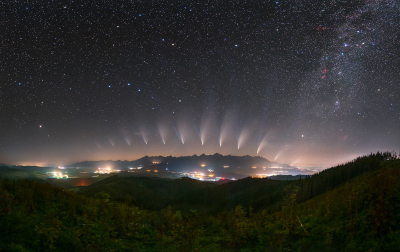
Neowise's metamorphosis, by Tomáš Slovinský and Petr Horálek, Slovakia
imagen
Creado para la OAE
Pie de foto: First place in the 2021 IAU OAE Astrophotography Contest, category Comets.
This image uses the chronophotography technique to capture the evolution of the comet C/2020 F3 (Neowise) over time, as it became visible in the northern skies in July 2020. Orbits of comets are extremely elliptical, which means that during part of their orbit they get close to the Sun. As a comet approaches the Sun, it gets heated, releases gas and dust creating an envelope or coma around the nucleus. The solar wind and photons (particles of electromagnetic radiation) interact with the coma producing the cometary tail, which can be seen clearly in this image. The tail of a comet always points away from the Sun, and extends as much as tens of millions of kilometres. This tail has two parts: the relatively straight bluish gas (ion or plasma) tail, which is made up of charged particles interacting with the magnetic fields of the solar wind; and the whitish dust tail compose of very small dust particles that are pushed by the radiation pressure from the Sun into a curve due to their slower speeds. Two regions in the Solar System are often associated with being “storehouses” of comets: the Kuiper Belt and the Oort Cloud. Comets with periods up to about two hundred years come from the Kuiper belt, a reservoir of cometary nuclei material with a disk-like shape located beyond Neptune. Longer period comets come from the Oort cloud, another huge reservoir of icy objects, with a spherical shape surrounding the Solar System. The outer limit of the Oort Cloud is not known as yet, but it could be as much as 10 thousand times the Sun-Earth distance, or even more. Due to gravitational disturbances, some of these cometary nuclei might be ejected towards the inner regions of the Solar System, sometimes approaching the Earth, offering some of the most spectacular views of a celestial body. The image also shows some prominent constellations and asterisms like the Big and Little Dippers, and also the North (Pole) Star – Polaris.
Crédito: Tomáš Slovinský and Petr Horálek/IAU OAE
Términos del glosario:
Cometa
Categorías:
Astronomía a simple vista
, Sistema Solar
Licencia: Creative Commons Reconocimiento 4.0 Internacional (CC BY 4.0) Creative Commons Reconocimiento 4.0 Internacional (CC BY 4.0) íconos
Este archivo en Zenodo ( imagen 19.53 MB)

El cometa Halley
imagen
Pie de foto: El cometa Halley es un cometa periódico conocido que recibe su nombre del astrónomo inglés Edmond Halley. Tiene un período orbital de aproximadamente 75 años y es visible a simple vista desde la Tierra cuando atraviesa el sistema solar interior.
La imagen muestra el cometa Halley, llamado oficialmente 1P/Halley, con una cola de gas y polvo que se aleja del Sol. Fue tomada desde el Observatorio de La Silla, en Chile, en 1986, durante su última visita al sistema solar interior. Las estrellas en esta imagen aparecen elongadas o como líneas formadas por tres puntos de diferentes colores, ya que la imagen se creó a partir de tres observaciones independientes a diferentes frecuencias mientras el telescopio seguía el movimiento del cometa, que se desplazaba muy ligeramente en comparación con las estrellas del fondo. Obsérvese que la cola del cometa no apunta exactamente en la misma dirección que el alargamiento de las estrellas. Esto nos muestra que la cola del cometa no siempre se encuentra detrás de él, sino que apunta en dirección opuesta al Sol.
El cometa pasa por su perihelio (la distancia más cercana al Sol) a una distancia de alrededor de 0,59 unidades astronómicas, justo entre las órbitas de Mercurio y Venus. Más allá de Neptuno, alcanza su afelio (la distancia máxima del Sol) a una distancia de aproximadamente 35 unidades astronómicas. El cometa Halley alcanzó su afelio en diciembre de 2023 y ahora se está acercando de nuevo. Se espera que vuelva a ser visible a simple vista desde la Tierra a mediados de 2061.
Crédito: ESO
Enlace del crédito
Términos del glosario:
Afelio , Cometa , Cola de un cometa , El Cometa Halley , Perihelio
Licencia: Creative Commons Reconocimiento 4.0 Internacional (CC BY 4.0) Creative Commons Reconocimiento 4.0 Internacional (CC BY 4.0) íconos
Archivo
( imagen
5.23 MB)
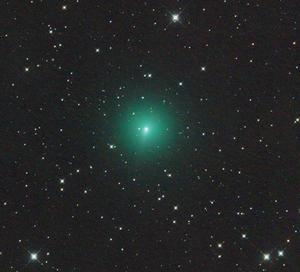
Measuring the average speed of a comet Actividad educativa de astroEDU (enlaces a la página web de astroEDU) Origen: astroEDU Descripción: Using telescope images of comet C/2019 Y4 we calculate its average speed and understand what a physical quantity is
Términos del glosario:
Cometa , Órbita
Etiquetas:
Software
, average speed
Rango de edades:
12-14
, 14-16
, 16-19
, 19+
Nivel educativo:
Secondary
Costos:
Gratis
Duración:
1 hora y 30 minutos
Tamaño del grupo:
Grupo
Competencias:
Analizar e interpretar datos
, Desarrollar y utilizar modelos
, Participar en debates basados en pruebas
Autores: Stefano Sandrelli, Giulia Iafrate, Giulia Pantiri, Riccardo Bevilacqua
Licencia: Creative Commons Reconocimiento 4.0 Internacional (CC BY 4.0) Creative Commons Reconocimiento 4.0 Internacional (CC BY 4.0) íconos





