Documentos y recursos - Buscar resultados
Buscar resultados

The Happy Face of Gravitational Lensing
imagen
Pie de foto: Captured by the NASA/ESA Hubble Space Telescope, this image showcases the galaxy cluster SDSS J1038+4849, affectionately dubbed the "happy face" cluster due to its striking resemblance to a smiling face. The two bright galaxies at the center resemble orange eyes, while the arcs surrounding them form the illusion of a smile. These arcs are actually a result of strong gravitational lensing, a phenomenon where the cluster's immense gravitational pull distorts and magnifies light from background objects. This particular case of gravitational lensing has produced an Einstein Ring, a ring-like structure formed by the precise alignment of the source, lens, and observer. By studying these gravitational lenses, astronomers gain insights into the properties of massive galaxies, allowing for a deeper understanding of the early Universe.
Crédito: NASA/ESA
Enlace del crédito
Términos del glosario:
Lente gravitacional
Categorías:
Cosmología
, Galaxias
Licencia: Dominio público Dominio público íconos
Archivo
( imagen
1.53 MB)
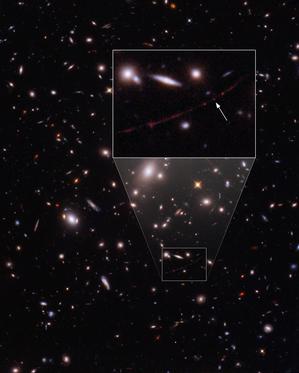
A gravitational lens magnifies one of the first stars
imagen
Pie de foto: This image zooms in on a star formed within the first billion years after the birth of the Universe (at a redshift of 6.2). The Hubble Space Telescope detected this light using a technique called gravitational lensing. A massive galaxy cluster between the observer and the imaged star creates a distorted and warped image of the parent galaxy and reveals its features.
Crédito: NASA, ESA, B. Welch (JHU), D. Coe (STScI), A. Pagan (STScI)
Enlace del crédito
Términos del glosario:
Lente gravitacional , Estrella
Categorías:
Cosmología
, Estrellas
Licencia: Creative Commons Reconocimiento 4.0 Internacional (CC BY 4.0) Creative Commons Reconocimiento 4.0 Internacional (CC BY 4.0) íconos
Archivo
( imagen
6.12 MB)


