Documentos y recursos - Buscar resultados
Buscar resultados
Delphinus Constellation Map
imagen
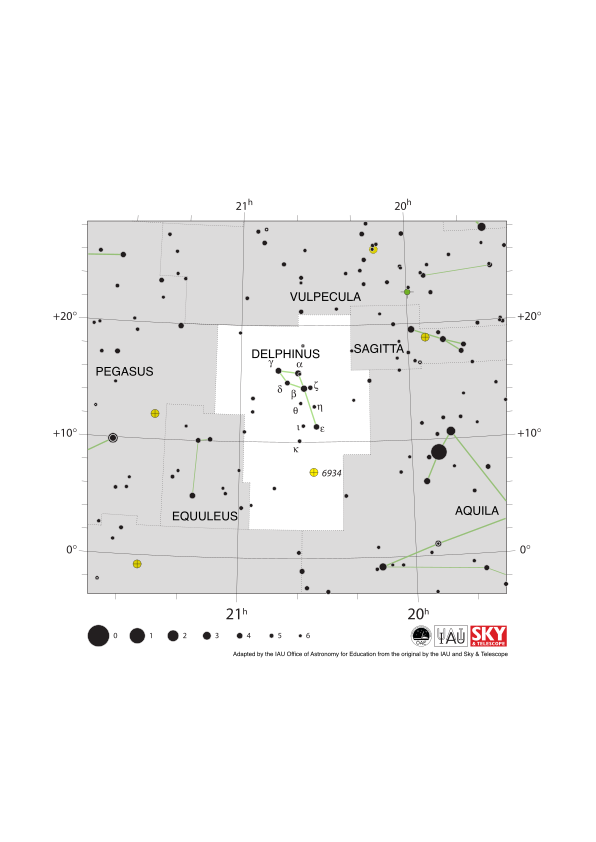
Pie de foto: The constellation Delphinus with its brighter stars and surrounding constellations. Delphinus is surrounded by (going clockwise from the top): Vulpecula, Sagitta, Aquila, Aquarius, Equuleus and Pegasus. Delphinus is a relatively small constellation with few bright stars.
Delphinus lies just north of the celestial equator and thus the whole constellation is visible at some point in the year to all but the most antarctic regions. The constellation is best viewed in the evenings in the early northern hemisphere autumn and early southern hemisphere spring.
The globular cluster NGC 6934 lies in Dephinus. It is marked here with a yellow circle with a plus sign superimposed on it.
The y-axis of this diagram is in degrees of declination with north as up and the x-axis is in hours of right ascension with east to the left. The sizes of the stars marked here relate to the star's apparent magnitude, a measure of its apparent brightness. The larger dots represent brighter stars. The Greek letters mark the brightest stars in the constellation. These are ranked by brightness with the brightest star being labeled alpha, the second brightest beta, etc., although this ordering is not always followed exactly. The dotted boundary lines mark the IAU's boundaries of the constellations and the solid green lines mark one of the common forms used to represent the figures of the constellations. Neither the constellation boundaries, nor the lines joining the stars appear on the sky.
Crédito: Adapted by the IAU Office of Astronomy for Education from the original by the IAU and Sky & Telescope
Enlace del crédito
Términos del glosario:
Magnitud Aparente , Coordenadas celestes , Ecuador celeste , Constelación , Declinación , Cúmulo globular , Ascensión recta (AR) , Acuario
Categorías:
Astronomía a simple vista
Licencia: Creative Commons Reconocimiento 4.0 Internacional (CC BY 4.0) Creative Commons Reconocimiento 4.0 Internacional (CC BY 4.0) íconos
Archivo
( imagen
70.98 kB)
Archivo PDF
(PDF file
147.37 kB)

Piscis Austrinus Constellation Map
imagen
Pie de foto: The constellation Piscis Austrinus with its bright stars and surrounding constellations. Piscis Austrinus is surrounded by (going clockwise from the top): Aquarius, Capricornus, Microscopium, Grus and Sculptor.
Piscis Austrinus is a southern constellation and thus the whole constellation is visible at some point in the year throughout the southern hemisphere. The whole constellation is also visible to some equatorial regions of the northern hemisphere with parts of the constellation visible to the remaining equatorial and some temperate northern hemisphere regions. Piscis Austrinus is best viewed in the evening in the northern hemisphere autumn and southern hemisphere spring.
The y-axis of this diagram is in degrees of declination with north as up and the x-axis is in hours of right ascension with east to the left. The sizes of the stars marked here relate to the star's apparent magnitude, a measure of its apparent brightness. The larger dots represent brighter stars. The Greek letters mark the brightest stars in the constellation. These are ranked by brightness with the brightest star being labeled alpha, the second brightest beta, etc., although this ordering is not always followed exactly. The dotted boundary lines mark the IAU's boundaries of the constellations and the solid green lines mark one of the common forms used to represent the figures of the constellations. The blue line in the top right of the diagram marks the ecliptic. Neither the constellation boundaries, nor the lines joining the stars, nor the ecliptic, appear on the sky.
Crédito: Adapted by the IAU Office of Astronomy for Education from the original by the IAU and Sky & Telescope
Enlace del crédito
Términos del glosario:
Magnitud Aparente , Capricornio , Coordenadas celestes , Constelación , Declinación , Eclíptica , Ascensión recta (AR) , Acuario
Categorías:
Astronomía a simple vista
Licencia: Creative Commons Reconocimiento 4.0 Internacional (CC BY 4.0) Creative Commons Reconocimiento 4.0 Internacional (CC BY 4.0) íconos
Archivo
( imagen
81.19 kB)
Archivo PDF
(PDF file
155.49 kB)
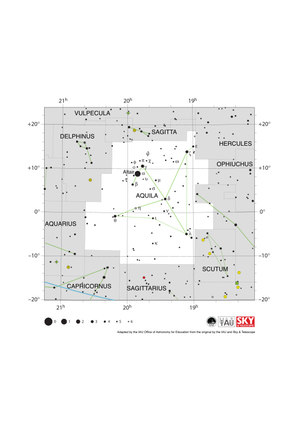
Aquila Constellation Map
imagen
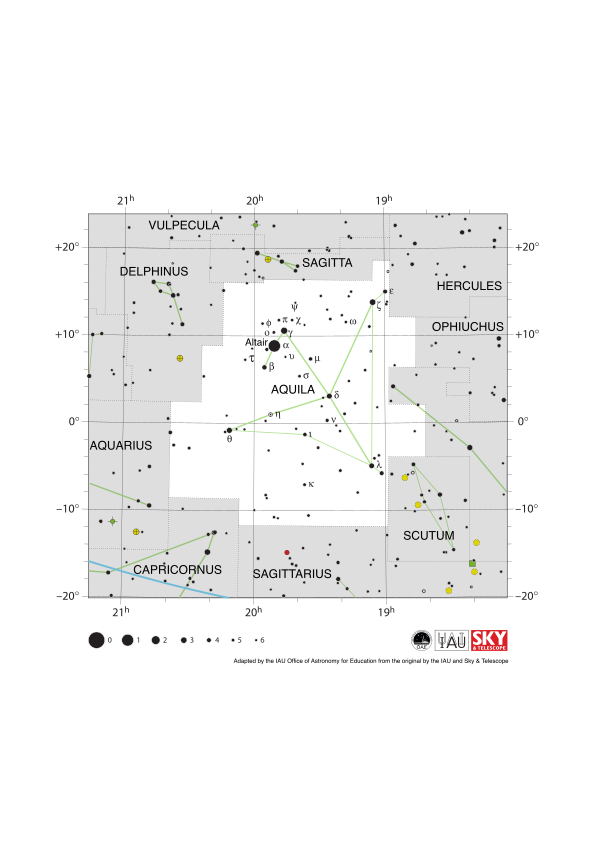
Pie de foto: The constellation Aquila with its bright stars and surrounding constellations. Aquila is surrounded by (going clockwise from the top): Sagitta, Hercules, Ophiuchus, Serpens Cauda, Scutum, Sagittarius, Capricornus, Aquarius and Delphinus. Aquila is most notable for its brightest star Altair. This forms one vertex of the prominent Summer Triangle asterism that is visible in northern hemisphere summer evenings.
Aquila spans the celestial equator and thus some part of it is visible from all of the Earth at some point in the year. It is most visible in the evenings in the late northern hemisphere summer and late southern hemisphere winter.
The y-axis of this diagram is in degrees of declination with north as up and the x-axis is in hours of right ascension with east to the left. The sizes of the stars marked here relate to the star's apparent magnitude, a measure of its apparent brightness. The larger dots represent brighter stars. The Greek letters mark the brightest stars in the constellation. These are ranked by brightness with the brightest star being labeled alpha, the second brightest beta, etc., although this ordering is not always followed exactly. The dotted boundary lines mark the IAU's boundaries of the constellations and the solid green lines mark one of the common forms used to represent the figures of the constellations. The blue line in the lower right of the diagram is the ecliptic. Neither the constellation boundaries, nor the line marking the ecliptic, nor the lines joining the stars appear on the sky.
Crédito: Adapted by the IAU Office of Astronomy for Education from the original by IAU/Sky & Telescope
Enlace del crédito
Términos del glosario:
Magnitud Aparente , Capricornio , Coordenadas celestes , Ecuador celeste , Constelación , Declinación , Eclíptica , Ascensión recta (AR) , Acuario , Asterismo
Categorías:
Astronomía a simple vista
Licencia: Creative Commons Reconocimiento 4.0 Internacional (CC BY 4.0) Creative Commons Reconocimiento 4.0 Internacional (CC BY 4.0) íconos
Archivo
( imagen
95.28 kB)
Archivo PDF
(PDF file
175.09 kB)
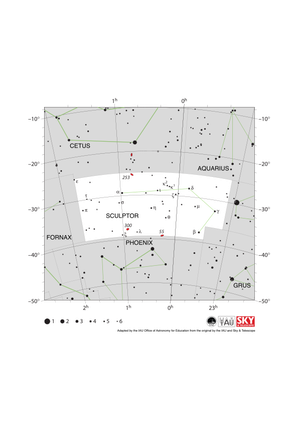
Sculptor Constellation Map
imagen
Pie de foto: The constellation Sculptor with its brighter stars and surrounding constellations. Sculptor is surrounded by (going clockwise from the top): Cetus, Aquarius, Piscis Austrinus, Grus, Phoenix and Fornax.
Sculptor is a southern constellation and thus the whole constellation is visible at some point in the year throughout the southern hemisphere. The whole constellation is also visible in equatorial and most temperate regions of the northern hemisphere. Parts of the constellation are also visible to the remaining northern temperate regions. Sculptor is best viewed in the evening in the late northern hemisphere autumn and late southern hemisphere spring.
The irregular galaxy NGC 55, and the spiral galaxies NGC 253 and NGC 300 all lie in Sculptor. There are marked here with red ellipses.
The y-axis of this diagram is in degrees of declination with north as up and the x-axis is in hours of right ascension with east to the left. The sizes of the stars marked here relate to the star's apparent magnitude, a measure of its apparent brightness. The larger dots represent brighter stars. The Greek letters mark the brightest stars in the constellation. These are ranked by brightness with the brightest star being labeled alpha, the second brightest beta, etc., although this ordering is not always followed exactly. The dotted boundary lines mark the IAU's boundaries of the constellations and the solid green lines mark one of the common forms used to represent the figures of the constellations. Neither the constellation boundaries, nor the lines joining the stars appear on the sky.
Crédito: Adapted by the IAU Office of Astronomy for Education from the original by the IAU and Sky & Telescope
Enlace del crédito
Términos del glosario:
Magnitud Aparente , Coordenadas celestes , Constelación , Declinación , Galaxia irregular , Ascensión recta (AR) , Galaxia espiral
Categorías:
Astronomía a simple vista
Licencia: Creative Commons Reconocimiento 4.0 Internacional (CC BY 4.0) Creative Commons Reconocimiento 4.0 Internacional (CC BY 4.0) íconos
Archivo
( imagen
90.52 kB)
Archivo PDF
(PDF file
166.79 kB)
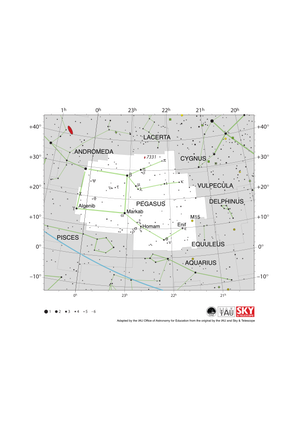
Pegasus Constellation Map
imagen
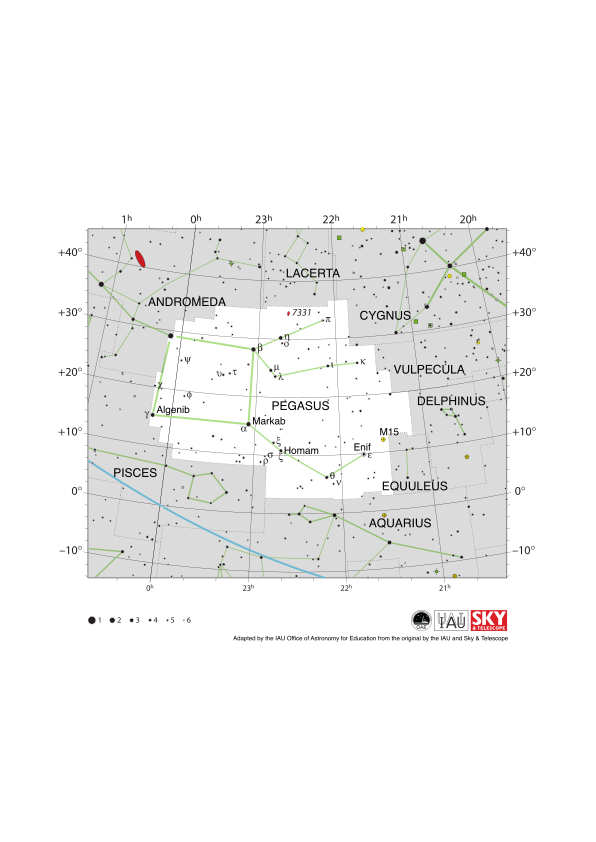
Pie de foto: The constellation Pegasus with its bright stars and surrounding constellations. Pegasus is surrounded by (going clockwise from the top): Lacerta, Cygnus, Vulpecula, Delphinus, Equuleus, Aquarius, Pisces and Andromeda. Pegasus is known for the prominent asterism the “Square of Pegasus” which consists of its three brightest stars plus the brightest star in Andromeda.
Pegasus is a northern constellation and thus the whole constellation is visible at some point in the year throughout the northern hemisphere. The whole constellation is also visible to southern hemisphere equatorial and temperate zones with parts of the constellation visible from all but the most antarctic regions. Pegasus is best viewed in the evening in the northern hemisphere autumn and southern hemisphere spring.
The globular cluster M15 lies in Pegasus and is marked here with a yellow circle with a plus sign superimposed on it. The spiral galaxy NGC 7331 also lies in Pegasus and is marked here with a red ellipse.
The y-axis of this diagram is in degrees of declination with north as up and the x-axis is in hours of right ascension with east to the left. The sizes of the stars marked here relate to the star's apparent magnitude, a measure of its apparent brightness. The larger dots represent brighter stars. The Greek letters mark the brightest stars in the constellation. These are ranked by brightness with the brightest star being labeled alpha, the second brightest beta, etc., although this ordering is not always followed exactly. The dotted boundary lines mark the IAU's boundaries of the constellations and the solid green lines mark one of the common forms used to represent the figures of the constellations. The blue line at the bottom of the diagram marks the ecliptic. Neither the constellation boundaries, nor the lines joining the stars, nor the ecliptic, appear on the sky.
Crédito: Adapted by the IAU Office of Astronomy for Education from the original by the IAU and Sky & Telescope
Enlace del crédito
Términos del glosario:
Andrómeda , Magnitud Aparente , Coordenadas celestes , Constelación , Declinación , Eclíptica , Cúmulo globular , Piscis , Ascensión recta (AR) , Galaxia espiral , Acuario , Asterismo
Categorías:
Astronomía a simple vista
Licencia: Creative Commons Reconocimiento 4.0 Internacional (CC BY 4.0) Creative Commons Reconocimiento 4.0 Internacional (CC BY 4.0) íconos
Archivo
( imagen
122.04 kB)
Archivo PDF
(PDF file
213.33 kB)