Documentos y recursos - Buscar resultados
Buscar resultados

Mapa de la Constelación de la Osa Mayor
imagen
Pie de foto: La constelación de la Osa Mayor junto con sus estrellas brillantes y las constelaciones que la rodean. La Osa Mayor está rodeada por (en el sentido de las agujas del reloj desde arriba): Draco, Camelopardalis, Lynx, Leo Menor, Leo, Coma Berenices, Canes Venatici y Bootes. La Osa Mayor es famosa por su distintivo asterismo, a menudo conocido en inglés como Big Dipper (Osa Mayor) o Plough (Arado). Este distintivo asterismo septentrional recibe una gran variedad de nombres de culturas de todo el mundo. Mientras que la mayoría de las constelaciones y asterismos están formados por estrellas no relacionadas que aparecen juntas en el cielo de forma aleatoria, cinco de las estrellas de la Osa Mayor forman parte de la Asociación Estelar de la Osa Mayor, un grupo de estrellas que se mueven juntas por el espacio y que probablemente se formaron en el mismo lugar hace 300 millones de años. Las dos estrellas del extremo derecho de la Osa Mayor en este diagrama forman un par de estrellas puntero que pueden utilizarse para localizar a Polaris, la estrella polar del norte que se encuentra en la constelación de la Osa Menor.
La Osa Mayor es una constelación boreal y es visible desde las regiones septentrionales y ecuatoriales. Algunas partes de la constelación son visibles desde todas las regiones del hemisferio sur, excepto las más antárticas, pero no todas las regiones templadas del hemisferio sur pueden ver toda la Osa Mayor. Por el contrario, la Osa Mayor y gran parte del resto de la constelación son circumpolares en las regiones árticas y en muchas regiones templadas del hemisferio norte. La Osa Mayor es más visible al atardecer en primavera en el hemisferio norte y en otoño en el hemisferio sur.
En la parte norte de esta constelación aparecen dos galaxias destacadas, la galaxia espiral M81, y M82, una posible galaxia espiral cuya estructura es difícil de observar desde la Tierra, ya que aparece de canto. Ambas se muestran aquí como elipses rojas. La nebulosa planetaria M97 (la nebulosa del Búho) se encuentra en el centro de la constelación y está marcada con un círculo verde superpuesto a un signo de más.
El eje-y de este diagrama está en grados de declinación con el norte hacia arriba y el eje-x está en horas de ascensión recta con el este a la izquierda. El tamaño de las estrellas marcadas aquí está relacionado con la magnitud aparente de la estrella, una medida de su brillo aparente. Los puntos más grandes representan estrellas más brillantes. Las letras griegas indican las estrellas más brillantes de la constelación. Están ordenadas según su brillo: la estrella más brillante se denomina alfa, la segunda más brillante beta, etc., aunque este orden no siempre se sigue con exactitud. Las líneas punteadas marcan los límites de las constelaciones según la UAI y las líneas verdes continuas marcan una de las formas habituales utilizadas para representar las figuras de las constelaciones. Ni los límites de las constelaciones ni las líneas que unen las estrellas aparecen en el cielo.
Crédito: Adaptado por la Oficina de Astronomía para la Educación de la UAI a partir del original de UAI/Sky & Telescope
Enlace del crédito
Términos del glosario:
Magnitud Aparente , Osa Mayor , Coordenadas celestes , Estrellas circumpolares , Constelación , Declinación , Leo , Nebulosa planetaria , Ascensión recta (AR) , Galaxia espiral , Asterismo
Categorías:
Astronomía a simple vista
Licencia: Creative Commons Reconocimiento 4.0 Internacional (CC BY 4.0) Creative Commons Reconocimiento 4.0 Internacional (CC BY 4.0) íconos
Archivo
( imagen
148.72 kB)
Archivo PDF
(PDF file
231.84 kB)

Mapa de la constelación de Sagitario
imagen
Pie de foto: La constelación de Sagitario junto con sus estrellas brillantes y las constelaciones circundantes. Sagitario está rodeada por (en el sentido de las agujas del reloj desde arriba) Aquila, Scutum, Serpens Cauda, Ofiuco, Scorpius, Corona Australis, Telescopio, Microscopio y Capricornio. Las estrellas más brillantes de Sagitario dibujan una característica forma de tetera. Sagitario se encuentra en la eclíptica (mostrada aquí como una línea azul), que es la trayectoria que el Sol parece seguir a través del cielo en el transcurso de un año. El Sol está en Sagitario desde mediados de diciembre hasta mediados de enero. Los demás planetas del Sistema Solar se encuentran a menudo en Sagitario.
Sagitario se encuentra al sur del ecuador celeste. La famosa constelación de la tetera es visible en todas las regiones del mundo excepto en las más árticas, pero las partes más meridionales de la constelación no son visibles en las zonas septentrionales de Asia, Europa y Norteamérica. Sagitario es más visible por la noche en verano en el hemisferio norte y en invierno en el hemisferio sur.
El agujero negro supermasivo Sagitario A*, que se encuentra en el centro de nuestra Vía Láctea, está situado en el borde occidental (aquí a la derecha) de Sagitario. Debido a que cubre un área en el centro de nuestra Galaxia, Sagitario alberga muchos cúmulos estelares, incluyendo cúmulos abiertos (marcados aquí con círculos amarillos) y cúmulos globulares (marcados aquí con círculos amarillos con signos + superpuestos). También hay tres nebulosas marcadas aquí con cuadrados verdes.
El eje-y de este diagrama está en grados de declinación con el norte hacia arriba y el eje-x está en horas de ascensión recta con el este a la izquierda. El tamaño de las estrellas marcadas aquí está relacionado con la magnitud aparente de la estrella, una medida de su brillo aparente. Los puntos más grandes representan estrellas más brillantes. Las letras griegas indican las estrellas más brillantes de la constelación. Están ordenadas según su brillo: la estrella más brillante se denomina alfa, la segunda más brillante beta, etc., aunque este orden no siempre se sigue con exactitud. Las líneas punteadas marcan los límites de las constelaciones según la UAI y las líneas verdes continuas marcan una de las formas habituales utilizadas para representar las figuras de las constelaciones. Ni los límites de las constelaciones, ni la línea que marca la eclíptica, ni las líneas que unen las estrellas aparecen en el cielo.
Crédito: Adaptado por la Oficina de Astronomía para la Educación de la UAI a partir del original de UAI/Sky & Telescope
Enlace del crédito
Términos del glosario:
Magnitud Aparente , Capricornio , Coordenadas celestes , Constelación , Declinación , Eclíptica , Cúmulo globular , Vía Láctea , Nebulosa , Ascensión recta (AR) , Sagitario A* , Escorpio , Agujero negro supermasivo , Zodiaco , Asterismo , Cúmulo abierto , Sagitario
Categorías:
Astronomía a simple vista
Licencia: Creative Commons Reconocimiento 4.0 Internacional (CC BY 4.0) Creative Commons Reconocimiento 4.0 Internacional (CC BY 4.0) íconos
Archivo
( imagen
155.66 kB)
Archivo PDF
(PDF file
237.32 kB)

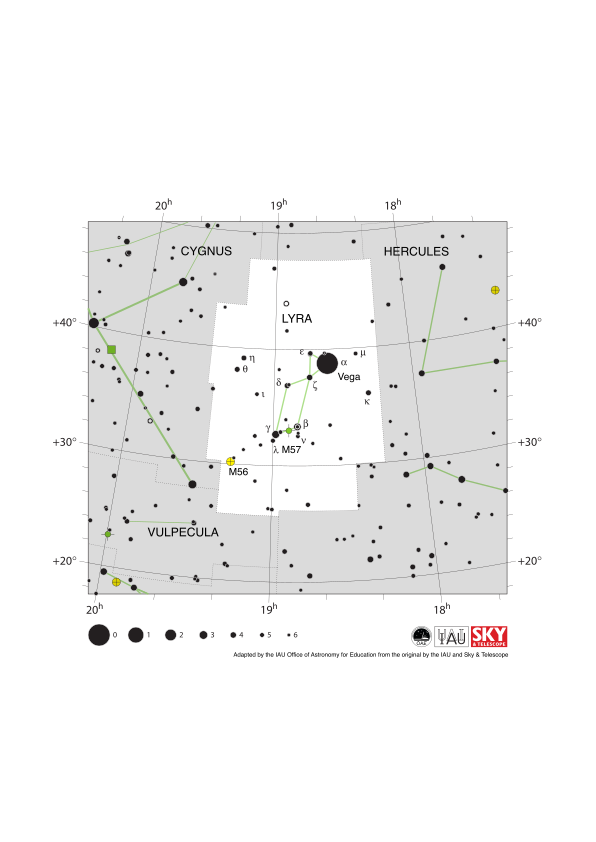
Lyra Constellation Map
imagen
Pie de foto: The constellation Lyra with its bright stars and surrounding constellations. Lyra is surrounded by (going clockwise from the top): Draco, Hercules, Vulpecula and Cygnus. Lyra is dominated by its brightest star Vega which is used to define the zero point of one of the most commonly used magnitude scales of stellar brightness. Vega forms one vertex of the prominent Summer Triangle asterism that is visible in northern hemisphere summer evenings.
Lyra is a northern constellation and thus is visible at some point in the year throughout the northern hemisphere. The whole constellation is also visible from all equatorial and some temperate regions of the southern hemisphere. Parts of the constellation are visible from the remaining southern temperate areas. Lyra is best viewed in the evenings in the northern hemisphere summer and southern hemisphere winter.
The famous planetary nebula M57, commonly known as the Ring Nebula, lies in Lyra. It is marked here with a green circle superimposed on a plus sign. The globular cluster M56 also lies in Lyra and is marked here with a yellow circle with a plus sign superimposed on it.
The y-axis of this diagram is in degrees of declination with north as up and the x-axis is in hours of right ascension with east to the left. The sizes of the stars marked here relate to the star's apparent magnitude, a measure of its apparent brightness. The larger dots represent brighter stars. The Greek letters mark the brightest stars in the constellation. These are ranked by brightness with the brightest star being labeled alpha, the second brightest beta, etc., although this ordering is not always followed exactly. The dotted boundary lines mark the IAU's boundaries of the constellations and the solid green lines mark one of the common forms used to represent the figures of the constellations. Neither the constellation boundaries, nor the lines joining the stars appear on the sky.
Crédito: Adapted by the IAU Office of Astronomy for Education from the original by the IAU and Sky & Telescope
Enlace del crédito
Términos del glosario:
Magnitud Aparente , Coordenadas celestes , Constelación , Declinación , Cúmulo globular , Nebulosa planetaria , Ascensión recta (AR) , Asterismo
Categorías:
Astronomía a simple vista
Licencia: Creative Commons Reconocimiento 4.0 Internacional (CC BY 4.0) Creative Commons Reconocimiento 4.0 Internacional (CC BY 4.0) íconos
Archivo
( imagen
81.99 kB)
Archivo PDF
(PDF file
160.41 kB)
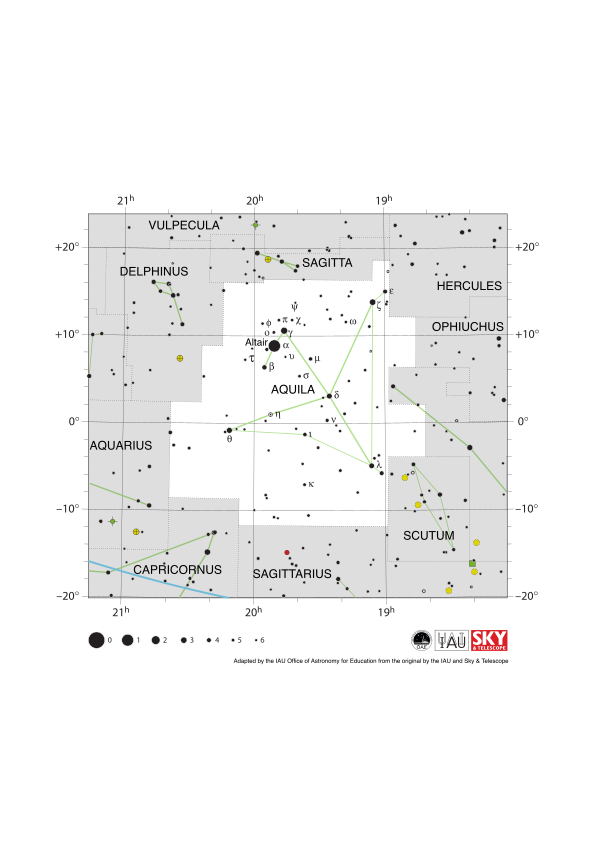
Aquila Constellation Map
imagen
Pie de foto: The constellation Aquila with its bright stars and surrounding constellations. Aquila is surrounded by (going clockwise from the top): Sagitta, Hercules, Ophiuchus, Serpens Cauda, Scutum, Sagittarius, Capricornus, Aquarius and Delphinus. Aquila is most notable for its brightest star Altair. This forms one vertex of the prominent Summer Triangle asterism that is visible in northern hemisphere summer evenings.
Aquila spans the celestial equator and thus some part of it is visible from all of the Earth at some point in the year. It is most visible in the evenings in the late northern hemisphere summer and late southern hemisphere winter.
The y-axis of this diagram is in degrees of declination with north as up and the x-axis is in hours of right ascension with east to the left. The sizes of the stars marked here relate to the star's apparent magnitude, a measure of its apparent brightness. The larger dots represent brighter stars. The Greek letters mark the brightest stars in the constellation. These are ranked by brightness with the brightest star being labeled alpha, the second brightest beta, etc., although this ordering is not always followed exactly. The dotted boundary lines mark the IAU's boundaries of the constellations and the solid green lines mark one of the common forms used to represent the figures of the constellations. The blue line in the lower right of the diagram is the ecliptic. Neither the constellation boundaries, nor the line marking the ecliptic, nor the lines joining the stars appear on the sky.
Crédito: Adapted by the IAU Office of Astronomy for Education from the original by IAU/Sky & Telescope
Enlace del crédito
Términos del glosario:
Magnitud Aparente , Capricornio , Coordenadas celestes , Ecuador celeste , Constelación , Declinación , Eclíptica , Ascensión recta (AR) , Acuario , Asterismo
Categorías:
Astronomía a simple vista
Licencia: Creative Commons Reconocimiento 4.0 Internacional (CC BY 4.0) Creative Commons Reconocimiento 4.0 Internacional (CC BY 4.0) íconos
Archivo
( imagen
95.28 kB)
Archivo PDF
(PDF file
175.09 kB)
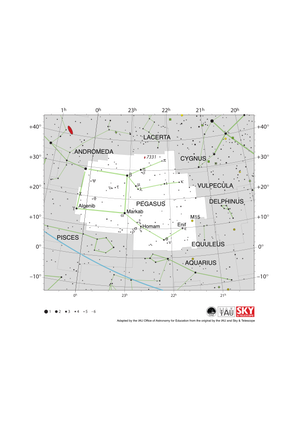
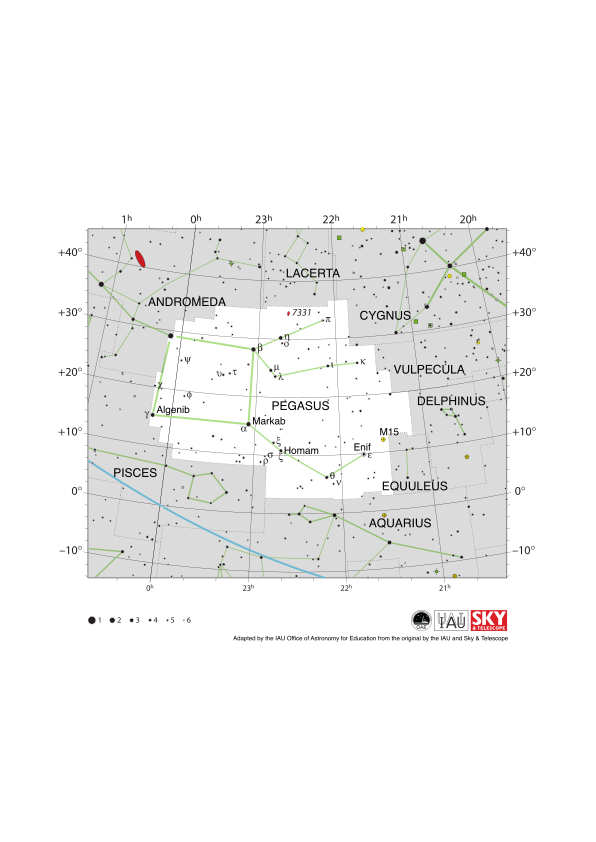
Pegasus Constellation Map
imagen
Pie de foto: The constellation Pegasus with its bright stars and surrounding constellations. Pegasus is surrounded by (going clockwise from the top): Lacerta, Cygnus, Vulpecula, Delphinus, Equuleus, Aquarius, Pisces and Andromeda. Pegasus is known for the prominent asterism the “Square of Pegasus” which consists of its three brightest stars plus the brightest star in Andromeda.
Pegasus is a northern constellation and thus the whole constellation is visible at some point in the year throughout the northern hemisphere. The whole constellation is also visible to southern hemisphere equatorial and temperate zones with parts of the constellation visible from all but the most antarctic regions. Pegasus is best viewed in the evening in the northern hemisphere autumn and southern hemisphere spring.
The globular cluster M15 lies in Pegasus and is marked here with a yellow circle with a plus sign superimposed on it. The spiral galaxy NGC 7331 also lies in Pegasus and is marked here with a red ellipse.
The y-axis of this diagram is in degrees of declination with north as up and the x-axis is in hours of right ascension with east to the left. The sizes of the stars marked here relate to the star's apparent magnitude, a measure of its apparent brightness. The larger dots represent brighter stars. The Greek letters mark the brightest stars in the constellation. These are ranked by brightness with the brightest star being labeled alpha, the second brightest beta, etc., although this ordering is not always followed exactly. The dotted boundary lines mark the IAU's boundaries of the constellations and the solid green lines mark one of the common forms used to represent the figures of the constellations. The blue line at the bottom of the diagram marks the ecliptic. Neither the constellation boundaries, nor the lines joining the stars, nor the ecliptic, appear on the sky.
Crédito: Adapted by the IAU Office of Astronomy for Education from the original by the IAU and Sky & Telescope
Enlace del crédito
Términos del glosario:
Andrómeda , Magnitud Aparente , Coordenadas celestes , Constelación , Declinación , Eclíptica , Cúmulo globular , Piscis , Ascensión recta (AR) , Galaxia espiral , Acuario , Asterismo
Categorías:
Astronomía a simple vista
Licencia: Creative Commons Reconocimiento 4.0 Internacional (CC BY 4.0) Creative Commons Reconocimiento 4.0 Internacional (CC BY 4.0) íconos
Archivo
( imagen
122.04 kB)
Archivo PDF
(PDF file
213.33 kB)