Documentos y recursos - Buscar resultados
Buscar resultados
Equal Day 2026 Planets
imagen
Archivo ( imagen 124.85 kB)
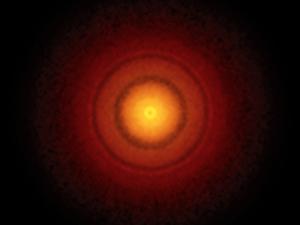
Planet formation around the star TW Hydrae
imagen
Pie de foto: This image shows the disk around the young star TW Hydrae. This star is only about 10 million years old, young enough that planets are still forming in a disk of gas and dust around it. This image was created using an array of submillimetre telescopes, each of which looks like a satellite dish. The signals from these telescopes were combined by a central processing computer to make this image. The lighter and darker patches show areas of the disk where there is more or less dust respectively. The dark rings and bright rings are evidence that the dust in the disk has been shepherded into some orbits and away from others. This is likely because there is one or more planets that are still forming hidden in the disk.
The whole image shows the disk around TW Hydrae out to a distance of about 70 astronomical units frm the central star. The two outer dark rings are separated from the central star by approximately the average distance between the Sun and Uranus and the average distance between the Sun and Pluto. The inner central hole appears to have been carved out by a planet orbiting TW Hydrae at a distance similar to the distance between the Earth and the Sun.
Crédito: S. Andrews (Harvard-Smithsonian CfA); B. Saxton (NRAO/AUI/NSF); ALMA (ESO/NAOJ/NRAO)
Enlace del crédito
Términos del glosario:
Formación de planetas
Categorías:
Exoplanetas y astrobiología
Licencia: Creative Commons Reconocimiento 4.0 Internacional (CC BY 4.0) Creative Commons Reconocimiento 4.0 Internacional (CC BY 4.0) íconos
Archivo
( imagen
210.48 kB)

Sailing the Celestial Seas
imagen
Creado para la OAE
Pie de foto: Honorable mention in the 2023 IAU OAE Astrophotography Contest, category of Still images taken exclusively with smartphones/mobile devices.
In this black and white snapshot taken in April 2022 with a smartphone, a solitary boat rests on the shores of Lake Eucumbene, Australia, framed by the brilliant display of stars comprising the Milky Way. The prominent glow of the galactic centre stands out against the night sky, its intricate patterns of stars and nebulae casting a striking contrast. Each shimmering dot represents a distant sun, possibly orbited by uncharted planets, underscoring the vastness and complexity of our sprawling home galaxy.
Crédito: Lucy Yunxi Hu/IAU OAE (CC BY 4.0)
Términos del glosario:
Vía Láctea , Navegación
Categorías:
Astronomía a simple vista
Etiquetas:
astrophotography
Licencia: Creative Commons Reconocimiento 4.0 Internacional (CC BY 4.0) Creative Commons Reconocimiento 4.0 Internacional (CC BY 4.0) íconos
Este archivo en Zenodo ( imagen 7.11 MB)
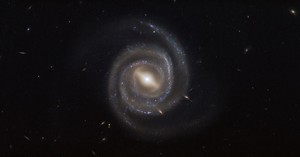
Hubble Image of Barred Spiral Galaxy UGC 6093
imagen
Pie de foto: This image from the Hubble Space Telescope shows the barred spiral galaxy UGC 6093. This galaxy has two spiral arms in its outer regions but the inner edge of each arm joins with the outer edge of a straight bar feature that goes across the galaxy's center.
This galaxy has been classified as an active galaxy due to the emissions of certain lines in its spectrum. This indicates that the supermassive black hole that lies in the center of the galaxy is accreting gas from its surroundings. Unlike some active galactic nuclei (AGN), the center of this galaxy does not shine especially brightly in the visible light so its status as an AGN is not immediately visible from this image.
Crédito: ESA/Hubble & NASA
Enlace del crédito
Términos del glosario:
Núcleo Galáctico Activo , Agujero negro supermasivo , Barra galáctica , Línea espectral
Licencia: Creative Commons Reconocimiento 4.0 Internacional (CC BY 4.0) Creative Commons Reconocimiento 4.0 Internacional (CC BY 4.0) íconos
Archivo
( imagen
987.80 kB)

To guard the Stars and the Sea Together
imagen
Creado para la OAE
Pie de foto: Winner in the 2022 IAU OAE Astrophotography Contest, category Still images of celestial patterns.
This image composition is amazing. In the far background of the landscape we see a chain of mountains that seems to mirror the structure of the Milky Way in the sky above. The strong daylight-like colours of the landscape are caused by the Moon, the bright light at the top of the image.
Taken in Kinabalu, Malaysia, in February 2019, this image shows the alignment of planets and the Moon, conveying the idea of the ecliptic as the central line of the Zodiac, the plane within which all planets orbit the Sun. The ecliptic is the central line of the Zodiac, so the region of about five to 10 degrees either side of the ecliptic is where the constellations of the Zodiac are located. Starting from the horizon towards the bottom left of the image we can see the planets Venus, Saturn and Jupiter. The planets have different cultural significance for people around the world, and are deeply embedded in social, religious and practical aspects of life. For example, Wardaman traditions of Indigenous Australians associate the planets with ancestor spirits who traverse the Celestial Road (ecliptic). The appearance and disappearance of planets in the sky are associated with various ceremonies. For example, when Venus starts being the “Morning star” after having been the “Evening star”, this marks the Banumbirr ceremony for the Yolnu people of Arnhem Land, in Australia.
The image also shows the constellations Scorpius, Aquila, Lupus and Triangulum Australe, the asterism of the Teapot, and the two pointer stars Alpha and Beta Centauri. The constellations, asterisms and individual stars within them have significance in many different cultures.
Malaysia, being close to the equator, has had connections to the north as well as to the south and almost the whole sky is visible over the course of the year. The star Antares is seen by the Kokatha people of the Western Desert as Kogolongo, the red tailed black cockatoo, while the Boorong refer to it as Djuit, the red-rumped parrot. The two stars which form the stinger of Scorpius (Shaula and Lesath), are called Karik Karik, the Australian Kestrel.
Crédito: Likai Lin/IAU OAE
Términos del glosario:
Constelación , Júpiter , Luna , Saturno , Escorpio , Venus , Zodiaco , Asterismo , Alfa Centauri
Categorías:
Astronomía a simple vista
Licencia: Creative Commons Reconocimiento 4.0 Internacional (CC BY 4.0) Creative Commons Reconocimiento 4.0 Internacional (CC BY 4.0) íconos
Este archivo en Zenodo ( imagen 3.77 MB)