Documentos y recursos - Buscar resultados
Buscar resultados
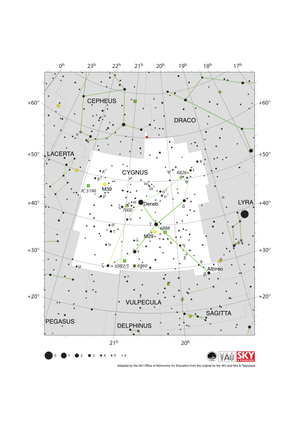
Cygnus Constellation Map
imagen
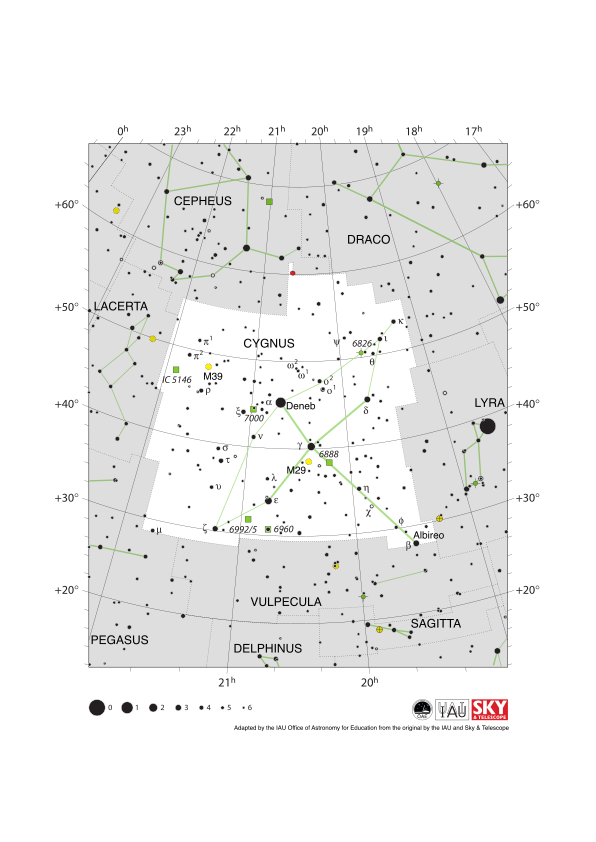
Pie de foto: The constellation Cygnus with its bright stars and surrounding constellations. Cygnus is surrounded by (going clockwise from the top): Cepheus, Draco, Lyra, Vulpecula, Pegasus and Lacerta. Cygnus is notable for its brightest star Deneb. This forms one vertex of the prominent Summer Triangle asterism that is visible in northern hemisphere summer evenings.
Cygnus is a northern constellation and thus the whole of the constellation is visible at some point in the year in the whole northern hemisphere. The whole constellation is also visible from equatorial regions of the southern hemisphere with parts of the constellation visible from temperate southern regions.
The plane of the Milky Way runs through Cygnus and thus the constellation is rich in nebulae and star clusters. These include the North America Nebula (NGC 7000) and the Crescent Nebula (NGC 6888). The Veil Nebula is a huge supernova remnant, parts of which are marked here as NGC 6960 and NGC 6992/5. All of the previously-mentioned nebulae are marked with green squares. The planetary nebula NGC 6826 is marked here with a green circle superimposed on a plus sign. The open star clusters M29 and M39 are marked here with yellow circles.
The y-axis of this diagram is in degrees of declination with north as up and the x-axis is in hours of right ascension with east to the left. The sizes of the stars marked here relate to the star's apparent magnitude, a measure of its apparent brightness. The larger dots represent brighter stars. The Greek letters mark the brightest stars in the constellation. These are ranked by brightness with the brightest star being labeled alpha, the second brightest beta, etc., although this ordering is not always followed exactly. The dotted boundary lines mark the IAU's boundaries of the constellations and the solid green lines mark one of the common forms used to represent the figures of the constellations. Neither the constellation boundaries, nor the lines joining the stars appear on the sky.
Crédito: Adapted by the IAU Office of Astronomy for Education from the original by the IAU and Sky & Telescope
Enlace del crédito
Términos del glosario:
Magnitud Aparente , Coordenadas celestes , Constelación , Declinación , Vía Láctea , Nebulosa , Nebulosa planetaria , Ascensión recta (AR) , Asterismo , Cúmulo abierto , Remanente de supernova
Categorías:
Astronomía a simple vista
Licencia: Creative Commons Reconocimiento 4.0 Internacional (CC BY 4.0) Creative Commons Reconocimiento 4.0 Internacional (CC BY 4.0) íconos
Archivo
( imagen
150.09 kB)
Archivo PDF
(PDF file
216.56 kB)

Vulpecula Constellation Map
imagen
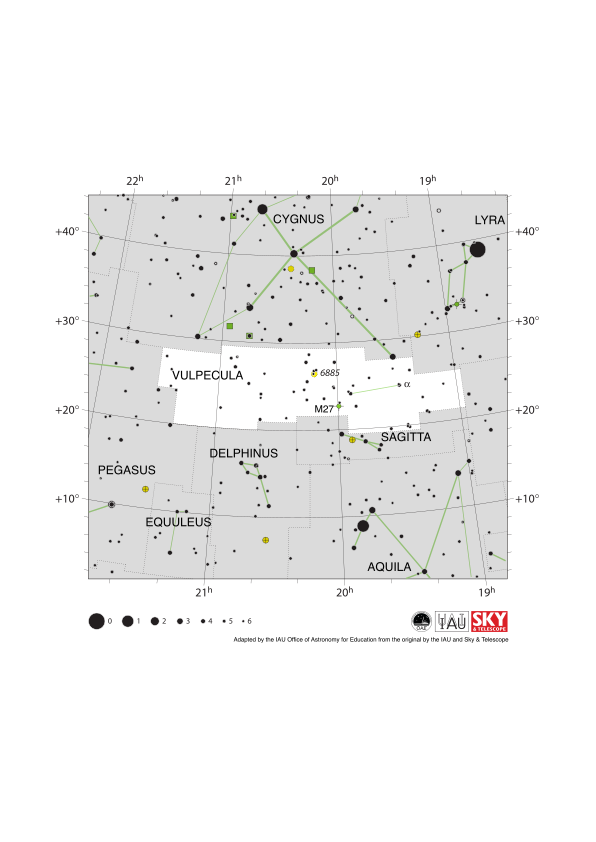
Pie de foto: The constellation Vulpecula with its brighter stars and surrounding constellations. Vulpecula is surrounded by (going clockwise from the top): Cygnus, Lyra, Hercules, Sagitta, Delphinus and Pegasus.
Vulpecula is a northern constellation and thus the whole constellation is visible at some point in the year throughout the northern hemisphere. The whole constellation is also visible in equatorial and temperate regions of the southern hemisphere. Vulpecula is best viewed in the evening in the northern hemisphere early autumn and southern hemisphere early spring.
The planetary nebula M27, commonly known as the Dumbbell Nebula lies in Vulpecula and is marked here with a green cross superimposed on a plus sign. The open cluster NGC 6885 also lies in Vulpecula and is marked here with a yellow circle.
The y-axis of this diagram is in degrees of declination with north as up and the x-axis is in hours of right ascension with east to the left. The sizes of the stars marked here relate to the star's apparent magnitude, a measure of its apparent brightness. The larger dots represent brighter stars. The Greek letters mark the brightest stars in the constellation. These are ranked by brightness with the brightest star being labeled alpha, the second brightest beta, etc., although this ordering is not always followed exactly. The dotted boundary lines mark the IAU's boundaries of the constellations and the solid green lines mark one of the common forms used to represent the figures of the constellations. Neither the constellation boundaries, nor the lines joining the stars appear on the sky.
Crédito: Adapted by the IAU Office of Astronomy for Education from the original by the IAU and Sky & Telescope
Enlace del crédito
Términos del glosario:
Magnitud Aparente , Coordenadas celestes , Constelación , Declinación , Nebulosa planetaria , Ascensión recta (AR) , Cúmulo abierto
Categorías:
Astronomía a simple vista
Licencia: Creative Commons Reconocimiento 4.0 Internacional (CC BY 4.0) Creative Commons Reconocimiento 4.0 Internacional (CC BY 4.0) íconos
Archivo
( imagen
100.83 kB)
Archivo PDF
(PDF file
175.44 kB)
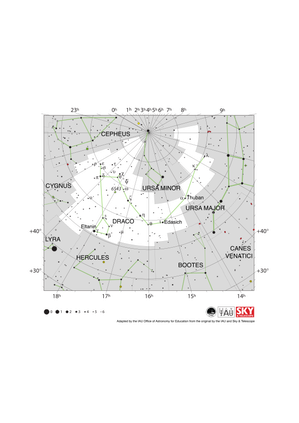
Draco Constellation Map
imagen
Pie de foto: The constellation Draco with its bright stars and surrounding constellations. Draco is surrounded by (going clockwise from the top): Cepheus, Ursa Minor, Boötes, Hercules, Lyra and Cygnus.
Draco is a sprawling northern constellation, parts of which lie close to the celestial north pole. As such the whole constellation is visible at some point in the year from the whole northern hemisphere and a thin sliver of the southern hemisphere near the equator. Parts of the constellation are visible from all other southern equatorial and some southern temperate regions. Draco is best viewed in the evenings in the northern hemisphere summer and southern hemisphere winter.
The planetary nebula NGC 6543 (also known as the Cat’s Eye Nebula) lies in Draco. It is marked here with a green circle superimposed on a plus sign.
This diagram maps an area around the north celestial pole. Here lines of constant right ascension converge. The right ascension values of these lines are marked on the x-axis above and below the diagram. Some of the lines of constant declination are marked on the y-axis. The sizes of the stars marked here relate to the star's apparent magnitude, a measure of its apparent brightness. The larger dots represent brighter stars. The Greek letters mark the brightest stars in the constellation. These are ranked by brightness with the brightest star being labeled alpha, the second brightest beta, etc., although this ordering is not always followed exactly. The dotted boundary lines mark the IAU's boundaries of the constellations and the solid green lines mark one of the common forms used to represent the figures of the constellations. Neither the constellation boundaries, nor the lines joining the stars appear on the sky.
Crédito: Adapted by the IAU Office of Astronomy for Education from the original by the IAU and Sky & Telescope
Enlace del crédito
Términos del glosario:
Magnitud Aparente , Coordenadas celestes , Estrellas circumpolares , Constelación , Declinación , Polo Norte Celeste (PNC) , Nebulosa planetaria , Ascensión recta (AR)
Categorías:
Astronomía a simple vista
Licencia: Creative Commons Reconocimiento 4.0 Internacional (CC BY 4.0) Creative Commons Reconocimiento 4.0 Internacional (CC BY 4.0) íconos
Archivo
( imagen
138.13 kB)
Archivo PDF
(PDF file
223.43 kB)

Lyra Constellation Map
imagen
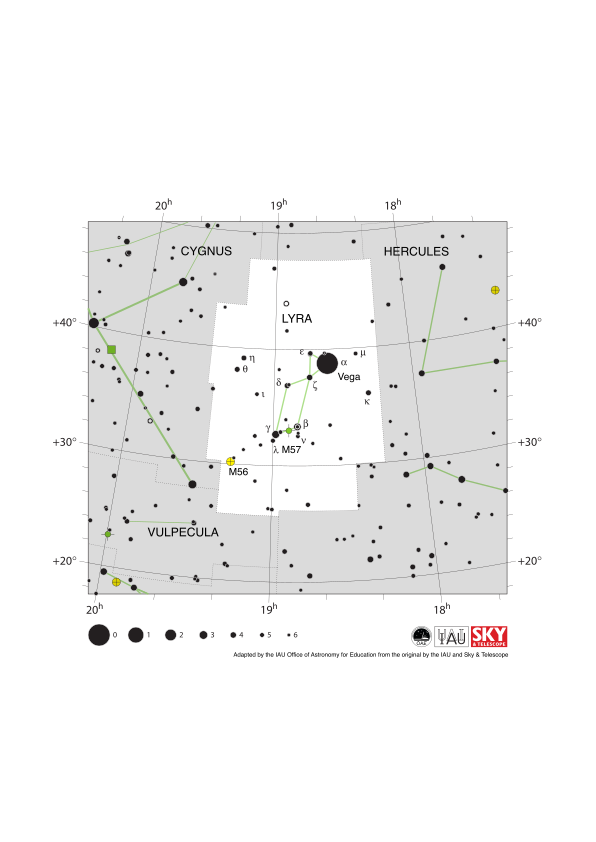
Pie de foto: The constellation Lyra with its bright stars and surrounding constellations. Lyra is surrounded by (going clockwise from the top): Draco, Hercules, Vulpecula and Cygnus. Lyra is dominated by its brightest star Vega which is used to define the zero point of one of the most commonly used magnitude scales of stellar brightness. Vega forms one vertex of the prominent Summer Triangle asterism that is visible in northern hemisphere summer evenings.
Lyra is a northern constellation and thus is visible at some point in the year throughout the northern hemisphere. The whole constellation is also visible from all equatorial and some temperate regions of the southern hemisphere. Parts of the constellation are visible from the remaining southern temperate areas. Lyra is best viewed in the evenings in the northern hemisphere summer and southern hemisphere winter.
The famous planetary nebula M57, commonly known as the Ring Nebula, lies in Lyra. It is marked here with a green circle superimposed on a plus sign. The globular cluster M56 also lies in Lyra and is marked here with a yellow circle with a plus sign superimposed on it.
The y-axis of this diagram is in degrees of declination with north as up and the x-axis is in hours of right ascension with east to the left. The sizes of the stars marked here relate to the star's apparent magnitude, a measure of its apparent brightness. The larger dots represent brighter stars. The Greek letters mark the brightest stars in the constellation. These are ranked by brightness with the brightest star being labeled alpha, the second brightest beta, etc., although this ordering is not always followed exactly. The dotted boundary lines mark the IAU's boundaries of the constellations and the solid green lines mark one of the common forms used to represent the figures of the constellations. Neither the constellation boundaries, nor the lines joining the stars appear on the sky.
Crédito: Adapted by the IAU Office of Astronomy for Education from the original by the IAU and Sky & Telescope
Enlace del crédito
Términos del glosario:
Magnitud Aparente , Coordenadas celestes , Constelación , Declinación , Cúmulo globular , Nebulosa planetaria , Ascensión recta (AR) , Asterismo
Categorías:
Astronomía a simple vista
Licencia: Creative Commons Reconocimiento 4.0 Internacional (CC BY 4.0) Creative Commons Reconocimiento 4.0 Internacional (CC BY 4.0) íconos
Archivo
( imagen
81.99 kB)
Archivo PDF
(PDF file
160.41 kB)

Perseus Constellation Map
imagen
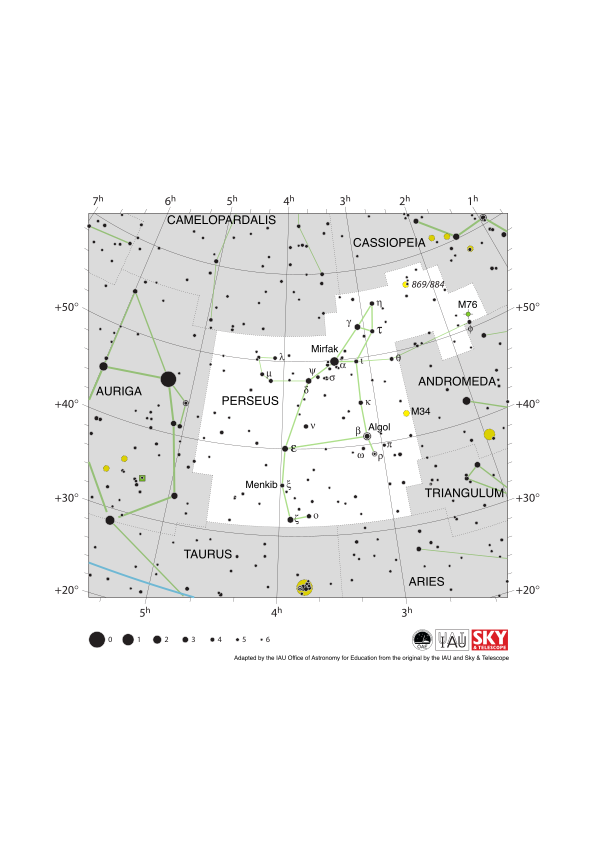
Pie de foto: The constellation Perseus with its bright stars and surrounding constellations. Perseus is surrounded by (going clockwise from the top): Camelopardalis, Cassiopeia, Andromeda, Triangulum, Aries, Taurus and Auriga. Perseus is home to the notable variable star Algol.
Perseus is a northern constellation and thus the whole constellation is visible at some point in the year throughout the northern hemisphere. The whole constellation is also visible to equatorial regions of the southern hemisphere with parts of the constellation visible to southern temperate regions. Perseus is best viewed in the evenings in the northern hemisphere winter and southern hemisphere summer.
The open clusters NGC 869 and NGC 884 (commonly known as the Double Cluster) lie in Perseus as does the open cluster M34. These are all marked with yellow circles. The brightest star in Perseus, Mirfak (alpha Persei), along with some of the surrounding stars are members of the Alpha Persei open cluster. The planetary nebula M76 also lies in Perseus, it is marked here with a green circle superimposed on a plus sign.
The y-axis of this diagram is in degrees of declination with north as up and the x-axis is in hours of right ascension with east to the left. The sizes of the stars marked here relate to the star's apparent magnitude, a measure of its apparent brightness. The larger dots represent brighter stars. The Greek letters mark the brightest stars in the constellation. These are ranked by brightness with the brightest star being labeled alpha, the second brightest beta, etc., although this ordering is not always followed exactly. The dot marking Algol is surrounded by a circle, showing it is a variable star. The dotted boundary lines mark the IAU's boundaries of the constellations and the solid green lines mark one of the common forms used to represent the figures of the constellations. The blue line at the bottom left of the diagram marks the ecliptic. Neither the constellation boundaries, nor the lines joining the stars, nor the ecliptic, appear on the sky.
Crédito: Adapted by the IAU Office of Astronomy for Education from the original by the IAU and Sky & Telescope
Enlace del crédito
Términos del glosario:
Magnitud Aparente , Coordenadas celestes , Constelación , Declinación , Eclíptica , Nebulosa planetaria , Ascensión recta (AR) , Cúmulo abierto , Estrella variable
Categorías:
Astronomía a simple vista
Licencia: Creative Commons Reconocimiento 4.0 Internacional (CC BY 4.0) Creative Commons Reconocimiento 4.0 Internacional (CC BY 4.0) íconos
Archivo
( imagen
119.08 kB)
Archivo PDF
(PDF file
189.39 kB)