Documentos y recursos - Buscar resultados
Buscar resultados

Mapa de la constelación de Andrómeda
imagen
Pie de foto: La constelación de Andrómeda muestra las estrellas brillantes y las constelaciones circundantes. Andrómeda está rodeada por (en el sentido de las agujas del reloj desde arriba) Casiopea, Lacerta, Pegaso, Piscis, Aries, Triángulo y Perseo. La estrella más brillante de Andrómeda (Alpheratz) se encuentra en la parte inferior de la constelación. Junto con tres estrellas de Pegaso forma el asterismo conocido como el "Gran Cuadrado de Pegaso". Las dos siguientes estrellas brillantes de la constelación (Mirach y Almach) forman una línea que se extiende hacia el noreste desde Alpheratz.
Andrómeda es una constelación boreal y es más visible por las tardes en el otoño del hemisferio norte. Es visible desde todo el hemisferio norte y desde la mayoría de las regiones templadas del hemisferio sur, pero no desde las regiones antárticas y subantárticas.
El objeto más famoso de Andrómeda, la Galaxia de Andrómeda, está marcado aquí con una elipse roja y su número de catálogo Messier M31.
El círculo amarillo de la izquierda marca la posición del cúmulo abierto NGC 752 y el círculo verde de la derecha marca NGC 7662 (la nebulosa azul de la bola de nieve), una nebulosa planetaria.
El eje-y de este diagrama está en grados de declinación y con el norte hacia arriba y el eje-x está en horas de ascensión recta con el este a la izquierda. El tamaño de las estrellas marcadas aquí está relacionado con su magnitud aparente, una medida de su brillo aparente. Los puntos más grandes representan estrellas más brillantes. Las letras griegas indican las estrellas más brillantes de la constelación. Están ordenadas por brillo: la estrella más brillante es la alfa, la segunda más brillante es la beta, etc., aunque este orden no siempre se sigue con exactitud.
Crédito: Adaptado por la Oficina de Astronomía para la Educación de la UAI a partir del original de IAU/Sky & Telescope
Enlace del crédito
Términos del glosario:
Andrómeda , Galaxia de Andrómeda , Magnitud Aparente , Constelación , Declinación , Nebulosa planetaria , Ascensión recta (AR) , Cúmulo abierto
Categorías:
Astronomía a simple vista
Licencia: Creative Commons Reconocimiento 4.0 Internacional (CC BY 4.0) Creative Commons Reconocimiento 4.0 Internacional (CC BY 4.0) íconos
Archivo
( imagen
110.23 kB)
Archivo PDF
(PDF file
197.31 kB)
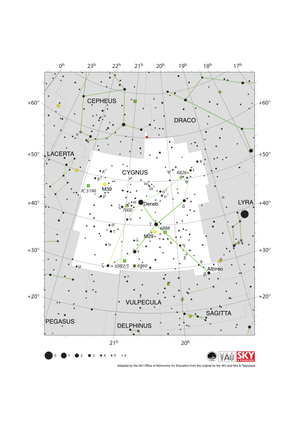
Cygnus Constellation Map
imagen
Pie de foto: The constellation Cygnus with its bright stars and surrounding constellations. Cygnus is surrounded by (going clockwise from the top): Cepheus, Draco, Lyra, Vulpecula, Pegasus and Lacerta. Cygnus is notable for its brightest star Deneb. This forms one vertex of the prominent Summer Triangle asterism that is visible in northern hemisphere summer evenings.
Cygnus is a northern constellation and thus the whole of the constellation is visible at some point in the year in the whole northern hemisphere. The whole constellation is also visible from equatorial regions of the southern hemisphere with parts of the constellation visible from temperate southern regions.
The plane of the Milky Way runs through Cygnus and thus the constellation is rich in nebulae and star clusters. These include the North America Nebula (NGC 7000) and the Crescent Nebula (NGC 6888). The Veil Nebula is a huge supernova remnant, parts of which are marked here as NGC 6960 and NGC 6992/5. All of the previously-mentioned nebulae are marked with green squares. The planetary nebula NGC 6826 is marked here with a green circle superimposed on a plus sign. The open star clusters M29 and M39 are marked here with yellow circles.
The y-axis of this diagram is in degrees of declination with north as up and the x-axis is in hours of right ascension with east to the left. The sizes of the stars marked here relate to the star's apparent magnitude, a measure of its apparent brightness. The larger dots represent brighter stars. The Greek letters mark the brightest stars in the constellation. These are ranked by brightness with the brightest star being labeled alpha, the second brightest beta, etc., although this ordering is not always followed exactly. The dotted boundary lines mark the IAU's boundaries of the constellations and the solid green lines mark one of the common forms used to represent the figures of the constellations. Neither the constellation boundaries, nor the lines joining the stars appear on the sky.
Crédito: Adapted by the IAU Office of Astronomy for Education from the original by the IAU and Sky & Telescope
Enlace del crédito
Términos del glosario:
Magnitud Aparente , Coordenadas celestes , Constelación , Declinación , Vía Láctea , Nebulosa , Nebulosa planetaria , Ascensión recta (AR) , Asterismo , Cúmulo abierto , Remanente de supernova
Categorías:
Astronomía a simple vista
Licencia: Creative Commons Reconocimiento 4.0 Internacional (CC BY 4.0) Creative Commons Reconocimiento 4.0 Internacional (CC BY 4.0) íconos
Archivo
( imagen
150.09 kB)
Archivo PDF
(PDF file
216.56 kB)