Documentos y recursos - Buscar resultados
Buscar resultados

Annual Parallax
imagen
Creado para la OAE
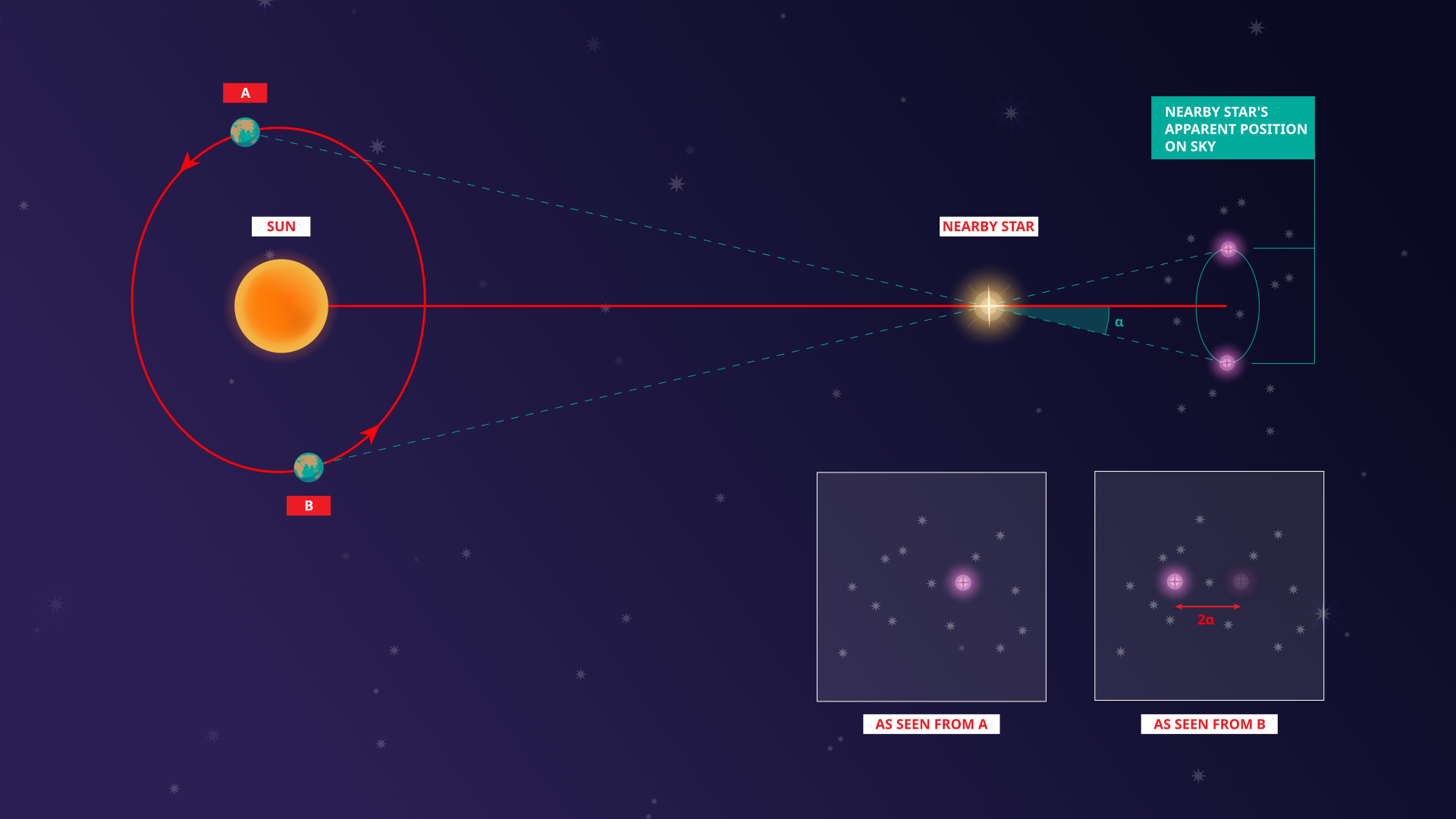
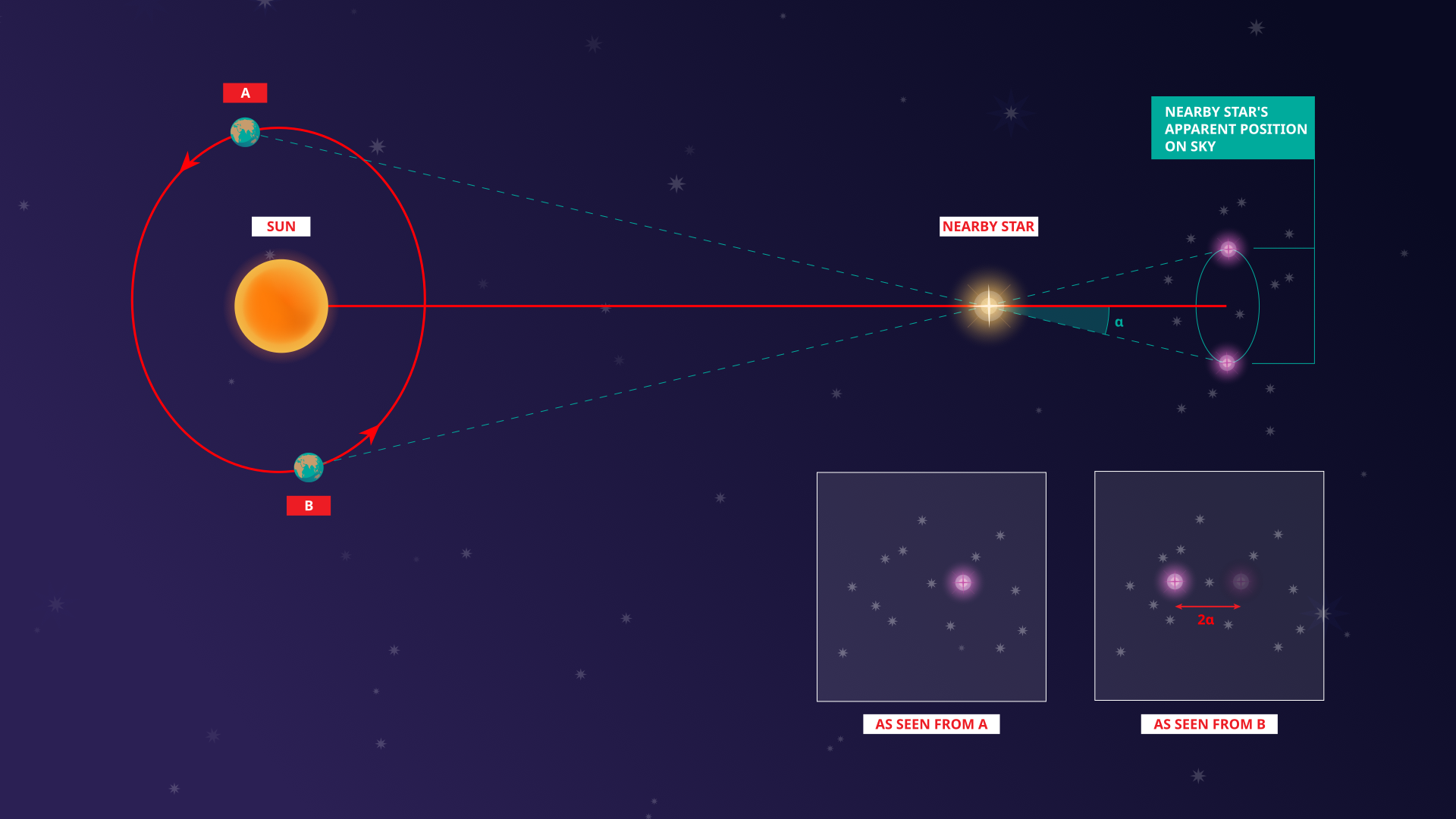
Pie de foto: Distance determination has historically been a challenge for astronomy. One of the primary ways to measure distance is to use annual parallax. The Earth orbits around the Sun over the course of a year meaning that it moves from one side of the Sun (shown here as position A) to the other side of the Sun (position B) over the course of six months. It then moves back to its original position over the remaining six months. This movement subtly changes the perspective an observer on Earth sees the night sky from. This is similar to the change in viewing perspective you may get when viewing a scene from your left eye and then your right eye. The change of viewing perspective causes nearby objects to shift in position in your vision. The annual motion of the Earth around the Sun changes the perspective of the observer enough to shift the observed positions of celestial objects. How big this effect is depends on the distance to the celestial object. Nearby stars will have bigger shifts in observed position than more distant stars.
The positional shift is known as the trigonometric or annual parallax (which we will call α here) and is defined as the shift in position of a star compared to what an observer at the center of the Solar System (the Sun) would see. In this diagram we see the star viewed from perspectives six months apart (positions A and B). When observed from position A the star’s shift in position will be α while when observed at position B it will be –α. Thus the relative difference in the stars position between being observed at position A and position B will be 2α.
The size of the trigonometric or annual parallax in arcseconds is approximately 1 divided by the distance in parsecs. An arcsecond (often represented by a ″ symbol) is the angular diameter a one-metre-long stick would have when viewed from 206 km away. A parsec (often abbreviated to pc) is 3.26 light years or 30.86 trillion kilometres. This is 206,265 astronomical units (the typical distance between the Earth and the Sun). No other star is closer than 1 pc to the Sun so all stars in the sky have trigonometric parallaxes less than one arcsecond.
While trigonometric parallaxes have long been used to measure the distances to objects in our Solar System or nearby stars, recent advances have pushed the boundaries of these distance measures further. The Gaia satellite has pushed the boundaries of parallax measurements to over a thousand parsecs. Arrays of radio telescopes can also very accurately measure the positions of very distant objects and thus their trigonometric parallax.
Note the Earth and Sun are not to scale here and the Earth’s axial tilt is not accurately represented.
Crédito: Aneta Margraf/IAU OAE
Términos del glosario:
Diámetro Angular , Paralaje anual , Unidad Astronómica , Paralaje
Categorías:
Astronomía observacional
Licencia: Creative Commons Reconocimiento 4.0 Internacional (CC BY 4.0) Creative Commons Reconocimiento 4.0 Internacional (CC BY 4.0) íconos
Archivo
( imagen
1.43 MB)
Archivo PDF
(PDF file
248.89 kB)
Also available in black and white
Archivo
( imagen
1.43 MB)
Archivo PDF
(
248.89 kB)
Camelopardalis Constellation Map
imagen
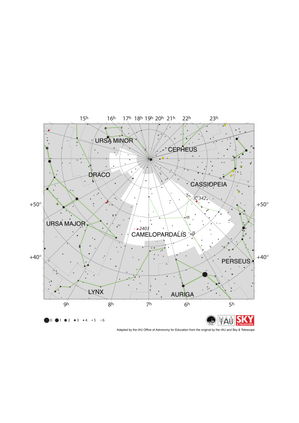
Pie de foto: The constellation Camelopardalis with its bright stars and surrounding constellations. Camelopardalis is surrounded by (going clockwise from the top): Cepheus, Cassiopea, Perseus, Auriga, Lynx, Ursa Major, Draco and Ursa Minor. Camelopardalis is a large constellation but contains relatively few bright stars.
Camelopardalis is a northern constellation and as such the whole constellation is visible for the whole northern hemisphere at some point in the year. It is also visible from equatorial parts of the southern hemisphere with some parts visible to temperate southern regions. The whole constellation is circumpolar for all arctic and more northerly temperate regions of the northern hemisphere. Camelopardalis is best viewed in the evening in the late northern hemisphere winter and late southern hemisphere summer.
The spiral galaxies NGC 2403 and IC 342 lie in Camelopardalis and are marked here with red ellipses.
This diagram maps an area around the north celestial pole. Here lines of constant right ascension converge. The right ascension values of these lines are marked on the x-axis above and below the diagram. Some of the lines of constant declination are marked on the y-axis. The sizes of the stars marked here relate to the star's apparent magnitude, a measure of its apparent brightness. The larger dots represent brighter stars. The Greek letters mark the brightest stars in the constellation. These are ranked by brightness with the brightest star being labeled alpha, the second brightest beta, etc., although this ordering is not always followed exactly. The dotted boundary lines mark the IAU's boundaries of the constellations and the solid green lines mark one of the common forms used to represent the figures of the constellations. Neither the constellation boundaries, nor the lines joining the stars appear on the sky.
Crédito: Adapted by the IAU Office of Astronomy for Education from the original by the IAU and Sky & Telescope
Enlace del crédito
Términos del glosario:
Magnitud Aparente , Coordenadas celestes , Estrellas circumpolares , Constelación , Declinación , Polo Norte Celeste (PNC) , Ascensión recta (AR) , Galaxia espiral
Categorías:
Astronomía a simple vista
Licencia: Creative Commons Reconocimiento 4.0 Internacional (CC BY 4.0) Creative Commons Reconocimiento 4.0 Internacional (CC BY 4.0) íconos
Archivo
( imagen
138.40 kB)
Archivo PDF
(PDF file
215.25 kB)
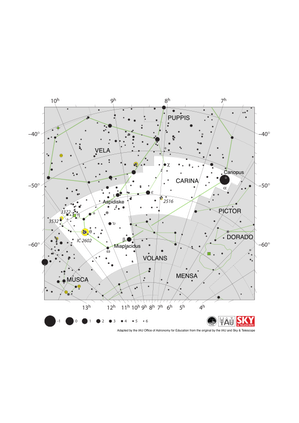
Carina Constellation Map
imagen
Pie de foto: The constellation Carina along with its bright stars and surrounding constellations. Carina is surrounded by (going clockwise from the top): Vela, Puppis, Pictor, Volans, Chamaeleon, Musca and Centaurus. Carina is notable for Canopus, the second brightest star in the night sky and for the famous variable star Eta Carinae. This latter object is a binary star system of two young very massive stars. Its brightness has varied greatly over the past few centuries. At one point it outshone Canopus before dimming by a factor of four thousand to become invisible to the naked eye. In recent years it has brightened enough to again be visible without the aid of a telescope.
Carina is a southern constellation and thus the whole constellation is visible at some point in the year to the entire southern hemisphere. The whole constellation is also visible from equatorial regions of the northern hemisphere with parts of the constellation visible from northern temperate regions.
The open clusters NGC 2516, NGC 3532 and IC 2602 lie in Carina. These are marked here by yellow circles. The Carina Nebula, also known as NGC 3372, lies in the constellation. This large nebula contains many massive young stars, including Eta Carinae.
This diagram maps an area around the south celestial pole. Here lines of constant right ascension converge. The right ascension values of these lines are marked on the x-axis above and below the diagram. Some of the lines of constant declination are marked on the y-axis. The sizes of the stars marked here relate to the star's apparent magnitude, a measure of its apparent brightness. The larger dots represent brighter stars. The Greek letters mark the brightest stars in the constellation. These are ranked by brightness with the brightest star being labeled alpha, the second brightest beta, etc., although this ordering is not always followed exactly. Carina was previously part of the larger Argo Navis constellation along with Vela and Puppis. As the letter designations for stars were created before this division took place, Greek letter designations are now divided between the three constellations with Carina having stars designated alpha and beta but no gamma or delta. The dotted boundary lines mark the IAU's boundaries of the constellations and the solid green lines mark one of the common forms used to represent the figures of the constellations. Neither the constellation boundaries, nor the lines joining the stars appear on the sky.
Crédito: Adapted by the IAU Office of Astronomy for Education from the original by the IAU and Sky & Telescope
Enlace del crédito
Términos del glosario:
Magnitud Aparente , Estrella binaria , Coordenadas celestes , Constelación , Declinación , Nebulosa , Ascensión recta (AR) , Cúmulo abierto , Estrella variable
Categorías:
Astronomía a simple vista
Licencia: Creative Commons Reconocimiento 4.0 Internacional (CC BY 4.0) Creative Commons Reconocimiento 4.0 Internacional (CC BY 4.0) íconos
Archivo
( imagen
144.72 kB)
Archivo PDF
(PDF file
214.81 kB)