Documentos y recursos - Buscar resultados
Buscar resultados

Indus Constellation Map
imagen
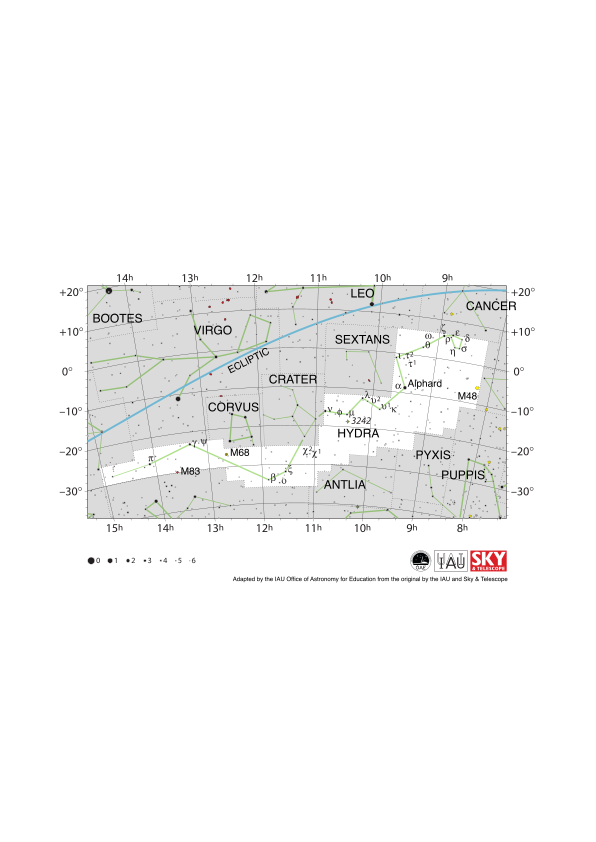
Pie de foto: The constellation Indus with its bright stars and surrounding constellations. Indus is surrounded by (going clockwise from the top): Microcopium, Sagittarius, Telescopium, Pavo, Octans, Tucana and Grus.
Indus lies near the south celestial pole and thus the whole constellation is visible at some point in the year throughout the southern hemisphere. The whole constellation is also visible to a thin strip of the northern hemisphere near the equator with remaining northern equatorial regions able to see parts of the constellation. Indus is circumpolar for temperate and antarctic regions of the southern hemisphere. Indus is best viewed in the evenings in the northern hemisphere autumn and southern hemisphere spring.
The y-axis of this diagram is in degrees of declination with north as up and the x-axis is in hours of right ascension with east to the left. The sizes of the stars marked here relate to the star's apparent magnitude, a measure of its apparent brightness. The larger dots represent brighter stars. The Greek letters mark the brightest stars in the constellation. These are ranked by brightness with the brightest star being labeled alpha, the second brightest beta, etc., although this ordering is not always followed exactly. The dotted boundary lines mark the IAU's boundaries of the constellations and the solid green lines mark one of the common forms used to represent the figures of the constellations. Neither the constellation boundaries, nor the lines joining the stars appear on the sky.
Crédito: Adapted by the IAU Office of Astronomy for Education from the original by the IAU and Sky & Telescope
Enlace del crédito
Términos del glosario:
Magnitud Aparente , Coordenadas celestes , Estrellas circumpolares , Constelación , Declinación , Ascensión recta (AR)
Categorías:
Astronomía a simple vista
Licencia: Creative Commons Reconocimiento 4.0 Internacional (CC BY 4.0) Creative Commons Reconocimiento 4.0 Internacional (CC BY 4.0) íconos
Archivo
( imagen
114.76 kB)
Archivo PDF
(PDF file
175.05 kB)
Eridanus Constellation Map
imagen
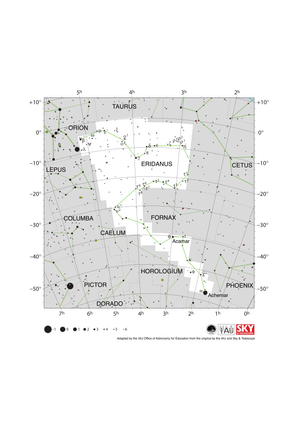
Pie de foto: The constellation Eridanus with its bright stars and surrounding constellations. Eridanus is surrounded by (going clockwise from the top): Taurus, Cetus, Fornax, Phoenix, Tucana, Hydrus, Horologium, Caelum, Lepus and Orion.
Eridanus is a large constellation that spans a wide range in declination. A small portion of the constellation is in the northern hemisphere with the southern-most point lying at a declination of almost -60°. As it spans the celestial equator, parts of the constellation are visible to the whole Earth at some point in the year. The whole constellation can be observed from northern and southern equatorial regions, southern temperate regions and most of Antarctica. Eridanus is best viewed in the evening in the northern hemisphere winter and southern hemisphere summer.
The y-axis of this diagram is in degrees of declination with north as up and the x-axis is in hours of right ascension with east to the left. The sizes of the stars marked here relate to the star's apparent magnitude, a measure of its apparent brightness. The larger dots represent brighter stars. The Greek letters mark the brightest stars in the constellation. These are ranked by brightness with the brightest star being labeled alpha, the second brightest beta, etc., although this ordering is not always followed exactly. The dotted boundary lines mark the IAU's boundaries of the constellations and the solid green lines mark one of the common forms used to represent the figures of the constellations. Neither the constellation boundaries, nor the lines joining the stars appear on the sky.
Crédito: Adapted by the IAU Office of Astronomy for Education from the original by the IAU and Sky & Telescope
Enlace del crédito
Términos del glosario:
Magnitud Aparente , Coordenadas celestes , Constelación , Declinación , Ascensión recta (AR) , Tauro , Orión
Categorías:
Astronomía a simple vista
Licencia: Creative Commons Reconocimiento 4.0 Internacional (CC BY 4.0) Creative Commons Reconocimiento 4.0 Internacional (CC BY 4.0) íconos
Archivo
( imagen
148.42 kB)
Archivo PDF
(PDF file
243.47 kB)

Sextans Constellation Map
imagen
Pie de foto: The constellation Sextans with its brighter stars and surrounding constellations. Sextans is surrounded by (going clockwise from the top): Leo, Hydra and Crater. Sextans is a small constellation with relatively few bright stars.
Sextans spans the celestial equator and thus parts of the constellation are visible at some point in the year across the Earth. The whole constellation is visible in all but the most arctic and most antarctic regions. Sextans is best viewed in the evening in the northern hemisphere spring and southern hemisphere autumn.
The lenticular galaxy NGC 3115 lies in Sextans. It is marked here with a red ellipse.
The y-axis of this diagram is in degrees of declination with north as up and the x-axis is in hours of right ascension with east to the left. The sizes of the stars marked here relate to the star's apparent magnitude, a measure of its apparent brightness. The larger dots represent brighter stars. The Greek letters mark the brightest stars in the constellation. These are ranked by brightness with the brightest star being labeled alpha, the second brightest beta, etc., although this ordering is not always followed exactly. The dotted boundary lines mark the IAU's boundaries of the constellations and the solid green lines mark one of the common forms used to represent the figures of the constellations. The blue line at the top of the diagram marks the ecliptic. Neither the constellation boundaries, nor the lines joining the stars, nor the ecliptic, appear on the sky.
Crédito: Adapted by the IAU Office of Astronomy for Education from the original by the IAU and Sky & Telescope
Enlace del crédito
Términos del glosario:
Magnitud Aparente , Coordenadas celestes , Ecuador celeste , Constelación , Declinación , Eclíptica , Leo , Ascensión recta (AR) , Galaxia lenticular
Categorías:
Astronomía a simple vista
Licencia: Creative Commons Reconocimiento 4.0 Internacional (CC BY 4.0) Creative Commons Reconocimiento 4.0 Internacional (CC BY 4.0) íconos
Archivo
( imagen
73.40 kB)
Archivo PDF
(PDF file
153.02 kB)
Canis Major Constellation Map
imagen
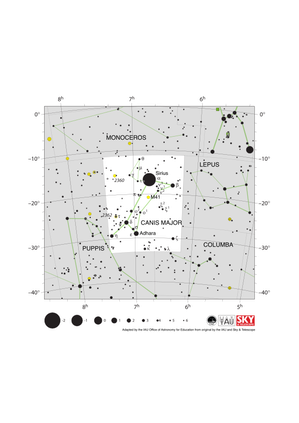
Pie de foto: The constellation Canis Major along with its bright stars and its surrounding constellations. Canis Major is surrounded by (going clockwise from the top): Monoceros, Lepus, Columba and Puppis. The constellation is dominated by Sirius, the star which appears brightest in the night sky, which far outshines all of the other stars in the constellation.
Canis Major lies just south of the celestial equator and is visible from all of the southern hemisphere as well as equatorial and temperate regions of the northern hemisphere. Sirius is visible from all but the most arctic regions. Canis Major is most visible in the evenings in late winter in the northern hemisphere and late summer in the southern hemisphere.
The open star clusters M41, NGC 2360 and NGC 2362 lie in the constellation. These are marked with yellow circles.
The y-axis of this diagram is in degrees of declination with north as up and the x-axis is in hours of right ascension with east to the left. The sizes of the stars marked here relate to the star's apparent magnitude, a measure of its apparent brightness. The larger dots represent brighter stars. The Greek letters mark the brightest stars in the constellation. These are ranked by brightness with the brightest star being labeled alpha, the second brightest beta, etc., although this ordering is not always followed exactly. The dotted boundary lines mark the IAU's boundaries of the constellations and the solid green lines mark one of the common forms used to represent the figures of the constellations. Neither the constellation boundaries, nor the lines joining the stars appear on the sky.
Crédito: Adapted by the IAU Office of Astronomy for Education from the original by IAU/Sky & Telescope
Enlace del crédito
Términos del glosario:
Magnitud Aparente , Coordenadas celestes , Ecuador celeste , Constelación , Declinación , Ascensión recta (AR) , Sirio , Cúmulo abierto
Categorías:
Astronomía a simple vista
Licencia: Creative Commons Reconocimiento 4.0 Internacional (CC BY 4.0) Creative Commons Reconocimiento 4.0 Internacional (CC BY 4.0) íconos
Archivo
( imagen
116.56 kB)
Archivo PDF
(PDF file
200.43 kB)
Hydra Constellation Map
imagen
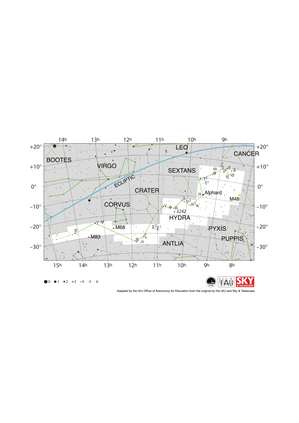
Pie de foto: The constellation Hydra with its bright stars and surrounding constellations. Hydra is surrounded by (going clockwise from the top): Leo, Cancer, Canis Minor, Monoceros, Puppis, Pyxis, Antlia, Centaurus, Lupus, Libra, Virgo, Corvus, Crater and Sextans.
Hydra is a large constellation that covers over a quarter of the celestial sphere in right ascension. It also spans the celestial equator and thus part of the constellation is visible from everywhere on the Earth at some point in the year. All parts of the constellation are visible at some point for all but the most antarctic parts of the southern hemisphere and to equatorial and most temperate regions of the northern hemisphere. However the wide span of the constellation means that all of it may not be visible at the same time in many of these regions. Hydra is best viewed in the northern hemisphere spring and southern hemisphere autumn.
The famous spiral galaxy M83, also known as the Pinwheel Galaxy, lies in Hydra. It is marked here with a red ellipse. The planetary nebula NGC 3242 can also be found in Hydra. It is marked here with a green circle with a plus sign superimposed on it. The open cluster M48 is marked here with a yellow circle while the globular cluster M68 is marked with a yellow circle with a plus sign superimposed on it.
The y-axis of this diagram is in degrees of declination with north as up and the x-axis is in hours of right ascension with east to the left. The sizes of the stars marked here relate to the star's apparent magnitude, a measure of its apparent brightness. The larger dots represent brighter stars. The Greek letters mark the brightest stars in the constellation. These are ranked by brightness with the brightest star being labeled alpha, the second brightest beta, etc., although this ordering is not always followed exactly. The dotted boundary lines mark the IAU's boundaries of the constellations and the solid green lines mark one of the common forms used to represent the figures of the constellations. The blue line on the diagram marks the ecliptic. Neither the constellation boundaries, nor the line marking the ecliptic, nor the lines joining the stars appear on the sky.
Crédito: Adapted by the IAU Office of Astronomy for Education from the original by the IAU and Sky & Telescope
Enlace del crédito
Términos del glosario:
Magnitud Aparente , Coordenadas celestes , Constelación , Declinación , Eclíptica , Cúmulo globular , Libra , Nebulosa planetaria , Ascensión recta (AR) , Galaxia espiral , Cáncer , Cúmulo abierto , Virgo
Categorías:
Astronomía a simple vista
Licencia: Creative Commons Reconocimiento 4.0 Internacional (CC BY 4.0) Creative Commons Reconocimiento 4.0 Internacional (CC BY 4.0) íconos
Archivo
( imagen
114.60 kB)
Archivo PDF
(PDF file
253.49 kB)