Documentos y recursos - Buscar resultados
Buscar resultados

Comet 67P/Churyumov-Gerasimenko
imagen
Pie de foto: Comet 67P/Churyumov–Gerasimenko's nucleus is a "dirty snowball" made of a mixture of frozen materials and dust. It is shaped like two large lobes: one 4.1 km × 3.3 km × 1.8 km, the other 2.6 km × 2.3 km × 1.8 km. These lobes are connected by a small bridge. When a cometary nucleus such as this nears the Sun its frozen, icy material is heated, turning into gas. This, combined with the embedded dust, provide the material for the comet's characteristic coma and tail.
Crédito: ESA/Rosetta/NAVCAM
Enlace del crédito
Términos del glosario:
Cometa , Núcleo del cometa
Categorías:
Sistema Solar
Licencia: Creative Commons Attribution-ShareAlike 3.0 IGO Creative Commons Attribution-ShareAlike 3.0 IGO íconos
Archivo
( imagen
4.75 MB)
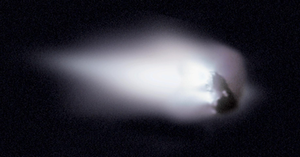
An Encounter With Halley's Comet
imagen
Pie de foto: This image shows the solid core, or nucleus, of Halley’s Comet, captured in 1986 by the European Space Agency spacecraft Giotto during its flyby of the comet in the inner Solar System. The nucleus appears irregular and potato-shaped, measuring roughly 15 kilometers (about 9 miles) across, and is composed of a mixture of ice, dust, and rock. Unlike the glowing fuzzy cloud (coma) and long tail that make comets visible from Earth, the nucleus itself is dark and difficult to see until a spacecraft passes close enough to take detailed images.
Halley’s Comet is one of the best-known comets because it returns to the inner Solar System approximately every 76 years, allowing generations of astronomers to observe it repeatedly. The material that is released from the nucleus as the comet warms near the Sun forms a glowing coma and long tails of gas and dust, and over many returns leaves trails of debris that produce meteor showers on Earth, such as the Eta Aquarids in May and the Orionids in October.
Crédito: NASA/ESA/Giotto Project
Enlace del crédito
Términos del glosario:
Coma de un cometa , Cometa , Núcleo del cometa , El Cometa Halley
Licencia: Dominio público Dominio público íconos
Archivo
( imagen
1.45 MB)
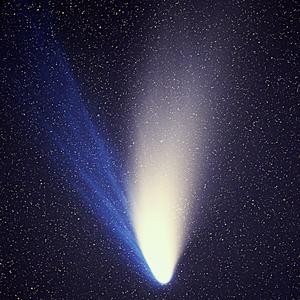
Comet Hale-Bopp
imagen
Pie de foto: Image of comet C/1995 O1 (Hale-Bopp), taken on 4 April 1997, with an exposure time of 10 minutes. The field shown is about 6.5°x6.5°. Two tails extend from the bright coma: one white-yellowish dust tail and a bluish gas tail, always pointing away from the Sun.
Crédito: E. Kolmhofer, H. Raab; Johannes-Kepler-Observatory, Linz, Austria
Enlace del crédito
Términos del glosario:
Cometa , Cola de un cometa
Categorías:
Sistema Solar
Licencia: Creative Commons Atribución-CompartirIgual 3.0 No portada Creative Commons Atribución-CompartirIgual 3.0 No portada íconos
Archivo
( imagen
882.93 kB)

Hello Comet, shall we dance?, by Robert Barsa, Slovakia
imagen
Creado para la OAE
Pie de foto: Third place in the 2021 IAU OAE Astrophotography Contest, category Comets.
This beautiful and poetic image taken from Slovakia in July 2020 captures the comet C/2020 F3 (Neowise). The direction of the tails of the comet provides a clue as to the position of the Sun. In the past, the appearance of a comet in the skies could be accompanied by apprehension and even fear from those who did not know what these objects really are. Through careful observations and the applications of knowledge from physics, chemistry and geology, we now understand that comets are objects left over from the earliest days when the Solar System formed. The most distinctive features of a comet are the bluish ion (gas) tail, and whitish dust tail, which can extend for tens of millions of kilometres. These distinctive features, easily observable with the unaided eye together with an understanding of the science, are no longer cause for fear, rather they help us understand the history of our Solar System, and bring awe, joy and contemplation, as portrayed in this image.
Crédito: Robert Barsa/IAU OAE
Términos del glosario:
Cometa , Cola de un cometa
Categorías:
Astronomía a simple vista
, Sistema Solar
Licencia: Creative Commons Reconocimiento 4.0 Internacional (CC BY 4.0) Creative Commons Reconocimiento 4.0 Internacional (CC BY 4.0) íconos
Este archivo en Zenodo ( imagen 2.59 MB)

El cometa Halley
imagen
Pie de foto: El cometa Halley es un cometa periódico conocido que recibe su nombre del astrónomo inglés Edmond Halley. Tiene un período orbital de aproximadamente 75 años y es visible a simple vista desde la Tierra cuando atraviesa el sistema solar interior.
La imagen muestra el cometa Halley, llamado oficialmente 1P/Halley, con una cola de gas y polvo que se aleja del Sol. Fue tomada desde el Observatorio de La Silla, en Chile, en 1986, durante su última visita al sistema solar interior. Las estrellas en esta imagen aparecen elongadas o como líneas formadas por tres puntos de diferentes colores, ya que la imagen se creó a partir de tres observaciones independientes a diferentes frecuencias mientras el telescopio seguía el movimiento del cometa, que se desplazaba muy ligeramente en comparación con las estrellas del fondo. Obsérvese que la cola del cometa no apunta exactamente en la misma dirección que el alargamiento de las estrellas. Esto nos muestra que la cola del cometa no siempre se encuentra detrás de él, sino que apunta en dirección opuesta al Sol.
El cometa pasa por su perihelio (la distancia más cercana al Sol) a una distancia de alrededor de 0,59 unidades astronómicas, justo entre las órbitas de Mercurio y Venus. Más allá de Neptuno, alcanza su afelio (la distancia máxima del Sol) a una distancia de aproximadamente 35 unidades astronómicas. El cometa Halley alcanzó su afelio en diciembre de 2023 y ahora se está acercando de nuevo. Se espera que vuelva a ser visible a simple vista desde la Tierra a mediados de 2061.
Crédito: ESO
Enlace del crédito
Términos del glosario:
Afelio , Cometa , Cola de un cometa , El Cometa Halley , Perihelio
Licencia: Creative Commons Reconocimiento 4.0 Internacional (CC BY 4.0) Creative Commons Reconocimiento 4.0 Internacional (CC BY 4.0) íconos
Archivo
( imagen
5.23 MB)





