Documentos y recursos - Buscar resultados
Buscar resultados

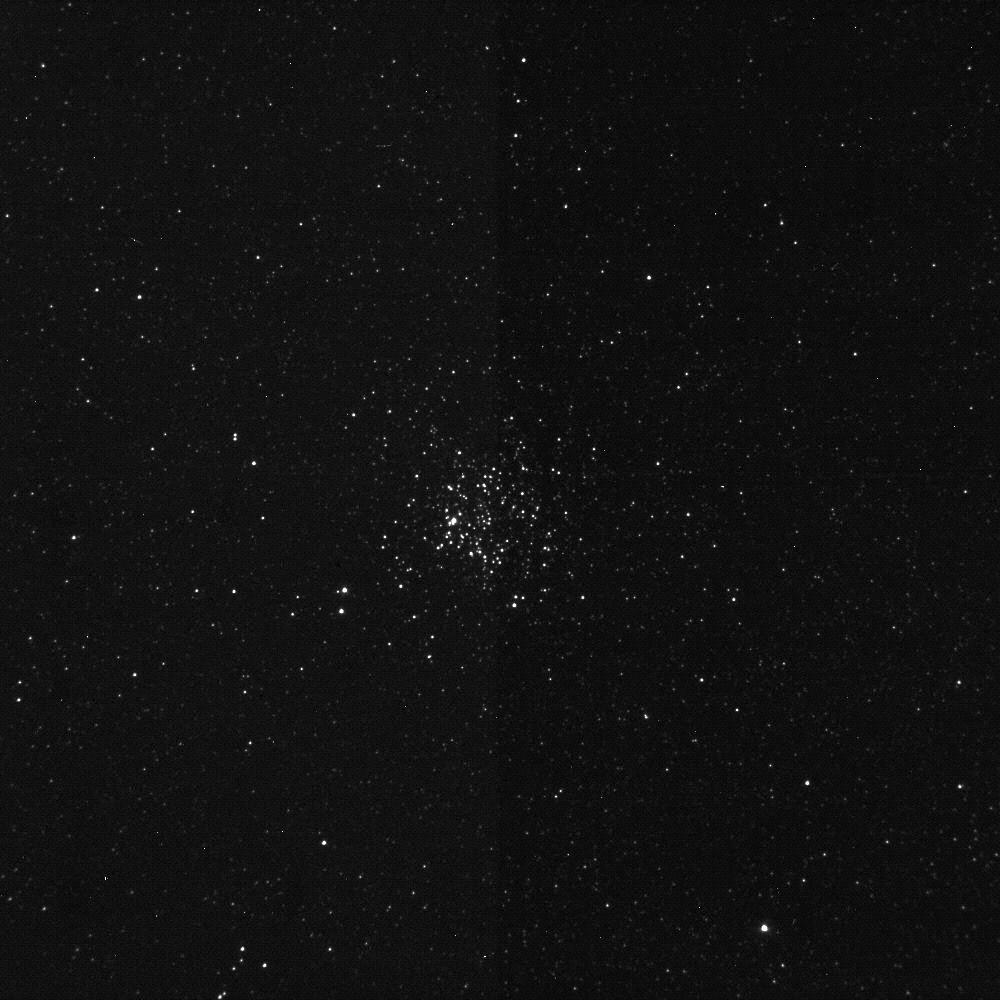
The Wild Duck Open Cluster
imagen
Pie de foto: This image shows the Wild Duck Cluster (also known as Messier 11 or M11), a bright grouping of stars that forms what astronomers call an open cluster in our Milky Way galaxy. Open clusters are collections of stars that were born from the same giant cloud of gas and dust and are still loosely held together by gravity. Most open clusters will slowly fall apart over hundreds of millions of years are they orbit through the galaxy. In this view, hundreds of stars appear close together against the dark background of space, with many shining at different brightnesses depending on their size and temperature.
The Wild Duck Cluster lies about 6,000 light-years from Earth and is around 300 million years old. Because the stars in an open cluster share a common origin, astronomers can use them as laboratories for testing theories on stellar evolution and behaviour.
Crédito: NASA/JPL
Enlace del crédito
Términos del glosario:
Objeto Messier , Cúmulo abierto
Licencia: Dominio público Dominio público íconos
Archivo
( imagen
472.01 kB)

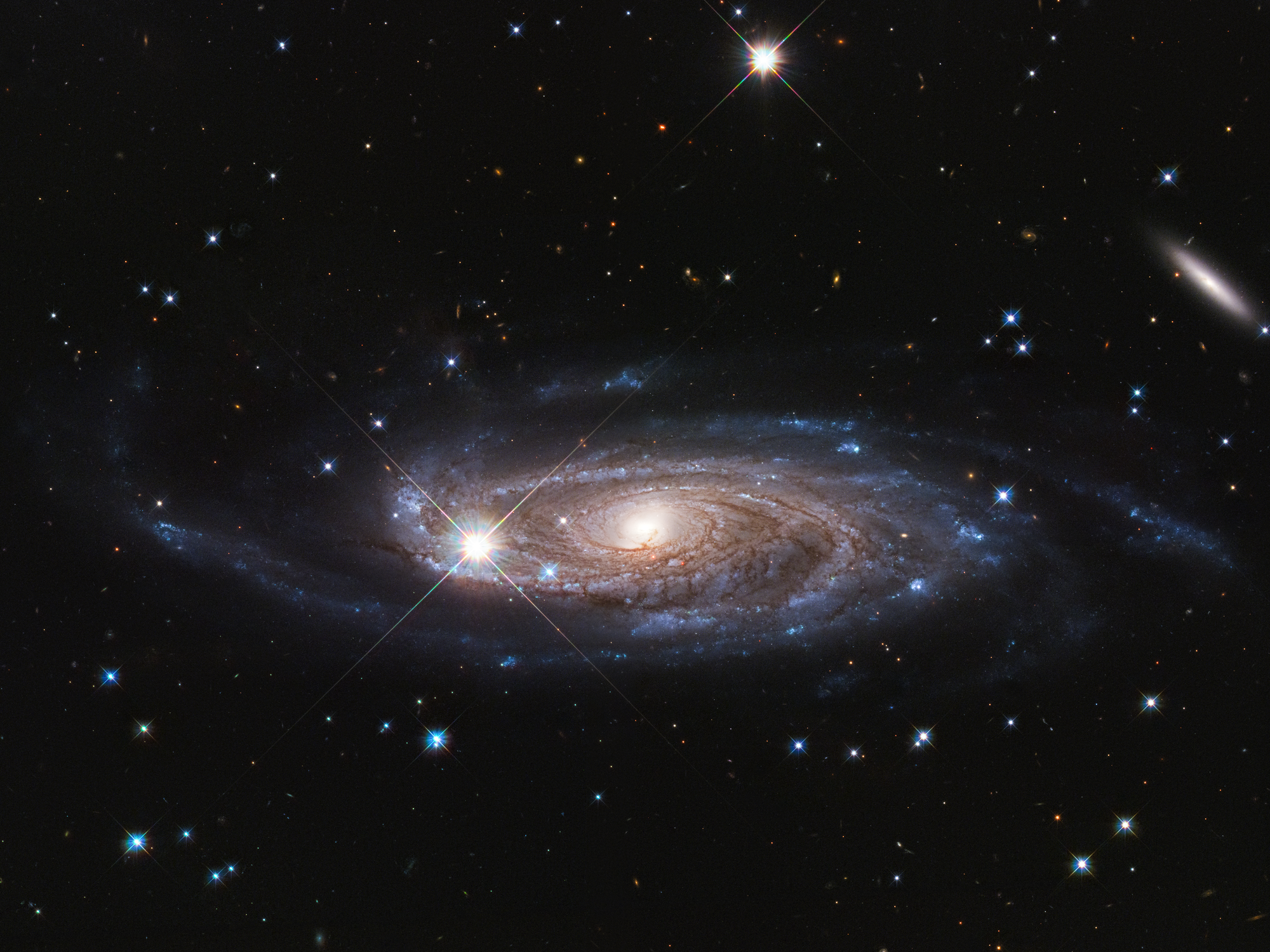
Spiral Galaxy UGC 2885
imagen
Pie de foto: This image shows UGC 2885, a spiral galaxy located in the constellation Perseus, about 230 million light-years from Earth. Spiral galaxies have rotating disks of stars, gas, and dust, with spiral arms extending outward from the central region. In UGC 2885, these arms are very broad and faint, revealing the galaxy’s large size. This galaxy is tilted at an angle to the observer on Earth, meaning it does not appear as the circular "grand design" spiral it would look like if viewed face-on, nor as the thin line with a central bulge it would appear as if viewed edge-on.
UGC 2885 is remarkable because it is roughly twice the diameter of the Milky Way. It was studied by astronomer Vera Rubin, whose observations of how galaxies rotate — including systems like this one — played a key role in the search for dark matter.
The bright star which appears to the left of the galaxy's center is a foreground object not related to the galaxy.
Crédito: NASA, ESA, Benne Holwerda (University of Louisville)
Enlace del crédito
Términos del glosario:
Galaxia de disco , Galaxia espiral
Licencia: Dominio público Dominio público íconos
Archivo
( imagen
4.87 MB)

Pioneer Plaques
imagen
Pie de foto: The Pioneer 10 and 11 spacecraft are the first human-made objects to leave the solar system and venture into interstellar space. To inform potentially intelligent species about our existence, they both carry small metal plaques identifying their time, place of origin and information about their builders. They provide the location of our solar system in the Milky Way by depicting the Solar System's position relative to 14 pulsars, with radiating lines that include information about their frequencies. A model of a hydrogen atom undergoing one particular atomic transition is depicted. The wavelength and frequency of this transition are used to express sizes and frequencies of the other items shown in the plaque. A more detailed view of Earth's position in the solar system, with the spacecraft's trajectory moving away from Earth, passing Mars and Jupiter is displayed at the bottom. The plaque also depicts a naked man and woman alongside the spacecraft to provide a sense of scale. The man’s hand is raised as a friendly gesture.
The 6-inch by 9-inch gold-anodized aluminum plate has the design engraved on it. It was attached to the support struts of the spacecraft's antenna to try to to protect it from erosion by any interstellar dust the spacecraft may encounter on its journey. Designed by Carl Sagan and Frank Drake, with artwork by Linda Salzman Sagan, these plaques are meant to communicate the origin of the spacecraft to any extraterrestrial life that might encounter them.
While Pioneer 10 is on a course towards the star Aldebaran in the Taurus constellation, which will take about two million years to reach, Pioneer 11 is heading in a different direction towards the constellation of Aquila. It will take approximately four million years to pass close to some of the constellation’s stars.
Crédito: NASA Ames
Enlace del crédito
Términos del glosario:
Inteligencia extraterrestre
Categorías:
Astronomía y sociedad
, Exoplanetas y astrobiología
, Exploración espacia
Licencia: Dominio público Dominio público íconos
Archivo
( imagen
5.94 MB)

Milky Way Arch over Lut Desert, Iran, by Amirreza Kamkar, Iran (Islamic Republic of)
imagen
Creado para la OAE
Pie de foto: Second place in the 2021 IAU OAE Astrophotography Contest, category Wide star fields.
This panoramic dawn image shows the majestic band of the Milky Way – our home Galaxy – made up of a few hundred billion stars, among other structures, most of which are not detectable by our eyes, or in some cases even directly with telescopes. The appearance of the band is because the Milky Way is a disc-shaped galaxy, and we (Earth/Solar System) are situated within the disc.
Diverse cultures and traditions around the world each have their own name and cultural stories for the Milky Way. The dark regions visible in the Milky Way are large, dense, cool nebulae (clouds of dust and gas), which obscure the light from stars in the Milky Way. The Indigenous Australians associate stories with the dark patches of the Milky Way, one of the most prominent being the Emu in the Sky (called Tchingal in Wotjobaluk country). In and around the band of the Milky Way there are a vast range of star clusters, two familiar ones are M6 (Butterfly cluster) and M7 (Ptolemy’s cluster).
The bright point just above the horizon is the planet Venus (known to the Boorong people of Indigenous Australia as Chargee Gnowee, elder sister of the Sun). Within the band of the Milky Way the brightest point in the image is the planet Jupiter (called Ginabongbearp, the Sulphur-crested white cockatoo by the Boorong). The planet Saturn is the bright point between Venus and Jupiter (closer to Venus than Jupiter).
There are two constellations and one asterism that can be easily discerned in the image: Aquila, Scorpio (Maui’s Hook), and Teapot (asterism in Sagittarius). In this image, the center of the Milky Way at an approximate distance of 26,000 light years from Earth, is located roughly to the top right of the Teapot spout.
The bright red-orange point to the right of Jupiter is the red supergiant star Antares and is part of the constellation Scorpio (known as Maui’s Hook in Māori and Polynesian cultures). This variation in the colour of stars is the result of temperature of the stars (lower temperature stars are redder, higher temperatures stars are bluer).
Crédito: Amirreza Kamkar/IAU OAE
Términos del glosario:
Vía Láctea , Nube de polvo
Categorías:
La Vía Láctea y el medio interestelar
, Astronomía a simple vista
Licencia: Creative Commons Reconocimiento 4.0 Internacional (CC BY 4.0) Creative Commons Reconocimiento 4.0 Internacional (CC BY 4.0) íconos
Este archivo en Zenodo ( imagen 2.85 MB)

Milky Way Arch over La Palma
imagen
Creado para la OAE
Pie de foto: Winner in the 2022 IAU OAE Astrophotography Contest, category Still images of celestial patterns.
This image, which shows the majestic band of the Milky Way and a range of culturally significant patterns, was taken in May 2022 at a very high altitude from the Roque de los Muchachos Observatory in La Palma, from which one can see the clouds below. Some prominent star patterns include Scorpius, Sagittarius, Lyra, Cygnus, Aquila, the Summer Triangle asterism, and the Teapot asterism.
As the Canary Islands used to be a starting point for European sailors to explore the world, we use this place to point to the many indigenous cultures they encountered. Most notably it is the dark patterns within the band of the Milky Way that hold significance for many Indigenous cultures around the world. The dark patterns are in fact dense, cool clouds of gas and dust that block the light from stars. Indigenous people see caves, waterways and various patterns associated with the dark regions of the Milky Way.
The constellations and patterns hold different cultural significance and interpretations for different people. For example, the constellation Scorpius is referred to by Polynesian people as the demigod Maui’s Fishhook. The Yolnu people of Arnhem Land associate Scorpius with a crocodile called Ingalpir. Some Indigenous Australian groups associate stories with individual stars within Scorpius, most notably Antares, the orange-red star in the top right of the image above the band of the Milky Way. Next to the Scorpion and above the bright centre of the Milky Way, there is a prominent dark cloud that is called the Pipe Nebula by modern astrophotographers. The smoke of this pipe goes up to rho Ophiuchi. This and all the other dark clouds in the Milky Way together form the backbone of heaven for some tribes, and an animal with black-and-white skin for South African Zulu people.
The nomenclature of bright stars also has cross-cultural roots. For example, Vega (the bright blue star towards the top of the image) comes from the Arabic waqi, from al-nasr al-waqi, the Eagle who throws himself down (in order to hunt). This contrasts with the Flying Eagle, Altair, also derived from Arabic. Antares is a Greek word meaning “the one similar to Mars”, referring to its colour. The star name Shaula in the stinger of the Scorpion is a modern version of the Babylonian or even Sumerian star name.
Crédito: Amirreza Kamkar/IAU OAE
Términos del glosario:
Constelación , Polvo , Vía Láctea , Escorpio , Asterismo , Nube de polvo , Extinción interestelar , Sagitario
Categorías:
La Vía Láctea y el medio interestelar
, Astronomía a simple vista
, Telescopios, instrumentos y observatorios
Licencia: Creative Commons Reconocimiento 4.0 Internacional (CC BY 4.0) Creative Commons Reconocimiento 4.0 Internacional (CC BY 4.0) íconos
Este archivo en Zenodo ( imagen 3.31 MB)