Documentos y recursos - Buscar resultados
Buscar resultados

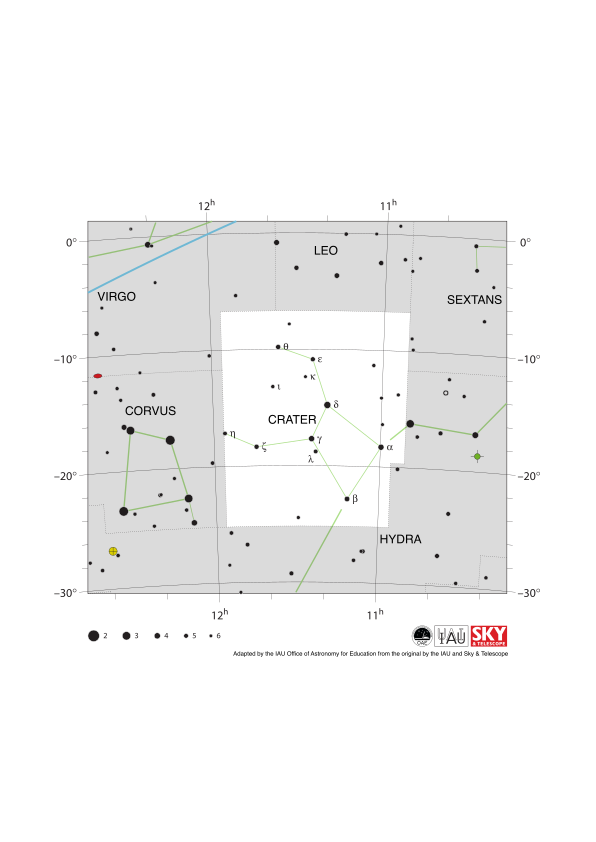
Crater Constellation Map
imagen
Pie de foto: The constellation Crater with its bright stars and surrounding constellations. Crater is surrounded by (going clockwise from the top): Leo, Sextans, Hydra, Corvus and Virgo.
Crater is a southern constellation so the whole of the cluster is visible at some point in the year from the whole of the southern hemisphere.The whole constellation is also visible from temperate and equatorial regions of the northern hemisphere. The constellation is best viewed in the evening in the northern hemisphere spring and southern hemisphere autumn.
The y-axis of this diagram is in degrees of declination with north as up and the x-axis is in hours of right ascension with east to the left. The sizes of the stars marked here relate to the star's apparent magnitude, a measure of its apparent brightness. The larger dots represent brighter stars. The Greek letters mark the brightest stars in the constellation. These are ranked by brightness with the brightest star being labeled alpha, the second brightest beta, etc., although this ordering is not always followed exactly. The dotted boundary lines mark the IAU's boundaries of the constellations and the solid green lines mark one of the common forms used to represent the figures of the constellations. The blue line at the top left of the diagram marks the ecliptic. Neither the constellation boundaries, nor the line marking the ecliptic, nor the lines joining the stars appear on the sky.
Crédito: Adapted by the IAU Office of Astronomy for Education from the original by the IAU and Sky & Telescope
Enlace del crédito
Términos del glosario:
Magnitud Aparente , Coordenadas celestes , Constelación , Declinación , Ascensión recta (AR)
Categorías:
Astronomía a simple vista
Licencia: Creative Commons Reconocimiento 4.0 Internacional (CC BY 4.0) Creative Commons Reconocimiento 4.0 Internacional (CC BY 4.0) íconos
Archivo
( imagen
66.17 kB)
Archivo PDF
(PDF file
142.93 kB)

Lupus Constellation Map
imagen
Pie de foto: The constellation Lupus with its bright stars and surrounding constellations. Lupus is surrounded by (going clockwise from the top): Libra, Hydra, Centaurus, Circinus, Norma and Scorpius.
Lupus is a southern constellation and thus the whole constellation is visible at some point in the year throughout the southern hemisphere. The whole constellation is visible in equatorial and some temperate regions of the northern hemisphere with parts of the constellation visible to remaining temperate regions. Lupus is best viewed in the evenings in the northern hemisphere summer and southern hemisphere winter.
The y-axis of this diagram is in degrees of declination with north as up and the x-axis is in hours of right ascension with east to the left. The sizes of the stars marked here relate to the star's apparent magnitude, a measure of its apparent brightness. The larger dots represent brighter stars. The Greek letters mark the brightest stars in the constellation. These are ranked by brightness with the brightest star being labeled alpha, the second brightest beta, etc., although this ordering is not always followed exactly. The dotted boundary lines mark the IAU's boundaries of the constellations and the solid green lines mark one of the common forms used to represent the figures of the constellations. The blue line in the top left of the diagram marks the ecliptic. Neither the constellation boundaries, nor the line marking the ecliptic, nor the lines joining the stars appear on the sky.
Crédito: Adapted by the IAU Office of Astronomy for Education from the original by the IAU and Sky & Telescope
Enlace del crédito
Términos del glosario:
Magnitud Aparente , Coordenadas celestes , Constelación , Declinación , Eclíptica , Libra , Ascensión recta (AR) , Escorpio
Categorías:
Astronomía a simple vista
Licencia: Creative Commons Reconocimiento 4.0 Internacional (CC BY 4.0) Creative Commons Reconocimiento 4.0 Internacional (CC BY 4.0) íconos
Archivo
( imagen
126.11 kB)
Archivo PDF
(PDF file
197.33 kB)

Piscis Austrinus Constellation Map
imagen
Pie de foto: The constellation Piscis Austrinus with its bright stars and surrounding constellations. Piscis Austrinus is surrounded by (going clockwise from the top): Aquarius, Capricornus, Microscopium, Grus and Sculptor.
Piscis Austrinus is a southern constellation and thus the whole constellation is visible at some point in the year throughout the southern hemisphere. The whole constellation is also visible to some equatorial regions of the northern hemisphere with parts of the constellation visible to the remaining equatorial and some temperate northern hemisphere regions. Piscis Austrinus is best viewed in the evening in the northern hemisphere autumn and southern hemisphere spring.
The y-axis of this diagram is in degrees of declination with north as up and the x-axis is in hours of right ascension with east to the left. The sizes of the stars marked here relate to the star's apparent magnitude, a measure of its apparent brightness. The larger dots represent brighter stars. The Greek letters mark the brightest stars in the constellation. These are ranked by brightness with the brightest star being labeled alpha, the second brightest beta, etc., although this ordering is not always followed exactly. The dotted boundary lines mark the IAU's boundaries of the constellations and the solid green lines mark one of the common forms used to represent the figures of the constellations. The blue line in the top right of the diagram marks the ecliptic. Neither the constellation boundaries, nor the lines joining the stars, nor the ecliptic, appear on the sky.
Crédito: Adapted by the IAU Office of Astronomy for Education from the original by the IAU and Sky & Telescope
Enlace del crédito
Términos del glosario:
Magnitud Aparente , Capricornio , Coordenadas celestes , Constelación , Declinación , Eclíptica , Ascensión recta (AR) , Acuario
Categorías:
Astronomía a simple vista
Licencia: Creative Commons Reconocimiento 4.0 Internacional (CC BY 4.0) Creative Commons Reconocimiento 4.0 Internacional (CC BY 4.0) íconos
Archivo
( imagen
81.19 kB)
Archivo PDF
(PDF file
155.49 kB)

Scutum Constellation Map
imagen
Pie de foto: The constellation Scutum with its brighter stars and surrounding constellations. Scutum is surrounded by (going clockwise from the top): Serpens Cauda, Sagittarius and Aquila.
Scutum is a southern constellation and thus the whole constellation is visible at some point in the year throughout the southern hemisphere. The whole constellation is also visible from equatorial and temperate regions of the northern hemisphere with parts of the constellation visible from all but the most arctic regions.
Two open clusters lie in Scutum: M11, commonly known as the Wild Duck Cluster; and M26. Both of these are marked here with yellow circles.
The y-axis of this diagram is in degrees of declination with north as up and the x-axis is in hours of right ascension with east to the left. The sizes of the stars marked here relate to the star's apparent magnitude, a measure of its apparent brightness. The larger dots represent brighter stars. The Greek letters mark the brightest stars in the constellation. These are ranked by brightness with the brightest star being labeled alpha, the second brightest beta, etc., although this ordering is not always followed exactly. The dotted boundary lines mark the IAU's boundaries of the constellations and the solid green lines mark one of the common forms used to represent the figures of the constellations. The blue line at the bottom of the diagram marks the ecliptic. Neither the constellation boundaries, nor the lines joining the stars, nor the ecliptic, appear on the sky.
Crédito: Adapted by the IAU Office of Astronomy for Education from the original by the IAU and Sky & Telescope
Enlace del crédito
Términos del glosario:
Magnitud Aparente , Coordenadas celestes , Constelación , Declinación , Ascensión recta (AR) , Cúmulo abierto
Categorías:
Astronomía a simple vista
Licencia: Creative Commons Reconocimiento 4.0 Internacional (CC BY 4.0) Creative Commons Reconocimiento 4.0 Internacional (CC BY 4.0) íconos
Archivo
( imagen
96.44 kB)
Archivo PDF
(PDF file
162.71 kB)
Microscopium Constellation Map
imagen
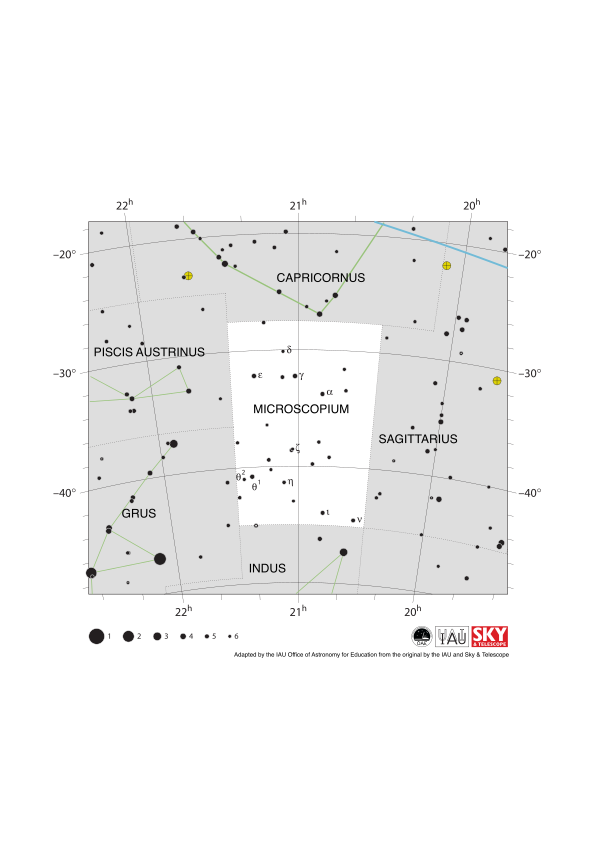
Pie de foto: The constellation Microscopium with its brighter stars and surrounding constellations. Microscopium is surrounded by (going clockwise from the top): Capricornus, Sagittarius, Telescopium, Indus, Grus and Piscis Austrinus. Microscopium is a faint constellation with relatively few bright stars.
Microscopium is a southern constellation and thus the whole constellation is visible at some point in the year throughout the southern hemisphere. The whole constellation is also visible in equatorial and some temperate regions of the northern hemisphere with parts of the constellation visible from other northern temperate regions. Microscopium is best viewed in the evening in the northern hemisphere autumn and southern hemisphere spring.
The y-axis of this diagram is in degrees of declination with north as up and the x-axis is in hours of right ascension with east to the left. The sizes of the stars marked here relate to the star's apparent magnitude, a measure of its apparent brightness. The larger dots represent brighter stars. The Greek letters mark the brightest stars in the constellation. These are ranked by brightness with the brightest star being labeled alpha, the second brightest beta, etc., although this ordering is not always followed exactly. The dotted boundary lines mark the IAU's boundaries of the constellations and the solid green lines mark one of the common forms used to represent the figures of the constellations. Neither the constellation boundaries, nor the line marking the ecliptic, nor the lines joining the stars appear on the sky. The ecliptic is marked with a blue line in the top right.
Crédito: Adapted by the IAU Office of Astronomy for Education from the original by the IAU and Sky & Telescope
Enlace del crédito
Términos del glosario:
Magnitud Aparente , Capricornio , Coordenadas celestes , Constelación , Declinación , Eclíptica , Ascensión recta (AR) , Sagitario
Categorías:
Astronomía a simple vista
Licencia: Creative Commons Reconocimiento 4.0 Internacional (CC BY 4.0) Creative Commons Reconocimiento 4.0 Internacional (CC BY 4.0) íconos
Archivo
( imagen
77.31 kB)
Archivo PDF
(PDF file
147.46 kB)