Documentos y recursos - Buscar resultados
Buscar resultados

Mapa de la constelación de Virgo
imagen
Pie de foto: La constelación zodiacal de Virgo y las constelaciones que la rodean. Comenzando por la parte superior del diagrama y siguiendo el sentido de las agujas del reloj, son Coma Berenices, Leo, Cráter, Corvus, Libra y Bootes. La estrella más brillante de Virgo, Espiga, se encuentra justo debajo de la eclíptica (mostrada aquí como una línea azul) en el centro del mapa. Una forma de localizar esta estrella en el cielo nocturno es seguir el asa de la Osa Mayor hasta la estrella Arcturus en Bootes y seguir una línea recta hasta Espiga ("arco a Arcturus y espiga a Spica"). Esta estrella se encuentra justo debajo de la eclíptica. La eclíptica es la trayectoria que el Sol parece seguir a través del cielo en el transcurso de un año. El Sol se encuentra en Virgo desde mediados de septiembre hasta finales de octubre. Los demás planetas del Sistema Solar se encuentran a menudo en Virgo.
Virgo abarca el ecuador celeste y, por tanto, parte de ella es visible en algún momento del año desde todo el planeta Tierra, con parte de la constelación oscurecida para las regiones más árticas y antárticas del mundo. Virgo es más visible por las tardes en primavera en el hemisferio norte y en otoño en el hemisferio sur.
La constelación de Virgo aparece como una persona tumbada con la espalda casi pegada a la eclíptica, los brazos extendidos y los pies apuntando hacia el este. En Virgo son visibles varios objetos de cielo profundo, como NGC4697, M49, M87, M86, M84 y M60, todos ellos mostrados con elipses rojas en el mapa. Todas ellas son galaxias espirales y elípticas situadas a varios millones de años luz de la Tierra. Más notablemente, M87 alberga el agujero negro supermasivo (Pōwehi) que fue fotografiado por el Event Horizon Telescope en 2019. Todas estas galaxias son miembros del Cúmulo de Virgo, el cúmulo de galaxias más cercano a la Vía Láctea.
El eje-y de este diagrama está en grados de declinación con el norte hacia arriba y el eje-x está en horas de ascensión recta con el este a la izquierda. El tamaño de las estrellas mostradas aquí está relacionado con la magnitud aparente de la estrella, una medida de su brillo aparente. Los puntos más grandes representan estrellas más brillantes. Las letras griegas indican las estrellas más brillantes de la constelación. Están ordenadas según su brillo: la estrella más brillante se denomina alfa, la segunda más brillante beta, etc., aunque este orden no siempre se sigue con exactitud. Las líneas punteadas marcan los límites de las constelaciones según la UAI y las líneas verdes continuas marcan una de las formas habituales utilizadas para representar las figuras de las constelaciones. Ni los límites de las constelaciones, ni la línea que marca la eclíptica, ni las líneas que unen las estrellas aparecen en el cielo.
Crédito: Adaptado por la Oficina de Astronomía para la Educación de la UAI a partir del original de UAI/Sky & Telescope
Enlace del crédito
Términos del glosario:
Magnitud Aparente , Osa Mayor , Coordenadas celestes , Cúmulo de galaxias , Constelación , Declinación , Eclíptica , Galaxia elíptica , Leo , Libra , Ascensión recta (AR) , Galaxia espiral , Agujero negro supermasivo , Zodiaco , Virgo
Categorías:
Astronomía a simple vista
Licencia: Creative Commons Reconocimiento 4.0 Internacional (CC BY 4.0) Creative Commons Reconocimiento 4.0 Internacional (CC BY 4.0) íconos
Archivo
( imagen
98.36 kB)
Archivo PDF
(PDF file
206.71 kB)
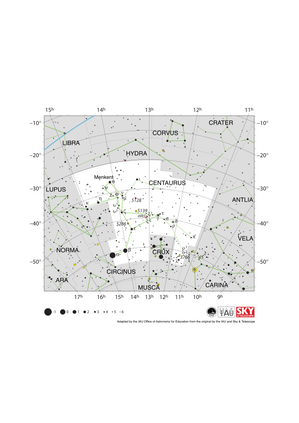
Centaurus Constellation Map
imagen
Pie de foto: The constellation Centaurus with its bright stars and surrounding constellations. Centaurus is surrounded by (going clockwise from the top): Hydra, Antlia, Vela, Carina, Musca, Crux, Circinus, Lupus and Libra. Centaurus is a large constellation most notable for its brightest star Alpha Centauri. Alpha Centauri is a triple star system and is the nearest star system to the Solar System. When viewed with the naked eye, the two brightest components of Alpha Centauri appear as one star. The combined light from these two stars makes Alpha Centauri appear as the third brightest star in the night sky. The third component of the Alpha Centauri system Proxima Centauri, the nearest star to the Sun, is too faint to be viewed with the naked eye.
Centaurus is a southern constellation and thus the whole constellation is visible from the southern hemisphere at some point in the year. The whole constellation is also visible from equatorial regions of the northern hemisphere with parts of the constellation visible from temperate northern regions. The constellation is best viewed in the evening in the late northern hemisphere spring and late southern hemisphere autumn.
The globular cluster Omega Centauri, also known as NGC 5319, lies in Centaurus. Bright enough to be seen with the naked eye, this cluster was initially given a designation as a star in the constellation before its true nature was realised. It is marked here with a yellow circle with a plus sign superimposed on it. As is the globular cluster NGC 5286. The open cluster NGC 3766 is marked here with a yellow circle. NGC 5128, also known as Centaurus A, is the closest active galaxy to Earth. The supermassive black hole at the heart of this galaxy has launched two huge jets of matter which emit in many different wavelengths including x-ray and radio emission. NGC 5128 is marked with a red ellipse here, as is the edge-on spiral galaxy NGC 4945.
The y-axis of this diagram is in degrees of declination with north as up and the x-axis is in hours of right ascension with east to the left. The sizes of the stars marked here relate to the star's apparent magnitude, a measure of its apparent brightness. The larger dots represent brighter stars. The Greek letters mark the brightest stars in the constellation. These are ranked by brightness with the brightest star being labeled alpha, the second brightest beta, etc., although this ordering is not always followed exactly. The dotted boundary lines mark the IAU's boundaries of the constellations and the solid green lines mark one of the common forms used to represent the figures of the constellations. The blue line in the top left is the ecliptic. Neither the constellation boundaries, nor the line marking the ecliptic, nor the lines joining the stars appear on the sky.
Crédito: Adapted by the IAU Office of Astronomy for Education from the original by the IAU and Sky & Telescope
Enlace del crédito
Términos del glosario:
Magnitud Aparente , Coordenadas celestes , Constelación , Declinación , Cúmulo globular , Ascensión recta (AR) , Cúmulo abierto , Alfa Centauri
Categorías:
Astronomía a simple vista
Licencia: Creative Commons Reconocimiento 4.0 Internacional (CC BY 4.0) Creative Commons Reconocimiento 4.0 Internacional (CC BY 4.0) íconos
Archivo
( imagen
152.88 kB)
Archivo PDF
(PDF file
255.96 kB)





