Documentos y recursos - Buscar resultados
Buscar resultados

Mare Crisium - Sea of Crises
imagen
Pie de foto: The image shows the lunar Mare Crisium, the “Sea of Crises,” as seen by NASA’s Lunar Reconnaissance Orbiter in 2015. The photo size is 750 × 750 km, about the size of Germany. Mare Crisium is located in the Moon’s Crisium basin, near the great Mare Tranquillitatis on the near side of the Moon. It is visible from Earth and is characterized by a relatively smooth and flat surface surrounded by cliffs and highlands. The basin that now contains the Mare Crisium was formed by a massive impact event likely during the Nectarian period approximately 3.9 billion years ago. During this time in lunar history, major basins including the Crisium basis were formed by large impact events. Later in lunar history, the basin was flooded by lava to form the dark and flat plain we see today. Its floor is about 1.8 kilometers below the typical lunar surface level. The study of lunar maria provides insights into the volcanic history and impact processes that have affected the Moon and other celestial objects.
Crédito: NASA, Lunar Reconnaissance Orbiter
Enlace del crédito
Términos del glosario:
Luna , Mare
Categorías:
Sistema Solar
Licencia: Dominio público Dominio público íconos
Archivo
( imagen
6.78 MB)
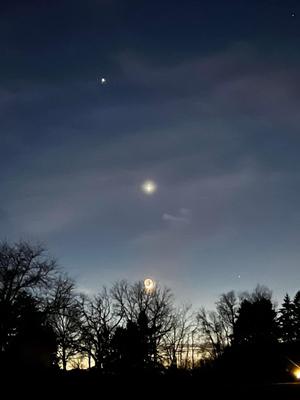
Jupiter, Venus, Moon Conjunction
imagen
Creado para la OAE
Pie de foto: Honorable mention in the 2023 IAU OAE Astrophotography Contest, category of Still images taken exclusively with smartphones/mobile devices.
Captured with a smartphone in February 2023, over the skies of Luzerne County, Pennsylvania, USA, this photograph offers a glimpse into a conjunction, an enthralling astronomical phenomenon that occurs when two or more celestial objects are seen in close proximity in the sky from our perspective, despite the objects not being physically near to each other. In this image, the brilliance of Jupiter (top), the allure of Venus (middle), and the familiar glow of our Moon (bottom) dance together against a backdrop of delicate clouds and a treeline silhouette, making it a moment worth treasuring.
Crédito: Joslynn Appel/IAU OAE (CC BY 4.0)
Términos del glosario:
Conjunción , Júpiter , Luna , Venus
Etiquetas:
astrophotography
Licencia: Creative Commons Reconocimiento 4.0 Internacional (CC BY 4.0) Creative Commons Reconocimiento 4.0 Internacional (CC BY 4.0) íconos
Este archivo en Zenodo ( imagen 132.00 kB)

Sunset view with crescent Moon and Venus at Paranal
imagen
Pie de foto: The waxing crescent moon photographed at sunset from the Paranal observatory in Chile in the Southern Hemisphere. Here we see the moon with a thin sliver illuminated. This thin sliver is orientated towards the Sun which has just set. Below and to the left of the Moon we see the planet Venus.
One of the small Auxiliary Telescopes which are sometimes linked to the Very Large Telescope is shown in the foreground.
Crédito: ESO/Y. Beletsky
Enlace del crédito
Términos del glosario:
Fase lunar , Venus , Cuarto creciente , Luna creciente
Categorías:
Sistema Solar
, Telescopios, instrumentos y observatorios
Licencia: Creative Commons Reconocimiento 4.0 Internacional (CC BY 4.0) Creative Commons Reconocimiento 4.0 Internacional (CC BY 4.0) íconos
Archivo
( imagen
2.34 MB)

Un eclipse solar total sobre el Observatorio La Silla, Chile
vídeo
Pie de foto: Un video en tiempo real que muestra el eclipse solar total del 2 de julio de 2019 sobre el Observatorio La Silla en Chile. Este video cubre los momentos antes de la totalidad, los poco menos de dos minutos de la totalidad y los momentos después de la totalidad. Nótese que al inicio del vídeo el Sol ya estaba casi completamente oculto por la Luna, pero es difícil verlo debido al brillo del Sol y a la exposición de la cámara. De hecho, la Luna comenzó a eclipsar parcialmente al Sol aproximadamente una hora antes del inicio de esta grabación y continuaría ocultando parcialmente al Sol durante aproximadamente el mismo tiempo después.
En el punto de la totalidad se puede ver el tenue resplandor de las regiones exteriores difusas del Sol, y en el horizonte, también se puede ver el resplandor de las partes de las zonas circundantes de la Tierra que no están experimentando la totalidad.
Crédito: ESO/A. Santerne
Enlace del crédito
Términos del glosario:
Eclipse solar , Eclipse solar total
Categorías:
El planeta Tierra
, Sistema Solar
Licencia: Creative Commons Reconocimiento 4.0 Internacional (CC BY 4.0) Creative Commons Reconocimiento 4.0 Internacional (CC BY 4.0) íconos
Archivo
( vídeo
255.13 MB)
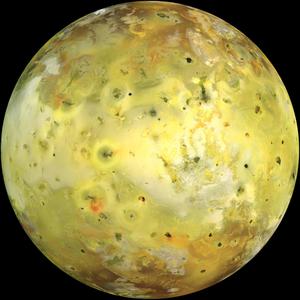
Io
imagen
Pie de foto: La sonda Galileo de la NASA captó, el 3 de julio de 1999, las imágenes de mayor resolución de Io, una de las cuatro lunas de Júpiter descubiertas por Galileo Galilei en 1610. Los colores de Io son testimonio de su intensa actividad volcánica, ya que proceden de compuestos sulfúricos. Las fuerzas de marea procedentes de Júpiter y de las lunas vecinas son la causa del vulcanismo de Io.
Crédito: NASA/JPL/Universidad de Arizona
Enlace del crédito
Términos del glosario:
Satélites galileanos , Ío , Lunas
Categorías:
Sistema Solar
Licencia: Dominio público Dominio público íconos
Archivo
( imagen
789.81 kB)





