Documentos y recursos - Buscar resultados
Buscar resultados
ESO's Very Large Telescope (VLT) at Paranal Observatory with a lunar halo
imagen
Pie de foto: The Very Large Telescope on Cerro Paranal in Chile has four reflecting telescopes each with a primary mirror 8.2m across. In this image one dome is open and firing laser beams into the sky. These lasers create artificial stars in the sky that can be used to adjust the telescope optics to remove the blurring effect of the Earth's atmosphere. This process is known as adaptive optics.
In the sky the Moon is surrounded by a bright halo. This is caused by light from the moon reflecting inside ice crystals in the Earth's atmosphere.
Crédito: Juan Carlos Muñoz-Mateos/ESO
Enlace del crédito
Términos del glosario:
Observatorio , Óptica adaptativa , Halo
Categorías:
Telescopios, instrumentos y observatorios
Licencia: Creative Commons Reconocimiento 4.0 Internacional (CC BY 4.0) Creative Commons Reconocimiento 4.0 Internacional (CC BY 4.0) íconos
Archivo
( imagen
4.27 MB)

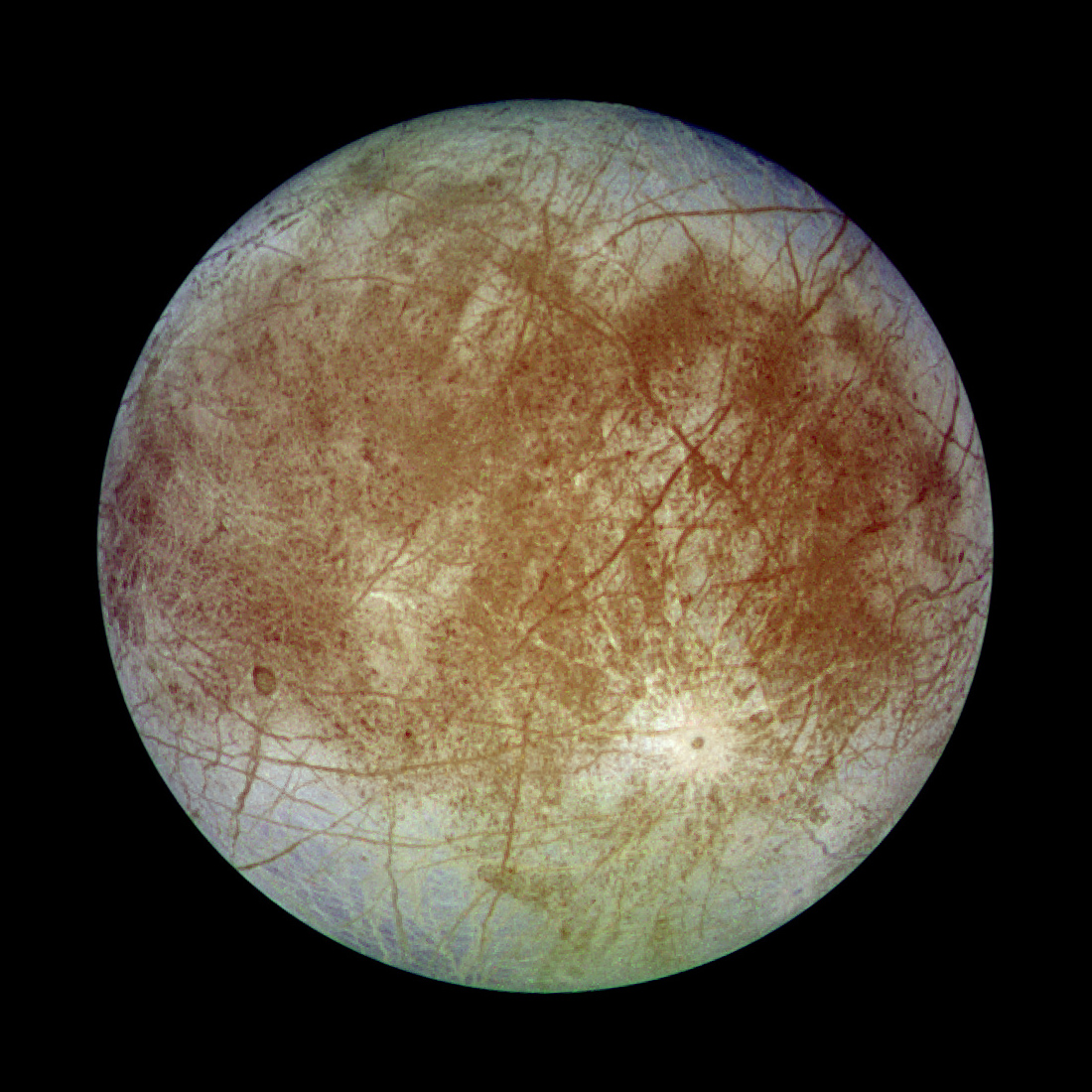
Europa
imagen
Pie de foto: This image taken by NASA's Galileo space probe in September 1996 shows Jupiter's ice-covered satellite, Europa, in approximate natural color. Long, dark lines are fractures in the crust, some of which are more than 3,000 kilometers (1,850 miles) long. The bright feature containing a central dark spot in the lower third of the image is a young impact crater some 50 kilometers (31 miles) in diameter. Europa is about 3,160 kilometers (1,950 miles) in diameter, or about the size of Earth's moon.
Crédito: NASA/JPL/DLR
Términos del glosario:
Satélites galileanos , Lunas
Categorías:
Sistema Solar
Licencia: Dominio público Dominio público íconos
Archivo
( imagen
622.91 kB)
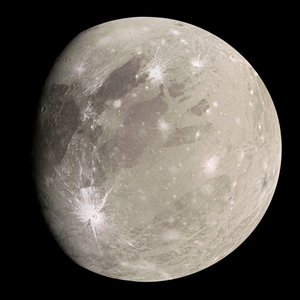
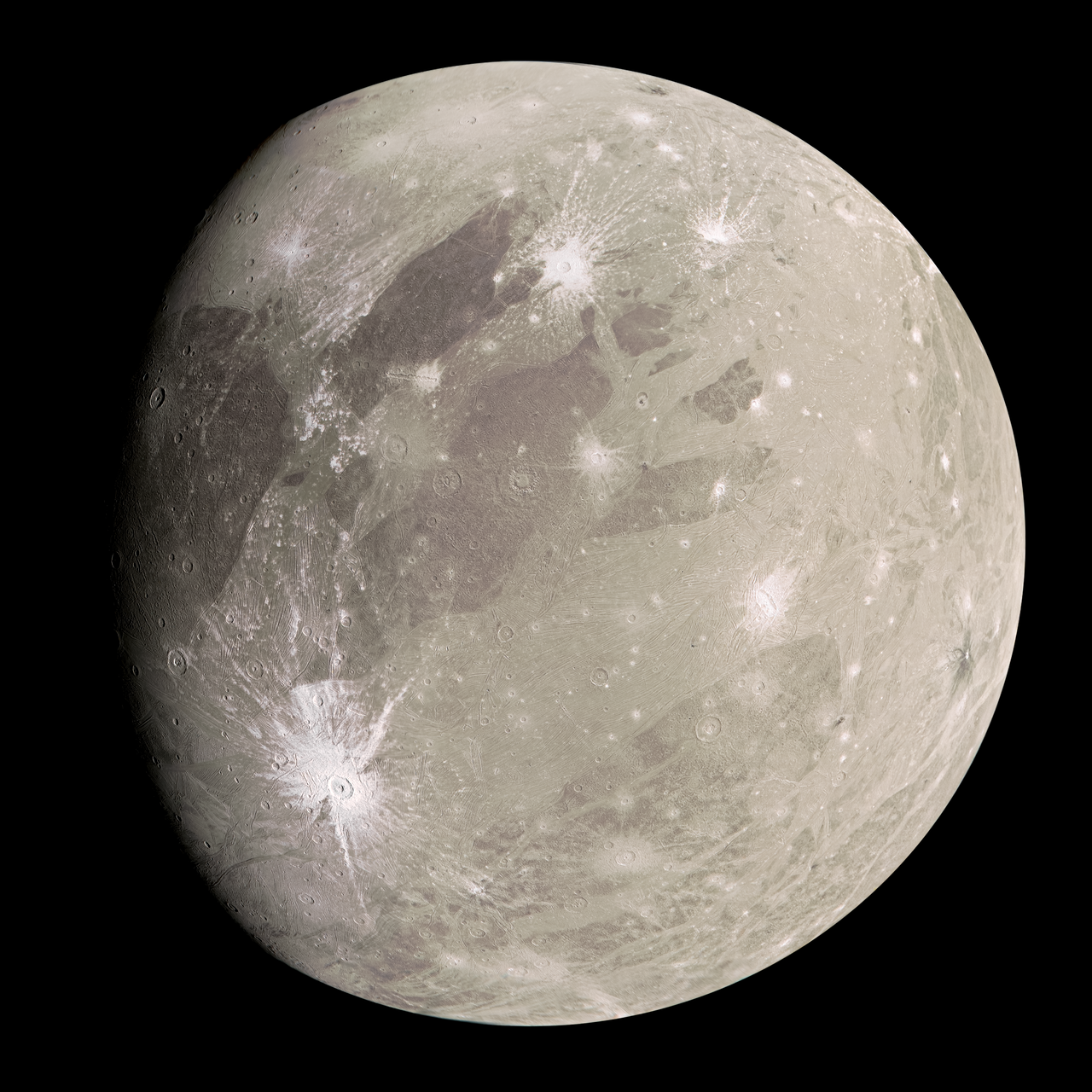
Ganymede seen by Juno spacecraft
imagen
Pie de foto: Ganymede is the largest and most massive natural moon of Jupiter, and at the same time, the largest moon in the solar system. It also stands out as it is the only moon in the solar system which has an internally generated magnetic field. This is likely created by a liquid iron or iron sulfide core.
With a diameter of over 5,000 kilometers, it exceeds Mercury in size. Although it has more than twice the mass of Earth's Moon, it hosts weaker surface gravity than Mercury, Io, and the Moon due to its lower mean density.
Ganymede's appearance is primarily composed of darker, heavily cratered regions, and brighter, less bombarded ones with deep grooves and ridges indicating geological activity. Whether this might be caused by tidal heating is still subject to further analysis. The brighter regions make up around two-thirds of Ganymede's surface.
The remaining area consists of dark regions, saturated with impact craters, which have been dated back to four billion years. It is assumed that the moon hosts a large saltwater ocean under its icy surface with extreme depths of up to 800 kilometers.
Ganymede likely has a very tenuous oxygen atmosphere, comparable to that found on the Jupiter moon Europa. It cannot be interpreted as a sign of life. Instead, it is thought that hydrogen and oxygen are split up by radiation on the moon's surface.
The first space probe to visit Ganymede was Pioneer 10, performing a high-speed flyby manoeuvre through the Jupiter system. Since then, it has been investigated by several other probes such as Galileo, New Horizons, and Juno. The Jupiter Icy Moons Explorer (JUICE) will be the first to actually enter orbit around Ganymede itself (in around 2034) to further study the moon's magnetic and icy surface. JUICE will impact Ganymede as the last act of its mission.
Crédito: NASA/JPL-Caltech/SwRI/MSSS/Kevin M. Gill
Enlace del crédito
Términos del glosario:
Satélites galileanos , Lunas
Licencia: Creative Commons Atribución 2.0 Genérica Creative Commons Atribución 2.0 Genérica íconos
Archivo
( imagen
1.85 MB)
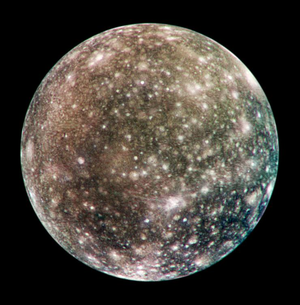
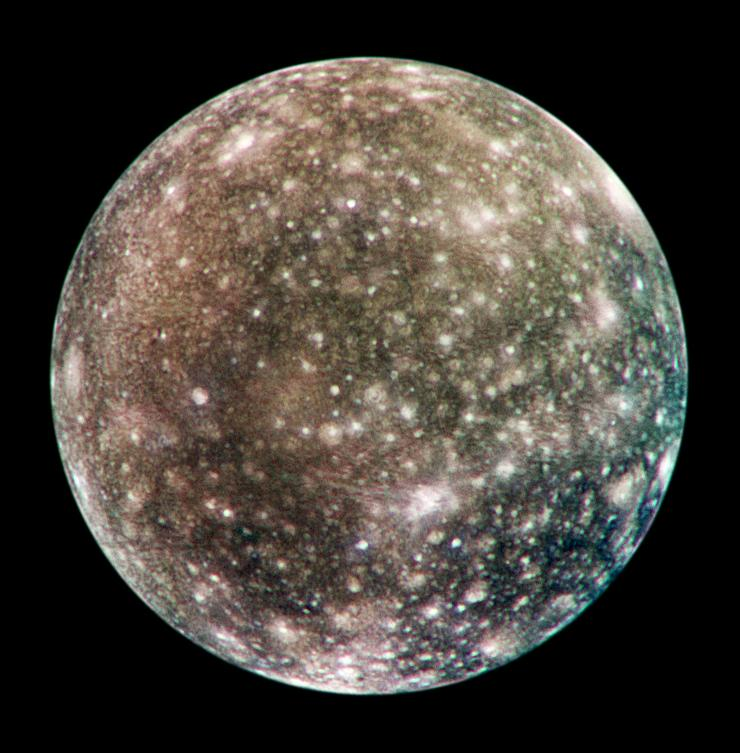
The Callisto satellite
imagen
Pie de foto: Callisto is the outermost of the four large Galilean moons of Jupiter and the third largest in the whole solar system, falling behind only Ganymede and Saturn's moon Titan. It orbits Jupiter at an average distance of around 1.9 million kilometers, roughly six times the distance between Earth and the Moon.
With a diameter of nearly 5,000 kilometers, it is almost as large as Mercury, the smallest planet in our solar system, but has only a third of its mass as it is composed of approximately equal amounts of rock and ice.
Callisto orbits Jupiter in a tidally locked rotation, always showing the same side to Jupiter. In contrast to the other three Galilean satellites – Io, Europa, and Ganymede – it is not in orbital resonance due to its farther outward location and is thus not appreciably tidally heated. It does not show any signs of plate tectonics or volcanic activity. Its lack of geological processes means that surface features like craters remain unchanged for billions of years. It is thought to have evolved predominantly under the influence of impacts, as its surface is the oldest and most heavily cratered object in the solar system. In fact, it is so covered in craters that any new impact will likely erase a former one.
Callisto's internal structure is still subject to discussion; it may consist of a deep salty ocean. It is thought to be composed mainly of a mix of ice and rock, which are present in various states throughout the inner layers of the moon. Callisto hosts a very thin atmosphere composed mainly of carbon dioxide and some traces of oxygen. The moon has been studied by numerous space probes, such as the Pioneer and Voyager missions and the Galileo orbiter, and will be subject to further explorations by NASA, ESA, and China’s National Space Administration (CNSA).
Crédito: NASA/JPL/DLR
Enlace del crédito
Términos del glosario:
Satélites galileanos , Lunas
Licencia: Dominio público Dominio público íconos
Archivo
( imagen
610.45 kB)
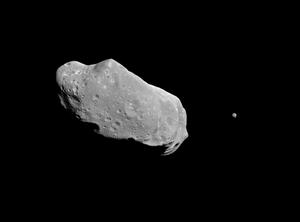
Ida and Dactyl
imagen
Pie de foto: This picture of the asteroid Ida with its satellite Dactyl was taken by the Galileo space probe in August 1993 from a range of 10,870 kilometers (6,755 miles). Ida is a heavily cratered, irregularly shaped asteroid in the main asteroid belt between Mars and Jupiter. This image is proof that asteroids like the 56 km large Ida can possess their own moons.
Crédito: NASA/JPL
Enlace del crédito
Términos del glosario:
Asteroide , Cinturón de Asteroides , Lunas
Categorías:
Sistema Solar
Licencia: Dominio público Dominio público íconos
Archivo
( imagen
56.80 kB)