Documentos y recursos - Buscar resultados
Buscar resultados

Winter Constellations
imagen
Creado para la OAE
Pie de foto: Winner in the 2022 IAU OAE Astrophotography Contest, category Still images of celestial patterns.
Taken from the Kottamia Astronomical Observatory, Cairo, Egypt, in December 2021, this image shows a few prominent winter constellations of the northern sky above the largest telescope in North Africa.
The photograph depicts the constellation of Orion (prominently in the middle of the image) with its belt of stars pointing up to Aldebaran in Taurus and down to Sirius in Canis Major. Aldebaran is a reddish star that we see in front of the open star cluster of the Hyades (at the upper right edge of the image), which is the face of Taurus, the bull. The bright white star is Sirius, the brightest star in the night sky. Its Greek name (Seirios) means “the burner” and can be understood metaphorically as “the brightest”.
This constellation has been represented in a variety of different cultures from all over the world. The ancient Egyptian religion also associates the constellation of Orion with a male figure, namely the god Osiris. It is told that Osiris was murdered by his envious brother Seth, who then dismembered the body and scattered the pieces all over the land. Fortunately, Osiris’s sister-wife Aset (Greek: Isis) is the most powerful sorceress and protective mother goddess. She collected the pieces, put them back together and breathed life back into the god. Aset is seen in the star pattern around the bright star Sirius at the bottom of the photograph. The Egyptian name for Sirius (and adjacent areas) is Sopdet (Greek: Sothis). The heliacal rise of Sirius in summer was a harbinger of the Egyptian new year.
Going north, we can spot a bluish star. This is Alhena, one of the stars in the feet of the zodiacal constellation Gemini, the twins, whose bright head stars would be beyond the upper left edge of the photograph. In the top centre we can see the star Elnath, in the constellation of Auriga, the charioteer. It is associated with Erichthonius, a hero of Greek mythology believed to be the inventor of the four-horse chariot. This same star is also considered the tip of the upper horn of Taurus, the bull. In Greek mythology Taurus is associated with the god Zeus who had sent him to rob a princess. It is commonly known that this Greek story was invented in order to include the Babylonian constellation in Greek mythology. In the Mesopotamian Gilgamesh saga, which is one of the oldest pieces of literature that we know (being traced back to the 3rd millennium), Taurus is the bull of heaven, sent by a jealous goddess and defeated by the king of Uruk to save his people. In the sky it harbours several interesting astronomical objects.
Crédito: Mohamed Aboushelib/IAU OAE
Términos del glosario:
Color , Constelación , Tauro , Orión
Categorías:
Astronomía a simple vista
, Estrellas
Licencia: Creative Commons Reconocimiento 4.0 Internacional (CC BY 4.0) Creative Commons Reconocimiento 4.0 Internacional (CC BY 4.0) íconos
Este archivo en Zenodo ( imagen 21.09 MB)
Chilean Nights
vídeo
Creado para la OAE
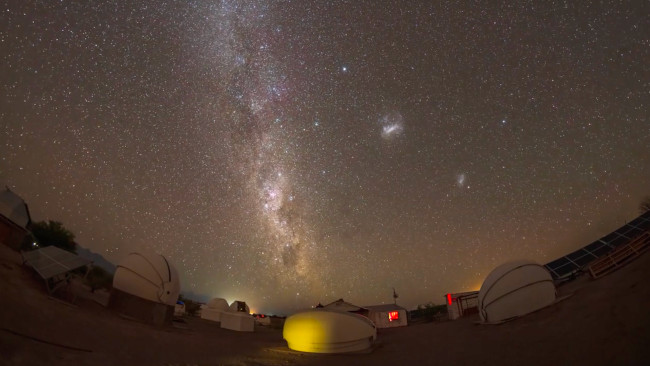
Pie de foto: Honourable mention in the 2022 IAU OAE Astrophotography Contest, category Time lapses of celestial patterns.
Shot in December 2020, this time-lapse shows the sky from San Pedro de Atacama, Chile, in the southern hemisphere.
Right in the first frame we can see our home galaxy, the Milky Way, as well as both the Large and Small Magellanic clouds, two satellite galaxies orbiting the Milky Way. In the bottom of the image the bright stars Rigil Kentaurus and Hadar (also known as Alpha and Beta Centauri) are visible, both in the constellation Centaurus. Just above, we can also see the small constellation Crux, visible from the northern tropical circles southwards. It is important for navigation purposes because its longer axis indicates the direction of the celestial south pole. The bright whitish star in the top of the image and to the right of the Galaxy is Canopus, one of the brightest stars in the night sky, located in the constellation Carina. Canopus is the second brightest star in the sky, while Rigil Kentaurus is the third brightest.
In some of the next frames, Orion, the great hunter, appears clearly with its bright stars and its characteristic asterism, the belt, composed of three aligned bright stars. Since this video was taken from the southern hemisphere, the Greek hero from the northern hemisphere seems to be performing a headstand.
We can also see the planets Jupiter and Saturn in a close conjunction, even finding themselves in the significant beam of Zodiacal light setting down below the horizon. There are also a few meteors blinking in some of the frames, one of them with a long-lasting and developing trail. The very bright object rising from behind the volcanoes of the Andes, creating spectacular shadows and crepuscular rays, is the Moon. In the last frame we see the Moon next to Saturn and Jupiter.
Crédito: Robert Barsa/IAU OAE
Términos del glosario:
Observatorio Astronómico , Constelación , Vía Láctea , Orión , Gran Nube de Magallanes (LMC) , Pequeña Nube de Magallanes (SMC) , Alfa Centauri
Categorías:
Galaxias
, La Vía Láctea y el medio interestelar
, Estrellas
, Telescopios, instrumentos y observatorios
Licencia: Creative Commons Reconocimiento 4.0 Internacional (CC BY 4.0) Creative Commons Reconocimiento 4.0 Internacional (CC BY 4.0) íconos
Este archivo en Zenodo ( vídeo 114.03 MB)
Chilean observatories at home office, by Robert Barsa, Slovakia
imagen
Creado para la OAE
Pie de foto: Third place in the 2021 IAU OAE Astrophotography Contest, category Wide star fields.
This rich panoramic image shows a range of constellations, deep sky objects and planets. The brightest point of light with a pale reddish hue (left of center) is the planet Mars. In the bottom far left of the image, located just above the sloped roof of the building are two points of light appearing very close to each other, these are the planets Jupiter (brighter) and Saturn. To the far right of the image the two fuzzy cloud-like objects are the Large and Small Magellanic Clouds. These are satellite dwarf galaxies of the Milky Way located at a distance of approximately 160,000 and 200,000 light years, respectively. The Andromeda Galaxy, which is located at an approximate distance of 2.5 million light years, appears in this image as a small, angled smudge between Mars and the brightest glow on the horizon (closer to the horizon). The bright glow is not from the Sun or the Moon, but the city lights of San Pedro de Atacama.
Prominent constellations include: Orion – identified by the three stars forming Orion’s Belt; Taurus – a small triangle shaped collection of stars to the left of Orion and identified by the pale orange star (Aldebaran) at the vertex of the triangle; Canis Major – to the bottom right of Orion, identified by the bright star Sirius (the brightest star in the night sky) and three stars in the shape of a triangle just above the observatory dome in the foreground; Pegasus – identified by the trapezium shape diagonally below Mars. Other constellations include Andromeda, Perseus and Aries. Diverse cultures around the world have their own names and rich stories associated with these constellations and many others.
To the top right of Orion’s Belt is an angled line of stars (Orion’s Sword) within which is a pinkish smudge (looks like a fuzzy star when observed with the unaided eye) that is the Orion Nebula – a stellar nursery located 1500 light years from Earth – where stars are formed. To the left of Taurus is a compact fuzzy smudge, and that is the Pleiades star cluster. The variation in the colour of stars is the result of temperature of the stars, for example, the red orange star to the bottom left of Orion’s Belt is the red giant star Betelgeuse. Cooler stars appear redder, compared to the higher temperature white and bluish stars. The colours in the image are enhanced because of the higher sensitivity of the digital camera compared to the human eye.
Crédito: Robert Barsa/IAU OAE
Términos del glosario:
Aries , Astronomía , Observatorio
Categorías:
Astronomía a simple vista
, Telescopios, instrumentos y observatorios
Licencia: Creative Commons Reconocimiento 4.0 Internacional (CC BY 4.0) Creative Commons Reconocimiento 4.0 Internacional (CC BY 4.0) íconos
Este archivo en Zenodo ( imagen 77.18 MB)
Stellar birth environment
imagen
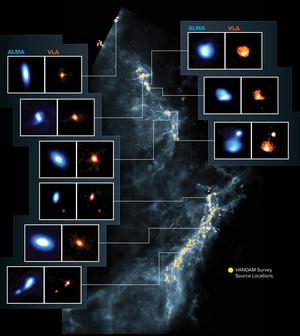
Pie de foto: Snapshot of the formation of multiple protostars in the Orion Molecular Clouds with a closer look at each of them with the Atacama Large Millimeter/submillimeter Array and Very Large Array. Such an image provides unique insights of the process and early stages of star formation as well as the influence of the parent cloud in which they form.
Crédito: ALMA (ESO/NAOJ/NRAO), J. Tobin; NRAO/AUI/NSF, S. Dagnello; Herschel/ESA
Enlace del crédito
Términos del glosario:
Protoestrella , Formación estelar
Categorías:
La Vía Láctea y el medio interestelar
, Estrellas
Licencia: Creative Commons Atribución 3.0 No portada Creative Commons Atribución 3.0 No portada íconos
Archivo
( imagen
426.34 kB)
Lluvia de meteoros de las Geminínidas, de Hao Yin, China
imagen
Creado para la OAE
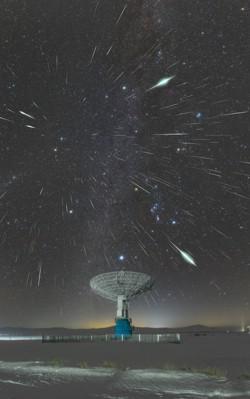
Pie de foto: Tercer puesto en el Concurso de Astrofotografía de la IAU OAE 2021, categoría «Lluvias de meteoros».
A medida que la Tierra orbita alrededor del Sol, puede cruzar la trayectoria de los restos dejados por un cometa o, con menor frecuencia, por un asteroide. Estos restos entran en la atmósfera a gran velocidad, produciendo hermosas estelas al quemarse en el cielo debido a la fricción con la atmósfera. La imagen captura la lluvia de meteoritos de las Gemínidas, llamada así porque el punto radiante se encuentra en el cielo, en la constelación de Géminis. Las partículas que componen la lluvia de meteoros viajan a una velocidad similar y en trayectorias paralelas, lo que provoca un efecto de perspectiva como si la estela se irradiara desde un único punto del cielo, conocido como punto radiante. Esta imagen, tomada en diciembre de 2020 en China, muestra claramente esta perspectiva. Se trata de una lluvia muy prolífica, hasta tal punto que en sus últimas apariciones se han podido observar más de cien meteoritos por hora. Esta lluvia de meteoritos es una de las pocas que no está asociada a un cometa, sino a un asteroide —el 3200 Faetón—, que podría ser un cometa que perdió todo su material volátil. Esta imagen muestra la gran cantidad de meteoros que se pueden observar en esta lluvia, que tiene lugar siempre en diciembre de cada año. La imagen también muestra una de las constelaciones más destacadas del cielo nocturno, Orión, fácilmente reconocible por las tres estrellas en diagonal que forman el Cinturón de Orión, y la estrella de color rojo anaranjado Betelgeuse. Justo encima de la antena hay un punto brillante: se trata de Sirio, la estrella más brillante del cielo nocturno y parte de la constelación de Canis Major. La mancha difusa de color azulado situada aproximadamente a las 2 en punto es el cúmulo estelar de las Pléyades.
Crédito: Hao Yin/IAU OAE
Términos del glosario:
Estrella fugaz
Categorías:
Astronomía a simple vista
Licencia: Creative Commons Reconocimiento 4.0 Internacional (CC BY 4.0) Creative Commons Reconocimiento 4.0 Internacional (CC BY 4.0) íconos
Este archivo en Zenodo ( imagen 9.78 MB)





