Documentos y recursos - Buscar resultados
Buscar resultados

The planet PDS 70b inside a protoplanetary disk
imagen
Pie de foto: An image of the planet PDS 70b. The young star PDS 70b has a protoplanetary disk surrounding it. Disks like these contains gas, fine sandy particles that astronomers refer to as dust and also larger bodies ranging from objects the size of pebbles to protoplanets (planets that are still forming).
This image was taken in infrared light using adaptive optics. Adaptive optics is a technique that uses flexible mirrors and computer analysis to remove the blurring effect of the Earth's atmosphere. This allows astronomers to search regions close to stars like PDS 70 that would otherwise be swamped by light from the star spread out by the Earth's atmosphere. In the center is a black circle. This is caused by a coronograph, a small circle that blocks out light from the parent star. This is surrounded by a bright oval, infrared light emitted from the material in the protoplanetary disk. To the right of the black circle covering the star is a bright dot. This is PDS 70b, a giant planet that is still forming .
Crédito: ESO/ A. Müller, MPIA
Enlace del crédito
Términos del glosario:
Formación de planetas , Protoplaneta , Disco protoplanetario , Óptica adaptativa
Categorías:
Exoplanetas y astrobiología
Licencia: Creative Commons Reconocimiento 4.0 Internacional (CC BY 4.0) Creative Commons Reconocimiento 4.0 Internacional (CC BY 4.0) íconos
Archivo
( imagen
1.59 MB)
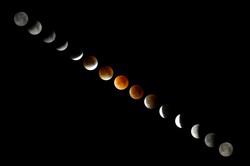
Red Moon, by Daniel Henrion, France
imagen
Creado para la OAE
Pie de foto: Third place in the 2021 IAU OAE Astrophotography Contest, category Total lunar eclipse.
Time-lapse images of a total supermoon lunar eclipse that took place on 28 September 2015. The photos show the Moon during the time it moved through the Earth´s umbra: Earth´s umbra touched the Moon´s outer limb at 1.07 a.m. UTC (upper left corner) and left the Moon´s surface at 4.27 a.m. UTC (lower right corner).
Crédito: Daniel Henrion/IAU OAE
Términos del glosario:
Eclipse , Luna , Eclipse lunar total
Categorías:
Astronomía a simple vista
, Sistema Solar
Licencia: Creative Commons Reconocimiento 4.0 Internacional (CC BY 4.0) Creative Commons Reconocimiento 4.0 Internacional (CC BY 4.0) íconos
Este archivo en Zenodo ( imagen 980.51 kB)
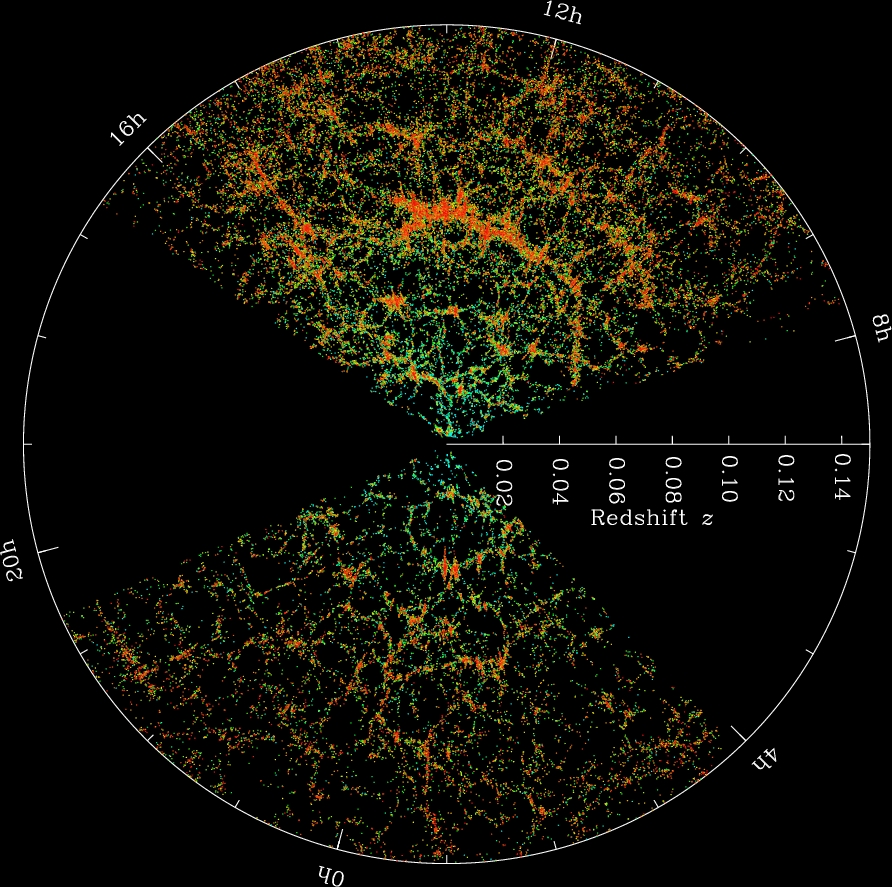
SDSS Redshift Map
imagen
Pie de foto: This image shows a map of the distribution of galaxies and is based on redshift data from the Sloan Digital Sky Survey (SDSS). Redshift measurements provides information on the distances, positions and motions of the galaxies.
The Earth is located at the center of the image, and each dot represents a galaxy. The outer circle represents a ""distance"" of about 2 billion light years. The idea of distance in cosmology is complex because the usual measurement of distance is the separation between two points in space at the same time. However, because of the speed of light, the further a distance, the farther back in time we are observing. The numbers on the outer circle are Right Ascension coordinates mapped onto a flat circle, and provides information on the position of the galaxies on the sky. The colours used represent the ages of the stars in the galaxies, the redder, more strongly clustered points represent galaxies comprising of older stars. The dark wedges that do not contain any dots are regions that were not mapped by the SDSS due to dust from the Milky Way galaxy obscuring the view.
Crédito: M. Blanton and Sloan Digital Sky Survey
Enlace del crédito
Términos del glosario:
Materia oscura , Desplazamiento al rojo
Categorías:
Cosmología
Licencia: Creative Commons Reconocimiento 4.0 Internacional (CC BY 4.0) Creative Commons Reconocimiento 4.0 Internacional (CC BY 4.0) íconos
Archivo
( imagen
507.35 kB)
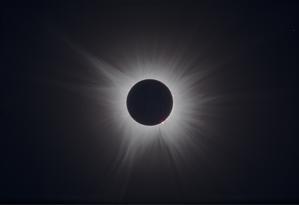
Solar corona
imagen
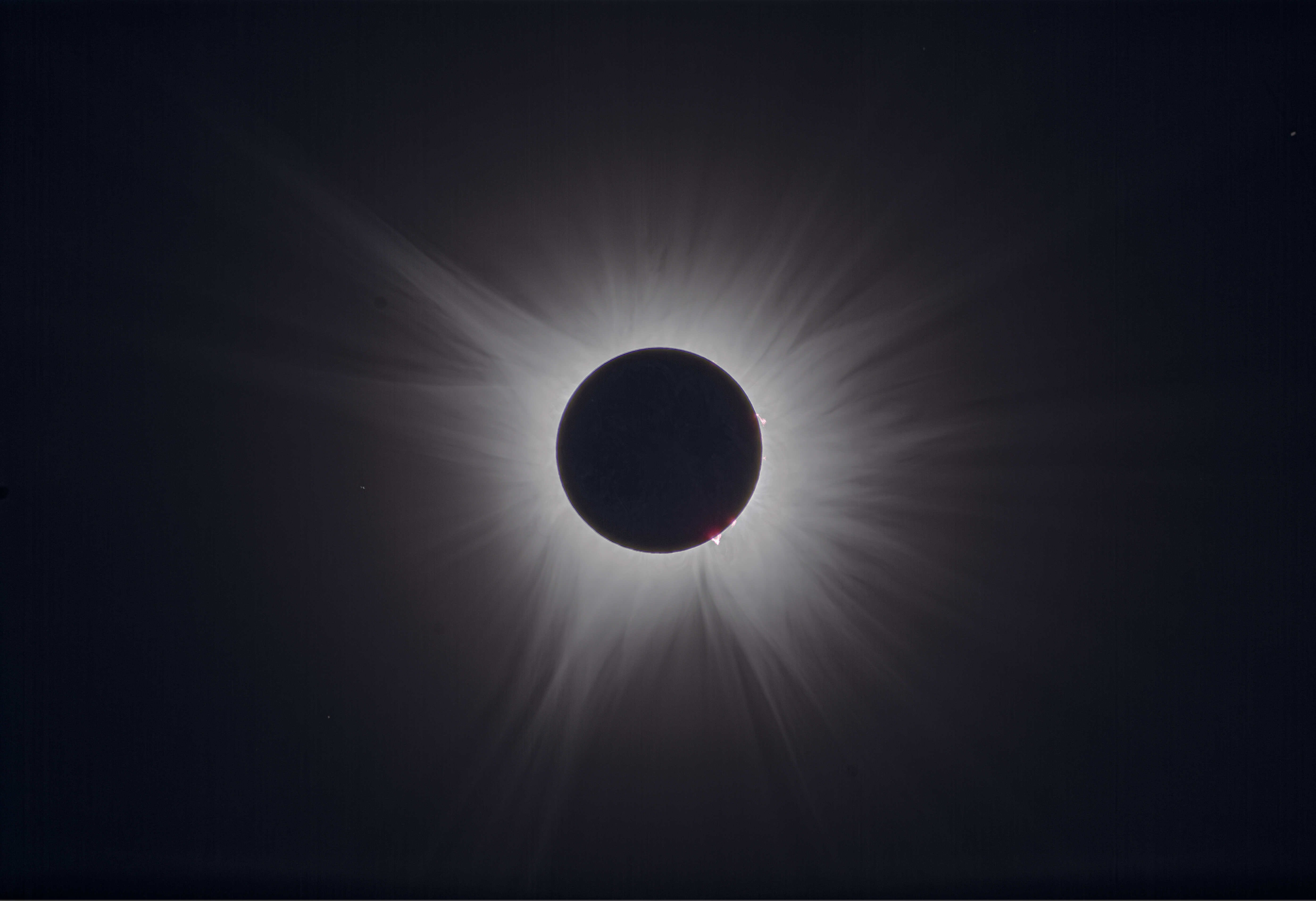
Pie de foto: Solar corona composite during the totality of the April 8th, 2024 solar eclipse. Solar prominences are also visible on the right side edge. This image was processed using a Larson-Sekanina-style technique. Multiple exposures ranging from 1/500 second to 4 seconds were stacked and combined with a rotational gradient filter to reveal fine structural detail across the corona's extreme brightness range. This is done because the inner corona saturates at longer exposures, while the outer corona and the Moon are only visible at those same longer exposures. The 4-second exposure was excluded from this image, since only the Moon was captured in this frame.
Crédito: Carolin Liefke
Etiquetas:
Solar corona
, Solar eclipse
, Sun
Licencia: Creative Commons Reconocimiento 4.0 Internacional (CC BY 4.0) Creative Commons Reconocimiento 4.0 Internacional (CC BY 4.0) íconos
Archivo
( imagen
8.75 MB)

The Crab Nebula
imagen
Pie de foto: The Crab Nebula is situated 6500 light years away in the constellation Taurus. This is remnant of a supernova explosion caused by a massive star at the end of its life. This happened several thousand years ago but the light from this explosion only reached the Earth in the year 1054. This celestial event was viewed by people across the world with many different societies noting it in their records.
The force of the supernova explosion has pushed pushed the outer layers of the star out into the surrounding gas. Here we see this as the bubbly orange structure as the force of the explosions ploughs into the surrounding gas. At its heart lies the Crab Nebula Pulsar, a neutron star that is the remains of the exploded star. This neutron star has a strong magnetic field. Electrons in nebula dance in this magnetic field, emitting the diffuse blue light we see inside the orange bubble.
Crédito: NASA, ESA, J. Hester and A. Loll (Arizona State University)
Enlace del crédito
Términos del glosario:
Remanente de supernova
Categorías:
La Vía Láctea y el medio interestelar
, Estrellas
Licencia: Dominio público Dominio público íconos
Archivo
( imagen
24.55 MB)