Documentos y recursos - Buscar resultados
Buscar resultados
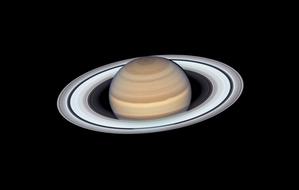
Saturn
imagen
Pie de foto: The NASA/ESA Hubble Space Telescope’s Wide Field Camera 3 observed Saturn on 20 June 2019 as the planet made its closest approach to Earth this year, at approximately 1.36 billion kilometres away. The image shows coloured bands of gas on the planet's surface as well as its prominent rings made of ice and rocky material.
Crédito: NASA, ESA, A. Simon (Goddard Space Flight Center), and M.H. Wong (University of California, Berkeley)
Enlace del crédito
Términos del glosario:
Gigante gaseoso , Planeta gigante , Planetas exteriores , Anillo , Saturno
Categorías:
Sistema Solar
Licencia: Creative Commons Reconocimiento 4.0 Internacional (CC BY 4.0) Creative Commons Reconocimiento 4.0 Internacional (CC BY 4.0) íconos
Archivo
( imagen
262.21 kB)

Lift-off of Apollo 11 on a Saturn V rocket
imagen
Pie de foto: The Apollo 11 Saturn V Space vehicle lifts off with Astronauts Neil A. Armstrong, Michael Collins and Edwin E. Aldrin, Jr., at 9:32 a.m. local time on July 16, 1969, from Launch Complex 39A at NASA's Kennedy Space Center, for the first Moon landing.
Crédito: NASA
Enlace del crédito
Términos del glosario:
Apolo , Luna
Categorías:
Exploración espacia
Licencia: Dominio público Dominio público íconos
Archivo
( imagen
11.91 MB)

Pan
imagen
Pie de foto: NASA's Cassini spacecraft captured this image of Saturn's moon Pan in March 2017. Pan is a so-called shepherd moon that orbits Saturn within the Encke gap of Saturn's rings. The striking thin brim stems from material Pan collects during its trajectory through the rings. Pan has a mean diameter of alomst 30 km.
Crédito: NASA/JPL-Caltech/Space Science Institute
Enlace del crédito
Términos del glosario:
Lunas
Categorías:
Sistema Solar
Licencia: Dominio público Dominio público íconos
Archivo
( imagen
469.25 kB)
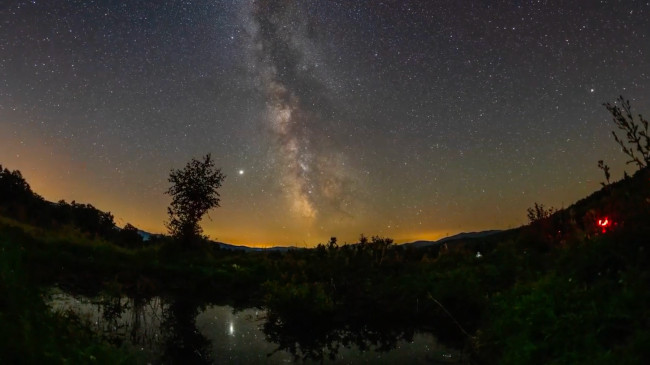
Flowing Night Sky
vídeo
Creado para la OAE
Pie de foto: Honourable mention in the 2022 IAU OAE Astrophotography Contest, category Time lapses of celestial patterns.
This time-lapse was shot from Slovakia in August 2020. By fixing the relative movement of the sky to Earth's rotation in some of the frames, we can experience a different perspective as a viewer.
The Milky Way, our home galaxy, is visible throughout the whole video. The bright objects near the Milky Way are Jupiter and Saturn, close together, Jupiter being the brighter one.
This video also shows the interaction of amateur astronomers observing the Perseids meteor shower with their telescopes pointed towards the sky. An unfortunate aspect of the art of astronomical observing, clouds can suddenly cover the whole sky. The fog occurs mostly because of the higher humidity after the rain.
Most of the light trails in the sky are made by satellites, but some of them, appearing just very briefly and not very noticeably, are meteors, as the video was shot around the peak of Perseids meteor shower.
Crédito: Robert Barsa/IAU OAE
Términos del glosario:
Júpiter , Vía Láctea , Saturno , Estrella fugaz
Categorías:
La Vía Láctea y el medio interestelar
, Astronomía a simple vista
, Estrellas
Licencia: Creative Commons Reconocimiento 4.0 Internacional (CC BY 4.0) Creative Commons Reconocimiento 4.0 Internacional (CC BY 4.0) íconos
Este archivo en Zenodo ( vídeo 254.11 MB)
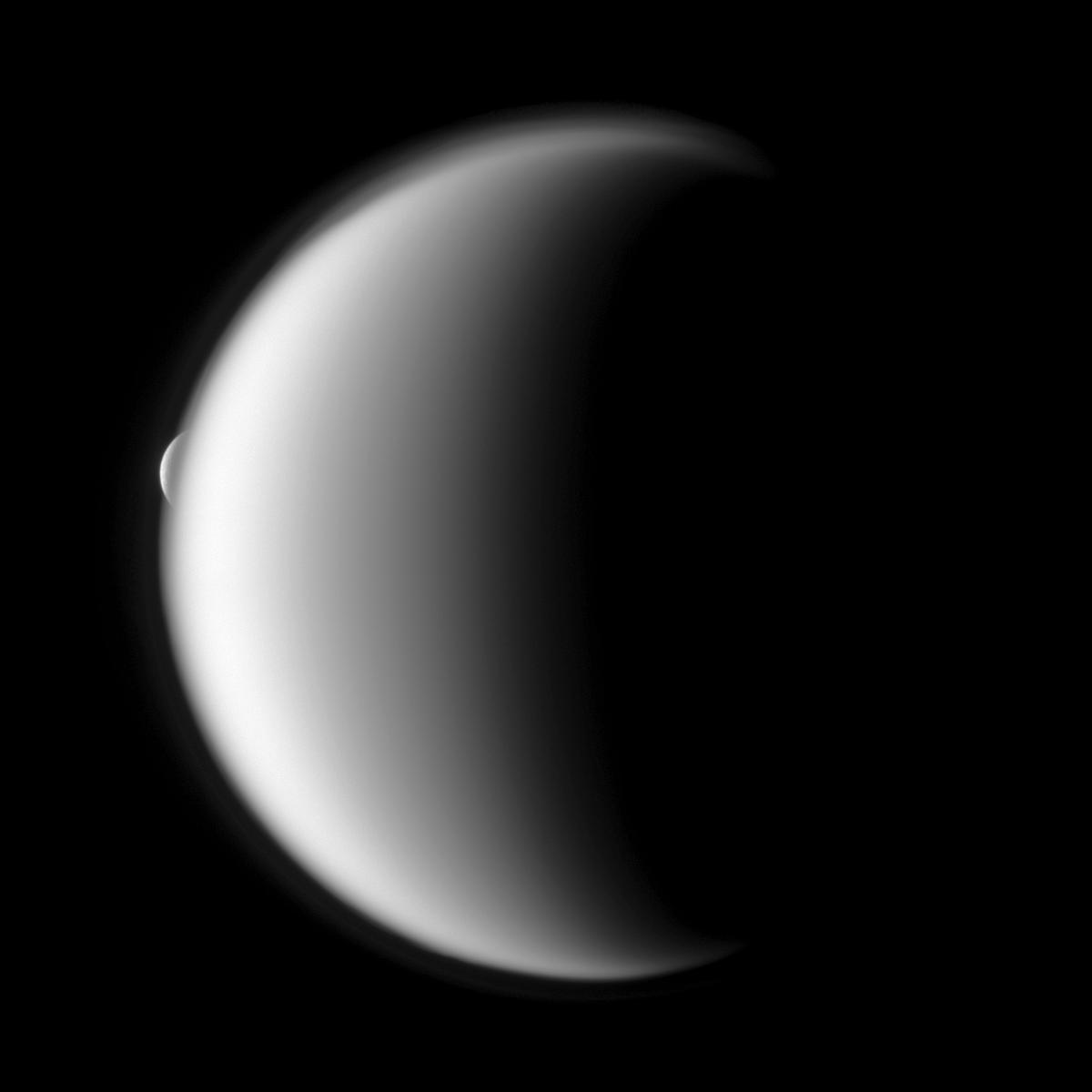
Rhea reappearing after occultation by Titan
imagen
Pie de foto: On October 27, 2009, NASA’s Cassini spacecraft orbiting around Saturn captured this view of Saturn's moon Rhea as it began to emerge after being hidden by Saturn's largest moon Titan during an occultation. An occultation is a celestial event in which one object moves in front of another and temporarily blocks the first object from view.
In this image, Titan — about 5,150 km across — was closer to the spacecraft at about 1 million km, while Rhea — roughly 1,528 km in diameter — was farther away at about 2.3 million km. Titan’s high-altitude atmospheric haze is visible as a faint glow around its limb, showing the difference in surface and atmospheric properties between these two moons.
Scientists study occultations like this because watching how one moon disappears behind or reappears from another helps refine our understanding of their orbits and physical characteristics.
Crédito: NASA/JPL/Space Science Institute
Enlace del crédito
Términos del glosario:
Lunas , Titán , Ocultación
Licencia: Dominio público Dominio público íconos
Archivo
( imagen
85.73 kB)