Documentos y recursos - Buscar resultados
Buscar resultados
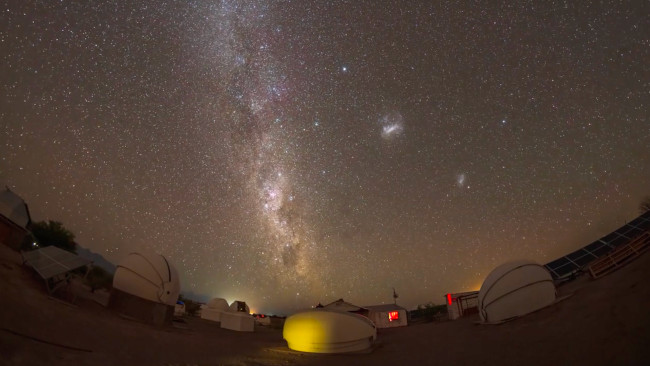
Chilean Nights
vídeo
Creado para la OAE
Pie de foto: Honourable mention in the 2022 IAU OAE Astrophotography Contest, category Time lapses of celestial patterns.
Shot in December 2020, this time-lapse shows the sky from San Pedro de Atacama, Chile, in the southern hemisphere.
Right in the first frame we can see our home galaxy, the Milky Way, as well as both the Large and Small Magellanic clouds, two satellite galaxies orbiting the Milky Way. In the bottom of the image the bright stars Rigil Kentaurus and Hadar (also known as Alpha and Beta Centauri) are visible, both in the constellation Centaurus. Just above, we can also see the small constellation Crux, visible from the northern tropical circles southwards. It is important for navigation purposes because its longer axis indicates the direction of the celestial south pole. The bright whitish star in the top of the image and to the right of the Galaxy is Canopus, one of the brightest stars in the night sky, located in the constellation Carina. Canopus is the second brightest star in the sky, while Rigil Kentaurus is the third brightest.
In some of the next frames, Orion, the great hunter, appears clearly with its bright stars and its characteristic asterism, the belt, composed of three aligned bright stars. Since this video was taken from the southern hemisphere, the Greek hero from the northern hemisphere seems to be performing a headstand.
We can also see the planets Jupiter and Saturn in a close conjunction, even finding themselves in the significant beam of Zodiacal light setting down below the horizon. There are also a few meteors blinking in some of the frames, one of them with a long-lasting and developing trail. The very bright object rising from behind the volcanoes of the Andes, creating spectacular shadows and crepuscular rays, is the Moon. In the last frame we see the Moon next to Saturn and Jupiter.
Crédito: Robert Barsa/IAU OAE
Términos del glosario:
Observatorio Astronómico , Constelación , Vía Láctea , Orión , Gran Nube de Magallanes (LMC) , Pequeña Nube de Magallanes (SMC) , Alfa Centauri
Categorías:
Galaxias
, La Vía Láctea y el medio interestelar
, Estrellas
, Telescopios, instrumentos y observatorios
Licencia: Creative Commons Reconocimiento 4.0 Internacional (CC BY 4.0) Creative Commons Reconocimiento 4.0 Internacional (CC BY 4.0) íconos
Este archivo en Zenodo ( vídeo 114.03 MB)
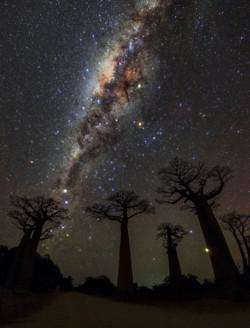
Milky Way over Avenue of Baobabs
imagen
Creado para la OAE
Pie de foto: Winner in the 2022 IAU OAE Astrophotography Contest, category Still images of celestial patterns.
This image, taken from the Avenue of Baobabs, Morondava, Madagascar, in July 2017, shows the majestic band of the Milky Way, our home galaxy, together with a rich collection of constellations and asterisms: Crux, Centaurus, Scorpius, Sagittarius and the Teapot asterism. Towards the bottom left of the image we can see the Southern Cross and the pointer stars Alpha (the brighter of the two) and Beta Centauri, which help to distinguish it from similar-looking configurations. Some cultures in Africa associate the Southern Cross with a giraffe, while others associate the constellations with a pride of lions or even with the Tree of Life.
Antares, the brightest star in the constellation Scorpius, is the orange-red star straight up from the middle baobab tree.
To the Pokomo people from southwestern Kenya, Africa, the Milky Way is associated with the smoke emanating from a campfire lit by ancient people. The various people in South Africa, in contrast, have different star tales; the Khoikhoi from the region around Cape Town explained the colours of the red and white stars as red and white roots that were roasted on a fire and thrown towards the sky together with the ashes of the fire. The Xhosa from further east consider the Milky Way the raised bristle of a huge angry dog, while the Zulu from near Johannesburg interpret it as a stream of spears of their strongest warriors.
Polynesian people, who were adept seafarers and navigators, see the constellation Scorpius as a fish hook, and refer to it as the demigod Maui’s Fish Hook. For the Djab Wurrung and the Jardwadjali people, the Southern Cross is part of a Dreamtime Story involving Tchingal, the Bram-bram-bult brothers (the pointer stars), their mother Druk (Delta Crux), and Bunya, the hunter who gets changed into a possum (Gacrux, red star at the top of the Southern Cross).
In this image, the planets Saturn (the bright point above Antares) and Jupiter (the bright point at the bottom-right of the image close to the trunk of the baobab tree) are visible. Indigenous cultures have various stories associated with the planets, for example Kamilaroi and Wailan people associate Saturn with wunygal, a small bird. The Boorong people of Western Victoria associate Jupiter with Ginabongbearp, the chief of the old spirits (Nurrumbunguttias), who takes the totemic form of the sulphur-crested white cockatoo.
Crédito: Amirreza Kamkar/IAU OAE
Términos del glosario:
Color , Polvo , Júpiter , Vía Láctea , Saturno , Escorpio , Cruz del Sur , Nube de polvo , Extinción interestelar , Alfa Centauri
Categorías:
La Vía Láctea y el medio interestelar
, Astronomía a simple vista
Licencia: Creative Commons Reconocimiento 4.0 Internacional (CC BY 4.0) Creative Commons Reconocimiento 4.0 Internacional (CC BY 4.0) íconos
Este archivo en Zenodo ( imagen 3.20 MB)
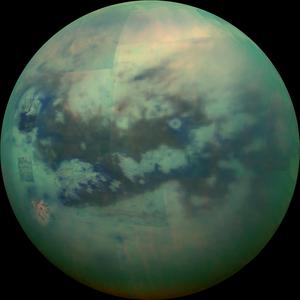
Titán con características superficiales
imagen
Pie de foto: Esta imagen compuesta, tomada por la sonda Cassini de la NASA en noviembre de 2015, muestra la radiación infrarroja procedente de Titán, la luna de Saturno. La luz infrarroja puede atravesar su atmósfera brumosa y revelar algunas de las características de su superficie. Durante su descenso hacia la superficie, el módulo de aterrizaje Huygens de la ESA, que viajaba a bordo de la sonda, descubrió lagos formados por hidrocarburos líquidos.
Crédito: NASA/JPL/Universidad de Arizona/Universidad de Idaho
Enlace del crédito
Términos del glosario:
Lunas , Titán
Categorías:
Sistema Solar
Licencia: Dominio público Dominio público íconos
Archivo
( imagen
160.31 kB)
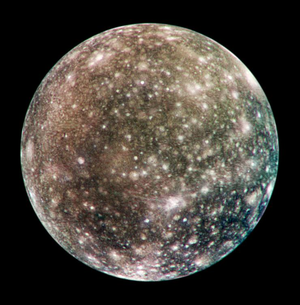
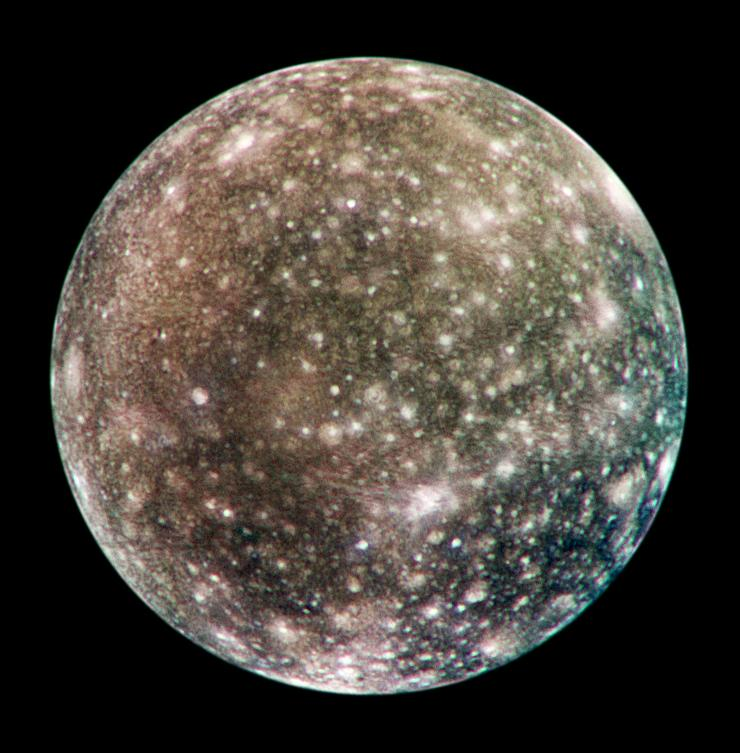
The Callisto satellite
imagen
Pie de foto: Callisto is the outermost of the four large Galilean moons of Jupiter and the third largest in the whole solar system, falling behind only Ganymede and Saturn's moon Titan. It orbits Jupiter at an average distance of around 1.9 million kilometers, roughly six times the distance between Earth and the Moon.
With a diameter of nearly 5,000 kilometers, it is almost as large as Mercury, the smallest planet in our solar system, but has only a third of its mass as it is composed of approximately equal amounts of rock and ice.
Callisto orbits Jupiter in a tidally locked rotation, always showing the same side to Jupiter. In contrast to the other three Galilean satellites – Io, Europa, and Ganymede – it is not in orbital resonance due to its farther outward location and is thus not appreciably tidally heated. It does not show any signs of plate tectonics or volcanic activity. Its lack of geological processes means that surface features like craters remain unchanged for billions of years. It is thought to have evolved predominantly under the influence of impacts, as its surface is the oldest and most heavily cratered object in the solar system. In fact, it is so covered in craters that any new impact will likely erase a former one.
Callisto's internal structure is still subject to discussion; it may consist of a deep salty ocean. It is thought to be composed mainly of a mix of ice and rock, which are present in various states throughout the inner layers of the moon. Callisto hosts a very thin atmosphere composed mainly of carbon dioxide and some traces of oxygen. The moon has been studied by numerous space probes, such as the Pioneer and Voyager missions and the Galileo orbiter, and will be subject to further explorations by NASA, ESA, and China’s National Space Administration (CNSA).
Crédito: NASA/JPL/DLR
Enlace del crédito
Términos del glosario:
Satélites galileanos , Lunas
Licencia: Dominio público Dominio público íconos
Archivo
( imagen
610.45 kB)
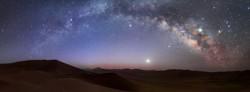
Milky Way Arch over Lut Desert, Iran, by Amirreza Kamkar, Iran (Islamic Republic of)
imagen
Creado para la OAE
Pie de foto: Second place in the 2021 IAU OAE Astrophotography Contest, category Wide star fields.
This panoramic dawn image shows the majestic band of the Milky Way – our home Galaxy – made up of a few hundred billion stars, among other structures, most of which are not detectable by our eyes, or in some cases even directly with telescopes. The appearance of the band is because the Milky Way is a disc-shaped galaxy, and we (Earth/Solar System) are situated within the disc.
Diverse cultures and traditions around the world each have their own name and cultural stories for the Milky Way. The dark regions visible in the Milky Way are large, dense, cool nebulae (clouds of dust and gas), which obscure the light from stars in the Milky Way. The Indigenous Australians associate stories with the dark patches of the Milky Way, one of the most prominent being the Emu in the Sky (called Tchingal in Wotjobaluk country). In and around the band of the Milky Way there are a vast range of star clusters, two familiar ones are M6 (Butterfly cluster) and M7 (Ptolemy’s cluster).
The bright point just above the horizon is the planet Venus (known to the Boorong people of Indigenous Australia as Chargee Gnowee, elder sister of the Sun). Within the band of the Milky Way the brightest point in the image is the planet Jupiter (called Ginabongbearp, the Sulphur-crested white cockatoo by the Boorong). The planet Saturn is the bright point between Venus and Jupiter (closer to Venus than Jupiter).
There are two constellations and one asterism that can be easily discerned in the image: Aquila, Scorpio (Maui’s Hook), and Teapot (asterism in Sagittarius). In this image, the center of the Milky Way at an approximate distance of 26,000 light years from Earth, is located roughly to the top right of the Teapot spout.
The bright red-orange point to the right of Jupiter is the red supergiant star Antares and is part of the constellation Scorpio (known as Maui’s Hook in Māori and Polynesian cultures). This variation in the colour of stars is the result of temperature of the stars (lower temperature stars are redder, higher temperatures stars are bluer).
Crédito: Amirreza Kamkar/IAU OAE
Términos del glosario:
Vía Láctea , Nube de polvo
Categorías:
La Vía Láctea y el medio interestelar
, Astronomía a simple vista
Licencia: Creative Commons Reconocimiento 4.0 Internacional (CC BY 4.0) Creative Commons Reconocimiento 4.0 Internacional (CC BY 4.0) íconos
Este archivo en Zenodo ( imagen 2.85 MB)