Documentos y recursos - Buscar resultados
Buscar resultados

To guard the Stars and the Sea Together
imagen
Creado para la OAE
Pie de foto: Winner in the 2022 IAU OAE Astrophotography Contest, category Still images of celestial patterns.
This image composition is amazing. In the far background of the landscape we see a chain of mountains that seems to mirror the structure of the Milky Way in the sky above. The strong daylight-like colours of the landscape are caused by the Moon, the bright light at the top of the image.
Taken in Kinabalu, Malaysia, in February 2019, this image shows the alignment of planets and the Moon, conveying the idea of the ecliptic as the central line of the Zodiac, the plane within which all planets orbit the Sun. The ecliptic is the central line of the Zodiac, so the region of about five to 10 degrees either side of the ecliptic is where the constellations of the Zodiac are located. Starting from the horizon towards the bottom left of the image we can see the planets Venus, Saturn and Jupiter. The planets have different cultural significance for people around the world, and are deeply embedded in social, religious and practical aspects of life. For example, Wardaman traditions of Indigenous Australians associate the planets with ancestor spirits who traverse the Celestial Road (ecliptic). The appearance and disappearance of planets in the sky are associated with various ceremonies. For example, when Venus starts being the “Morning star” after having been the “Evening star”, this marks the Banumbirr ceremony for the Yolnu people of Arnhem Land, in Australia.
The image also shows the constellations Scorpius, Aquila, Lupus and Triangulum Australe, the asterism of the Teapot, and the two pointer stars Alpha and Beta Centauri. The constellations, asterisms and individual stars within them have significance in many different cultures.
Malaysia, being close to the equator, has had connections to the north as well as to the south and almost the whole sky is visible over the course of the year. The star Antares is seen by the Kokatha people of the Western Desert as Kogolongo, the red tailed black cockatoo, while the Boorong refer to it as Djuit, the red-rumped parrot. The two stars which form the stinger of Scorpius (Shaula and Lesath), are called Karik Karik, the Australian Kestrel.
Crédito: Likai Lin/IAU OAE
Términos del glosario:
Constelación , Júpiter , Luna , Saturno , Escorpio , Venus , Zodiaco , Asterismo , Alfa Centauri
Categorías:
Astronomía a simple vista
Licencia: Creative Commons Reconocimiento 4.0 Internacional (CC BY 4.0) Creative Commons Reconocimiento 4.0 Internacional (CC BY 4.0) íconos
Este archivo en Zenodo ( imagen 3.77 MB)
Chilean observatories at home office, by Robert Barsa, Slovakia
imagen
Creado para la OAE
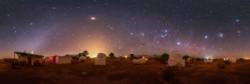
Pie de foto: Third place in the 2021 IAU OAE Astrophotography Contest, category Wide star fields.
This rich panoramic image shows a range of constellations, deep sky objects and planets. The brightest point of light with a pale reddish hue (left of center) is the planet Mars. In the bottom far left of the image, located just above the sloped roof of the building are two points of light appearing very close to each other, these are the planets Jupiter (brighter) and Saturn. To the far right of the image the two fuzzy cloud-like objects are the Large and Small Magellanic Clouds. These are satellite dwarf galaxies of the Milky Way located at a distance of approximately 160,000 and 200,000 light years, respectively. The Andromeda Galaxy, which is located at an approximate distance of 2.5 million light years, appears in this image as a small, angled smudge between Mars and the brightest glow on the horizon (closer to the horizon). The bright glow is not from the Sun or the Moon, but the city lights of San Pedro de Atacama.
Prominent constellations include: Orion – identified by the three stars forming Orion’s Belt; Taurus – a small triangle shaped collection of stars to the left of Orion and identified by the pale orange star (Aldebaran) at the vertex of the triangle; Canis Major – to the bottom right of Orion, identified by the bright star Sirius (the brightest star in the night sky) and three stars in the shape of a triangle just above the observatory dome in the foreground; Pegasus – identified by the trapezium shape diagonally below Mars. Other constellations include Andromeda, Perseus and Aries. Diverse cultures around the world have their own names and rich stories associated with these constellations and many others.
To the top right of Orion’s Belt is an angled line of stars (Orion’s Sword) within which is a pinkish smudge (looks like a fuzzy star when observed with the unaided eye) that is the Orion Nebula – a stellar nursery located 1500 light years from Earth – where stars are formed. To the left of Taurus is a compact fuzzy smudge, and that is the Pleiades star cluster. The variation in the colour of stars is the result of temperature of the stars, for example, the red orange star to the bottom left of Orion’s Belt is the red giant star Betelgeuse. Cooler stars appear redder, compared to the higher temperature white and bluish stars. The colours in the image are enhanced because of the higher sensitivity of the digital camera compared to the human eye.
Crédito: Robert Barsa/IAU OAE
Términos del glosario:
Aries , Astronomía , Observatorio
Categorías:
Astronomía a simple vista
, Telescopios, instrumentos y observatorios
Licencia: Creative Commons Reconocimiento 4.0 Internacional (CC BY 4.0) Creative Commons Reconocimiento 4.0 Internacional (CC BY 4.0) íconos
Este archivo en Zenodo ( imagen 77.18 MB)
The Milky Way Across the Zenith
imagen
Creado para la OAE
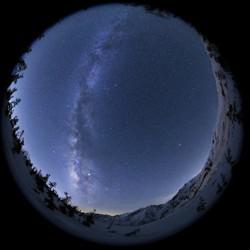
Pie de foto: Winner in the 2022 IAU OAE Astrophotography Contest, category Still images of celestial patterns.
This all-sky image shows our home galaxy, the Milky Way, crossing the zenith, the point just above the observer as seen from Nagano, Japan, in May 2019. Such images of the whole sky can be taken either with a fish-eye lens or with a convex mirror on the ground, the latter of which would show the photographer as well.
Some of the brightest stars in the night sky can be seen in this image, as well as two of the giant planets of our Solar System: Jupiter, the brightest point in the bottom of this image, and Saturn, another bright point just to the opposite side of the Galaxy, to the bottom and next to the horizon.
Directly right of the Milky Way and below Jupiter, we can spot the bright red star Antares, the primary star of the Japanese asterism of The Heart. Japanese constellations derive from ancient Chinese constellations, which were adopted with only slight or no changes. In this tradition, The Heart is the heart of the “Azure Dragon”, a super-constellation that represents the spring. In the Babylonian and Greco-Roman traditions, this area is considered the heart of the Scorpion. In Babylonian religion, the star is associated with Lisi, the child of the mother goddess, but in Greek mythology it is related to the planet Mars, because of its colour. The reddish colour also led to the star’s Chinese name “The Fire Star”. We know that this colour is caused by its relatively cool temperature.
Going from Antares to the right of the image, we find the more northern parts of the sky. The bright star in the lower-right of the image, close to the horizon, is Arcturus, located in the modern constellation Boötes. While Antares and its surrounding area are considered the heart of the Azure Dragon, Arcturus and Spica (below the horizon) are two single-star asterisms forming its huge horn. Pointing towards it from above, at the right-hand edge of the image’s horizon, we can see the handle of the Big Dipper, or Plough, which is part of the constellation Ursa Major.
The bright point to the right of the galaxy and just above the middle of the image is Vega, located in the modern constellation Lyra. Extending a line to the other side of the Galaxy and a bit lower in the image we can find Altair, in the constellation Aquila. From that point we extend another line to Deneb, the brightest star in the constellation of the Swan, also a bit higher in this image and completely flooded by the Milky Way. These three bright stars comprise the asterism known as the Summer Triangle in the northern hemisphere.
Crédito: Ohnishi Kouji/IAU OAE
Términos del glosario:
Júpiter , Vía Láctea , Saturno , Escorpio
Categorías:
La Vía Láctea y el medio interestelar
, Astronomía a simple vista
Licencia: Creative Commons Reconocimiento 4.0 Internacional (CC BY 4.0) Creative Commons Reconocimiento 4.0 Internacional (CC BY 4.0) íconos
Este archivo en Zenodo ( imagen 11.13 MB)





