Documentos y recursos - Buscar resultados
Buscar resultados

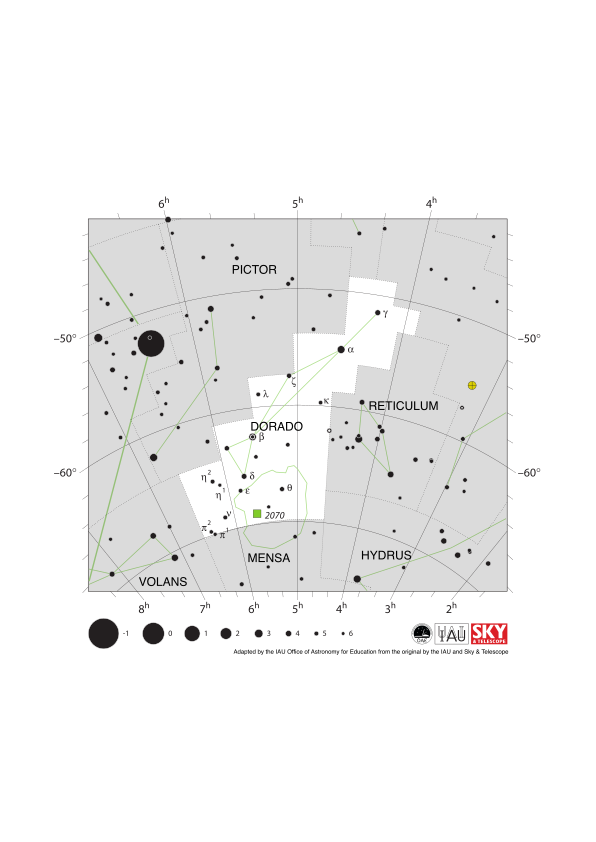
Dorado Constellation Map
imagen
Pie de foto: The constellation Dorado with its bright stars and surrounding constellations. Dorado is surrounded by (going clockwise from the top): Pictor, Caelum, Horologium, Reticulum, Hydrus, Mensa and Volans.
Dorado is a southern constellation and thus the whole constellation is visible at some point in the year from the whole southern hemisphere. The whole constellation is also visible to equatorial regions of the northern hemisphere. Dorado is circumpolar for temperate and antarctic regions of the southern hemisphere. This constellation is best viewed in the northern hemisphere winter and southern hemisphere summer.
The Large Magellanic Cloud (LMC), a satellite galaxy of the Milky Way, lies in Dorado and the neighboring constellation Mensa. The outline of the Large Magellanic Cloud is marked here as a roughly circular loop in green. The open cluster NGC 2070 lies at the heart of the Tarantula Nebula. This is marked here with a green square.
The y-axis of this diagram is in degrees of declination with north as up and the x-axis is in hours of right ascension with east to the left. The sizes of the stars marked here relate to the star's apparent magnitude, a measure of its apparent brightness. The larger dots represent brighter stars. The Greek letters mark the brightest stars in the constellation. These are ranked by brightness with the brightest star being labeled alpha, the second brightest beta, etc., although this ordering is not always followed exactly. The dotted boundary lines mark the IAU's boundaries of the constellations and the solid green lines mark one of the common forms used to represent the figures of the constellations. Neither the constellation boundaries, nor the lines joining the stars appear on the sky.
Crédito: Adapted by the IAU Office of Astronomy for Education from the original by the IAU and Sky & Telescope
Enlace del crédito
Términos del glosario:
Magnitud Aparente , Coordenadas celestes , Estrellas circumpolares , Constelación , Declinación , Nebulosa , Ascensión recta (AR) , Cúmulo abierto , Gran Nube de Magallanes (LMC)
Categorías:
Astronomía a simple vista
Licencia: Creative Commons Reconocimiento 4.0 Internacional (CC BY 4.0) Creative Commons Reconocimiento 4.0 Internacional (CC BY 4.0) íconos
Archivo
( imagen
94.49 kB)
Archivo PDF
(PDF file
155.00 kB)

Sextans Constellation Map
imagen
Pie de foto: The constellation Sextans with its brighter stars and surrounding constellations. Sextans is surrounded by (going clockwise from the top): Leo, Hydra and Crater. Sextans is a small constellation with relatively few bright stars.
Sextans spans the celestial equator and thus parts of the constellation are visible at some point in the year across the Earth. The whole constellation is visible in all but the most arctic and most antarctic regions. Sextans is best viewed in the evening in the northern hemisphere spring and southern hemisphere autumn.
The lenticular galaxy NGC 3115 lies in Sextans. It is marked here with a red ellipse.
The y-axis of this diagram is in degrees of declination with north as up and the x-axis is in hours of right ascension with east to the left. The sizes of the stars marked here relate to the star's apparent magnitude, a measure of its apparent brightness. The larger dots represent brighter stars. The Greek letters mark the brightest stars in the constellation. These are ranked by brightness with the brightest star being labeled alpha, the second brightest beta, etc., although this ordering is not always followed exactly. The dotted boundary lines mark the IAU's boundaries of the constellations and the solid green lines mark one of the common forms used to represent the figures of the constellations. The blue line at the top of the diagram marks the ecliptic. Neither the constellation boundaries, nor the lines joining the stars, nor the ecliptic, appear on the sky.
Crédito: Adapted by the IAU Office of Astronomy for Education from the original by the IAU and Sky & Telescope
Enlace del crédito
Términos del glosario:
Magnitud Aparente , Coordenadas celestes , Ecuador celeste , Constelación , Declinación , Eclíptica , Leo , Ascensión recta (AR) , Galaxia lenticular
Categorías:
Astronomía a simple vista
Licencia: Creative Commons Reconocimiento 4.0 Internacional (CC BY 4.0) Creative Commons Reconocimiento 4.0 Internacional (CC BY 4.0) íconos
Archivo
( imagen
73.40 kB)
Archivo PDF
(PDF file
153.02 kB)

Mensa Constellation Map
imagen
Pie de foto: The constellation Mensa with its brighter stars and surrounding constellations. Mensa is surrounded by (going clockwise from the top): Dorado, Hydrus, Octans, Chamaeleon and Volans. Mensa is a faint constellation with relatively few bright stars.
Mensa lies close to the south celestial pole and thus the whole constellation is visible at some point in the year throughout the southern hemisphere. The whole constellation is visible to a thin strip of the northern hemisphere around the equator with parts of the constellation visible to some other northern equatorial regions. Mensa is circumpolar in temperate, antarctic and some equatorial regions of the southern hemisphere. Mensa is best viewed in the evenings in the northern hemisphere winter and southern hemisphere summer.
The Large Magellanic Cloud (LMC), a satellite galaxy of the Milky Way, lies in Mensa and the neighboring constellation Dorado. The outline of the Large Magellanic Cloud is marked here as a roughly circular loop in green.
This diagram maps an area around the south celestial pole. Here lines of constant right ascension converge. The right ascension values of these lines are marked on the x-axis above and below the diagram. The solid circle around the pole marks a line of -80° declination with the larger, incomplete circle to the right marking -70° declination. The sizes of the stars marked here relate to the star's apparent magnitude, a measure of its apparent brightness. The larger dots represent brighter stars. The Greek letters mark the brightest stars in the constellation. These are ranked by brightness with the brightest star being labeled alpha, the second brightest beta, etc., although this ordering is not always followed exactly. The dotted boundary lines mark the IAU's boundaries of the constellations and the solid green lines mark one of the common forms used to represent the figures of the constellations. Neither the constellation boundaries, nor the lines joining the stars appear on the sky.
Crédito: Adapted by the IAU Office of Astronomy for Education from the original by the IAU and Sky & Telescope
Enlace del crédito
Términos del glosario:
Magnitud Aparente , Coordenadas celestes , Constelación , Declinación , Ascensión recta (AR)
Categorías:
Astronomía a simple vista
Licencia: Creative Commons Reconocimiento 4.0 Internacional (CC BY 4.0) Creative Commons Reconocimiento 4.0 Internacional (CC BY 4.0) íconos
Archivo
( imagen
135.16 kB)
Archivo PDF
(PDF file
172.00 kB)