Documents & Ressources - Résultat de la recherche
Résultats de la recherche
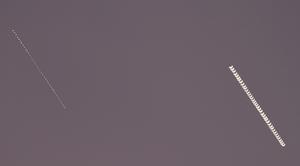
Venus and Mercury Trails
image
Créé pour l'OAE
Légende : Honorable mention in the 2023 IAU OAE Astrophotography Contest, category of Still images of phases of Venus.
In this composite image, both Mercury (left) and Venus (right) can be seen heading into the sunset. The phases of each are beautifully captured as they descend. Not all planets or moons in the Solar System show phases as viewed from Earth. This phenomenon occurs because the orbits of Venus and Mercury are positioned between Earth’s orbit and the Sun, sometimes allowing us to see only part of the illuminated portion of each planet. These phases are similar to the phases we see of our own Moon.
Crédit : Marcella Giulia Pace (CC BY 4.0)
Termes du glossaire:
Mercure , Phase , Vénus
Catégories :
Système solaire
Mots clés :
astrophotography
Licence : Creative Commons (CC) Attribution 4.0 International (CC BY 4.0) Creative Commons (CC) Attribution 4.0 International (CC BY 4.0) Icônes
Ce fichier est sur Zenodo ( image 4.86 MB)

Conjunction of Mercury and Venus above the Moon
image
Légende : From the observing deck at the European Southern Observatory’s Paranal site in Chile, in March 2008, astronomers captured a conjunction of celestial objects—a moment when two or more astronomical objects appear close together in the sky as seen from Earth. In this scene, the innermost planets Mercury and Venus appear aligned above the Moon, forming a pattern against the sky just before dawn. Although they are at very different distances from Earth, the geometry of their orbits brought them into almost the same line of sight, creating this beautiful cosmic alignment.
In the image, the bright crescent Moon is visible low in the sky near the horizon, forming the most prominent object in the lower part of the scene. Just above the Moon, the brighter planet Venus can be seen, while Mercury, fainter and further from the horizon, appears nearby in the upper part of the image.
Crédit : ESO/Y. Beletsky
Lien du crédit
Termes du glossaire:
Conjonction
Licence : Creative Commons (CC) Attribution 4.0 International (CC BY 4.0) Creative Commons (CC) Attribution 4.0 International (CC BY 4.0) Icônes
Fichier
( image
2.43 MB)

Sunset view with crescent Moon and Venus at Paranal
image
Légende : The waxing crescent moon photographed at sunset from the Paranal observatory in Chile in the Southern Hemisphere. Here we see the moon with a thin sliver illuminated. This thin sliver is orientated towards the Sun which has just set. Below and to the left of the Moon we see the planet Venus.
One of the small Auxiliary Telescopes which are sometimes linked to the Very Large Telescope is shown in the foreground.
Crédit : ESO/Y. Beletsky
Lien du crédit
Termes du glossaire:
Phase lunaire , Vénus , Le premier croissant , Croissant de lune
Catégories :
Système solaire
, Télescopes, instruments et observatoires
Licence : Creative Commons (CC) Attribution 4.0 International (CC BY 4.0) Creative Commons (CC) Attribution 4.0 International (CC BY 4.0) Icônes
Fichier
( image
2.34 MB)



- Ressources
- Moteur de recherche des ressources pédagogiques
- Parcourir les ressources pédagogiques par Sujet
- Parcourir les images
- AstroEdu - Activités en classe
- Grandes Idées - Littéracie en astronomie
- Glossaire
- Rapports de l'OAE
- L'astronomie pour l'Education à travers le monde
- Sélection de ressources externes