Documents & Ressources - Résultat de la recherche
Résultats de la recherche

Dark matter and Dark energy (Part 1) – Discovering the main components of the Universe Activités pédagogiques de astroEDU (liens vers le site astroEDU) Origin: astroEDU Description : Lets' investigate gravity, dark matter and dark energy with some very simple experiments!
Termes du glossaire:
Énergie noire , Matière noire , Gravité , Univers
Catégories :
Cosmologie
, Physique
Mots clés :
Experiment
, Galaxies
Tranches d'âge :
12-14
, 14-16
, 16-19
, 19+
Niveau scolaire :
Informelle - Médiation
, Collège
Domaines d'apprentissage :
Apprentissage par découverte guidée
, Cours interactif
, Modélisation
, Basée sur l'observation
, Autre
, Résolution de problèmes
Coûts :
Faible
Durée :
45min
Taille du groupe :
Par groupe
Compétences :
Construire des explications
, Développer et utiliser des modèles
, S'engager dans des arguments fondés sur des preuves
, Planifier et mener des enquêtes
Auteurs : Tran Dong Thai Han, Massimo Viola, Henk Hoekstra
Licence : Creative Commons (CC) Attribution 4.0 International (CC BY 4.0) Creative Commons (CC) Attribution 4.0 International (CC BY 4.0) Icônes

Dark matter & dark energy (Part 2) – Understanding the nature of dark matter and dark energy Activités pédagogiques de astroEDU (liens vers le site astroEDU) Origin: astroEDU Description : Let's investigate the nature of dark matter and energy with gravitational lensing!
Termes du glossaire:
Énergie noire , Matière noire , Lentille gravitationnelle , Gravité , Univers
Catégories :
Cosmologie
, Physique
Mots clés :
Experiment
, Invisible
Tranches d'âge :
12-14
, 14-16
, 16-19
, 19+
Niveau scolaire :
Informelle - Médiation
, Collège
Domaines d'apprentissage :
Apprentissage par découverte guidée
, Cours interactif
, Modélisation
, Résolution de problèmes
Coûts :
Moyen
Durée :
45min
Taille du groupe :
Par groupe
Compétences :
Construire des explications
, Développer et utiliser des modèles
, S'engager dans des arguments fondés sur des preuves
Auteurs : Tran Dong Thai Han, Henk Hoekstra, Massimo Viola
Licence : Creative Commons (CC) Attribution 4.0 International (CC BY 4.0) Creative Commons (CC) Attribution 4.0 International (CC BY 4.0) Icônes
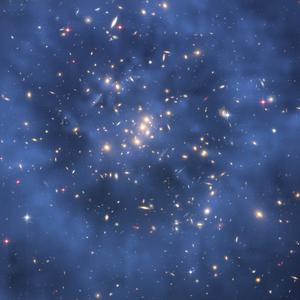
Dark matter
image
Légende : This image of the galaxy cluster ZwCl0024+1652 is created using mathematical modelling, together with observations from the Hubble Space Telescope (HST).
The Hubble observations were taken in November 2004 by the Advanced Camera for Surveys (ACS). The exquisite resolution of the ACS, allowed very detailed measurements to be made of the gravitational lensing in the cluster. The blue nebulosity is a superimposed ""map"" of the dark matter distribution in the galaxy cluster and is not visible in the observations, but is a mathematical model created based on the gravitational lensing data.
The ""dark matter ring"" the is present in the image is one of the strongest pieces of evidence to date for the existence of dark matter. Observational data provides evidence that Dark matter makes up about 1/4 of the Universe, and is believed to make up the underlying structure of the cosmos. In addition, a large percentage the mass in galaxies and galaxy clusters is dark matter, which is not visible via direct observations.
Crédit : NASA, ESA, M.J. Jee and H. Ford (Johns Hopkins University)
Lien du crédit
Termes du glossaire:
Matière noire
Catégories :
Cosmologie
Licence : Creative Commons (CC) Attribution 4.0 International (CC BY 4.0) Creative Commons (CC) Attribution 4.0 International (CC BY 4.0) Icônes
Fichier
( image
12.30 MB)






- Ressources
- Moteur de recherche des ressources pédagogiques
- Parcourir les ressources pédagogiques par Sujet
- Parcourir les images
- AstroEdu - Activités en classe
- Grandes Idées - Littéracie en astronomie
- Glossaire
- Rapports de l'OAE
- L'astronomie pour l'Education à travers le monde
- Sélection de ressources externes