Documents & Ressources - Résultat de la recherche
Résultats de la recherche
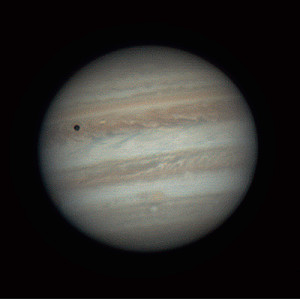
Jupiter, Io and its shadow, by Ralf Burkart, Germany
vidéo
Créé pour l'OAE
Légende : First place in the 2021 IAU OAE Astrophotography Contest, category Galilean moons.
This time-lapse of Jupiter taken in 2017 from Germany beautifully illustrates the transit of one of the Galilean moons, Io, in front of Jupiter. As this is simply a moon casting a shadow on a planet it is equivalent to a lunar eclipse on Earth observed from further away. While the shadow of the moon is clearly visible from the beginning, it might be difficult to spot the moon itself against the background of the beautiful atmospheric bands of Jupiter the first time the video is seen. Watching it repeatedly allows appreciating the rapid motion and rotation in this fantastic observation.
Crédit : Ralf Burkart/IAU OAE
Termes du glossaire:
Satellites galiléens , Géantes gazeuses , Io , Jupiter , Lunes , Orbite , Planètes extérieures , Planète , Transit
Catégories :
Système solaire
Licence : Creative Commons (CC) Attribution 4.0 International (CC BY 4.0) Creative Commons (CC) Attribution 4.0 International (CC BY 4.0) Icônes
Ce fichier est sur Zenodo ( vidéo 12.64 MB)
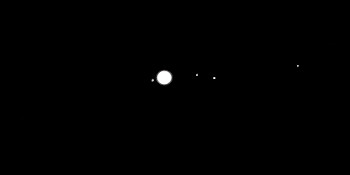
Jupiter Moons Movie2, par Nicolas Hurez, Paul-Antoine Matrangolo, et Carl Pennypacker, États-Unis d'Amérique
vidéo
Créé pour l'OAE
Légende : Deuxième place au concours d'astrophotographie 2021 de l'UAI OAE, catégorie Lunes galiléennes.
Cette séquence montre l'orbite des quatre lunes galiléennes autour de la planète Jupiter. Les images ont été obtenues en 2018 avec l'observatoire mondial Las Cumbres à différents endroits de la Terre, ce qui a permis une séquence continue d'images sur environ une demi-semaine, sans interruption pendant la journée. Avec un ciel clair et au cours de plusieurs nuits, le mouvement des lunes galiléennes peut également être observé avec des jumelles (idéalement en stabilisant vos coudes sur une surface).
Crédit : Nicolas Hurez, Paul-Antoine Matrangolo et Carl Pennypacker/IAU OAE
Termes du glossaire:
Satellites galiléens , Géantes gazeuses , Io , Jupiter , Lunes , Orbite , Planètes extérieures , Planète
Catégories :
Système solaire
Licence : Creative Commons (CC) Attribution 4.0 International (CC BY 4.0) Creative Commons (CC) Attribution 4.0 International (CC BY 4.0) Icônes
Ce fichier est sur Zenodo ( vidéo 890.47 kB)

Halley's Comet
image
Légende : Halley’s Comet, is a well-known periodic comet, named after the English astronomer Edmond Halley. It has an orbital period of approximately 75 years and is visible from Earth with the naked eye when it passes through the inner solar system.
The image shows Halley’s Comet, officially designated 1P/Halley, with a tail of gas and dust streaming away from the Sun. It was taken from the La-Silla-Observatory in Chile in 1986 during Halley's Comet's last visit to the inner solar system. The stars in this image appear elongated or as lines of three different colored dots as image was created from three separate observations in different colors of light and the telescope was tracking the comet, which was moving very slightly compared to the background stars. Note that the comets tail does not point in exactly the same direction as the elongation of the stars. This shows us that the comet tail is not always behind the comet, but instead pointing away from the Sun.
The comet passes its perihelion (closest distance to the Sun) at a distance of around 0.59 astronomical units, right between the orbits of Mercury and Venus. Beyond Neptune, it reaches its aphelion (furthest distance from the Sun) at a distance of approximately 35 astronomical units. Halley's Comet reached aphelion in December 2023 and is now moving inwards again. It is expected to be seen with the naked eye from Earth again in mid-2061.
Crédit : ESO
Lien du crédit
Termes du glossaire:
Aphélie , Comète , Queue cométaire , La comète de Halley , Périhélie
Licence : Creative Commons (CC) Attribution 4.0 International (CC BY 4.0) Creative Commons (CC) Attribution 4.0 International (CC BY 4.0) Icônes
Fichier
( image
5.23 MB)

H-alpha image of the Sun's chromosphere
image
Légende : This false-color image was captured with a 10-cm telescope at the Big Bear Solar Observatory (BBSO) in the United States in July 2002. It depicts the full disk of the Sun using the H-alpha emission line of hydrogen. When observed in this spectral line, the Sun's chromosphere appears particularly prominent due to hydrogen atoms emitting light at the specific wavelength. This emission produces a distinctive red color, making features such as spicules (jets of plasma that look hair-like) and plage (bright patches in the chromosphere) highly visible. Several small solar prominences can be seen protruding from the edge of the solar disk. When prominences (also known as filaments) cross the face of the disk they appear as dark threads caused by the cooler material in the prominence absorbing light. The chromosphere is also visible in the violet part of the solar spectrum due to ionized calcium showing emissions in these wavelengths.
Crédit : Big Bear Solar Observatory (BBSO)/New Jersey Institut of Technology (NJIT)
Lien du crédit
Termes du glossaire:
Chromosphère , Protubérance solaire , Soleil , Raie spectrale
Catégories :
Le Soleil
Licence : Domaine Public Domaine Public Icônes
Fichier
( image
2.82 MB)
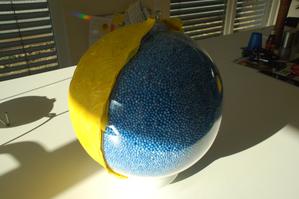
One Million Earths inside our Sun Activités pédagogiques de astroEDU (liens vers le site astroEDU) Description : Learn how to build a model of the Sun...which can fit nearly 1 million little Earth balls!
Termes du glossaire:
Terre , Soleil
Catégories :
Mathématiques
, Système solaire
, Le Soleil
Mots clés :
Dimension
, Distances
, Hands-on
, Model
, Relative sizes
, Scales
Tranches d'âge :
4-6
, 6-8
, 8-10
, 10-12
, 12-14
, 14-16
, 16-19
, 19+
Niveau scolaire :
Informelle - Médiation
, Collège
, Autre
, Maternelle
, Primaire
, Secondaire
, Université
Domaines d'apprentissage :
Apprentissage par découverte guidée
, Modélisation
, Résolution de problèmes
Coûts :
Moyen
Durée :
30min
Taille du groupe :
Par groupe
Compétences :
Analyser et interpréter des données
, Poser des questions
, Communiquer des informations
, Développer et utiliser des modèles
, Utiliser les mathématiques et la pensée computationnelle
Auteurs : Natalie Fischer
Licence : Creative Commons (CC) Attribution 4.0 International (CC BY 4.0) Creative Commons (CC) Attribution 4.0 International (CC BY 4.0) Icônes



- Ressources
- Moteur de recherche des ressources pédagogiques
- Parcourir les ressources pédagogiques par Sujet
- Parcourir les images
- AstroEdu - Activités en classe
- Grandes Idées - Littéracie en astronomie
- Glossaire
- Rapports de l'OAE
- L'astronomie pour l'Education à travers le monde
- Sélection de ressources externes