Documents & Ressources - Résultat de la recherche
Résultats de la recherche

Detailed View of Charon, Moon of Pluto
image
Légende : Charon is the largest natural moon of the dwarf planet Pluto. This detailed image was taken by NASA’s New Horizons spacecraft in 2015 during its historic mission through the outer Solar System. Charon’s surface shows a fascinating mix of light and dark regions, including vast canyons, broad plains, and impact crater. With a diameter of about 1,200 kilometers, Charon is more than half the diameter of Pluto, making it unusually large compared to its parent body. Charon's mass is roughly 12% of that of Pluto.
Because Pluto and Charon are so close in mass, the center of mass of the system (the point both Pluto and Charon orbit) is not within Pluto but between Pluto and Charon. This is in contrast to systems like the Earth and its Moon where the center of mass lies within the larger body, the Earth in this case. Scientists think the Pluto-Charon system may have formed by a collision of two objects that then separated and began to orbit each other. By studying Charon and the smaller moons that circle Pluto, astronomers gain insight into how moons form and how distant icy bodies evolve over billions of years.
Crédit : NASA/Johns Hopkins University Applied Physics Laboratory/Southwest Research Institute/Alex Parker
Lien du crédit
Termes du glossaire:
Lunes , Pluto
Licence : Domaine Public Domaine Public Icônes
Fichier
( image
2.88 MB)
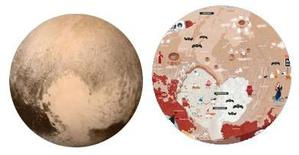
Children's Planetary Maps: Pluto & Charon Activités pédagogiques de astroEDU (liens vers le site astroEDU) Origin: astroEDU Description : Learn about our furthest neighbors
Termes du glossaire:
Astrobiologie , Science planétaire , Pluto
Mots clés :
Charon
, Maps
, Planetary cartography
, Spatial thinking
Tranches d'âge :
6-8
, 8-10
, 10-12
, 12-14
Niveau scolaire :
Collège
, Primaire
, Secondaire
Domaines d'apprentissage :
Apprentissage par enquête
Coûts :
Faible
Durée :
2h
Taille du groupe :
Par groupe
Compétences :
Analyser et interpréter des données
, Poser des questions
, Communiquer des informations
, Construire des explications
, Développer et utiliser des modèles
, S'engager dans des arguments fondés sur des preuves
, Planifier et mener des enquêtes
Auteurs : Henrik Hargitai, Mátyás Gede
Licence : Creative Commons (CC) Attribution 4.0 International (CC BY 4.0) Creative Commons (CC) Attribution 4.0 International (CC BY 4.0) Icônes
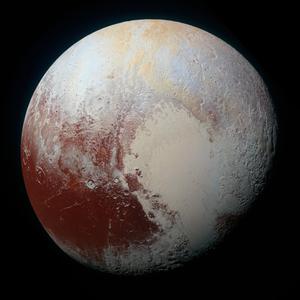
Pluton
image
Légende : La sonde spatiale New Horizons de la NASA a prise cette vue haute résolution en couleurs de la planète naine Pluton en juillet 2015. L'image combine des images bleues, rouges et infrarouges prises par la caméra Ralph/Multispectral Visual Imaging Camera (MVIC). La surface de Pluton apparaît ici comme un arc-en-ciel de bleus pâles, de jaunes, d'oranges et de rouges profonds. L'image révèle des détails et des couleurs sur des échelles aussi petites que 1,3 kilomètres.
Crédit : NASA/Johns Hopkins University Applied Physics Laboratory/Southwest Research Institute
Lien du crédit
Termes du glossaire:
Planète naine , Ceinture de Kuiper , Pluto , Objet transneptunien
Catégories :
Système solaire
Licence : Domaine Public Domaine Public Icônes
Fichier
( image
2.55 MB)
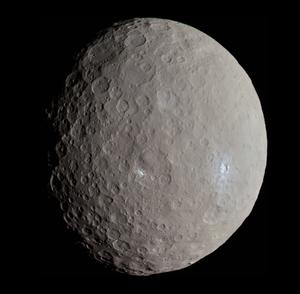
Cérès
image
Légende : Image en couleurs de la planète naine Cérès acquise par la sonde Dawn en mai 2015, à une distance de 13641 km. Le cratère proéminent et brillant à droite est Haulani. Le plus petit point lumineux à sa gauche se trouve dans le cratère Oxo. Les éjectas de ces impacts semblent avoir exposé des matériaux brillants, probablement de la glace d'eau.
Crédit : NASA / JPL-Caltech / UCLA / MPS / DLR / IDA / Justin Cowart
Termes du glossaire:
Ceinture d'astéroïdes , Cratère , Planète naine , Cratères d'impact
Catégories :
Système solaire
Licence : Creative Commons (CC) Attribution 2.0 Générique Creative Commons (CC) Attribution 2.0 Générique Icônes
Fichier
( image
269.29 kB)



- Ressources
- Moteur de recherche des ressources pédagogiques
- Parcourir les ressources pédagogiques par Sujet
- Parcourir les images
- AstroEdu - Activités en classe
- Grandes Idées - Littéracie en astronomie
- Glossaire
- Rapports de l'OAE
- L'astronomie pour l'Education à travers le monde
- Sélection de ressources externes